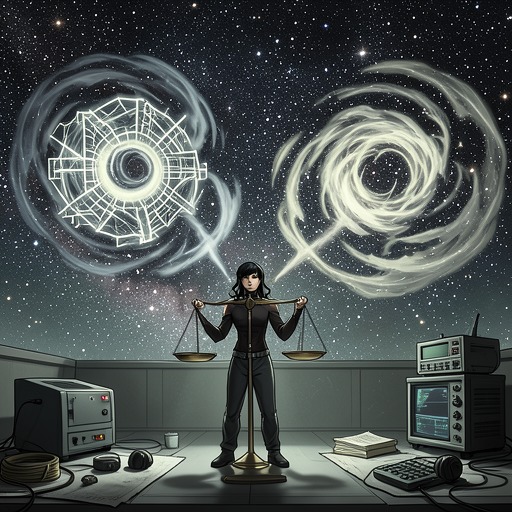
Cosmic Factions of Order and Chaos
The Stars Have EyesCosmic Factions of Order and Chaos is the cosmological distinction used to explain why some cosmic entities that enter reality behave as destructive invaders while others operate according to a radically different logic. The concept is introduced through Magh'rathlak the Observer’s attempt to correct Major Gordon Archer’s understanding of her nature: she insists that she is “a being of order, not chaos,” but the ensuing exchange makes clear that order is not synonymous with goodness, mercy, or moral safety.
The Two Cosmic Factions
Magh'rathlak the Observer describes two broad factions of cosmic entities. Those that transgress into reality are most often born of chaos. Their characteristic impulses include senseless destruction, deliberate deception, and the encouragement of malicious violations of obligations. The language of transgression makes entry into ordinary reality itself appear morally and structurally significant: these entities do not merely arrive from elsewhere, but cross a boundary in ways associated with disorder and harm.
Entities arising from order possess diametrically opposed sensibilities. Their opposition to chaos is therefore not presented as a simple difference in temperament, nor as a conventional conflict between heroes and monsters. It is a difference in the principles by which they understand action, obligation, control, and consequence. Magh'rathlak’s explanation deliberately avoids reducing the cosmology to a human moral binary.
Order Without Benevolence
Major Gordon Archer immediately tests the distinction by asking whether Magh'rathlak is the “good kind of unspeakable horror.” Her answer rejects that interpretation. She explains that some of her kind would be considered tyrants, oppressors, and slave masters by human standards. The order faction can therefore produce domination as readily as it produces restraint; its members may impose structure rather than pursue freedom or compassion.
The difference also concerns how power is exercised. Magh'rathlak states that members of her faction rarely cross the veil into reality, preferring to control things remotely from the other side because that method is more efficient. This detail gives order a distinctly administrative and strategic character. Chaos manifests through disruptive intrusion, while order may preserve distance, hierarchy, and control through deliberate systems of influence. The result is not a reassuring alternative but a more complicated threat model: an entity can be orderly, consistent, and still oppressive.
Evidence and Conduct
Magh'rathlak acknowledges that her words cannot convince Archer and asks him to consider them alongside her actions. This request shifts the concept from abstract cosmology to an evidentiary dispute. Her affiliation is not established by a label; it must be assessed through observable conduct, especially by people who have been monitoring her and are prepared to treat her as a potentially catastrophic anomaly.
The available reports support her claim in limited but meaningful ways. Staff Sergeant Damian Benett and Agent Sarah Johanson have documented several minor disruptions and anomalous phenomena, yet nothing that warranted retaliation from Archer’s team. Magh'rathlak was also aware of their monitoring activities, including the scrutiny associated with Archer’s psi-op, but did not obstruct the investigation or conceal her movements. Her unusual restraint is what makes the classification persuasive: she has opportunities to deceive or interfere, but does not use them in the manner Archer associates with chaos.
That restraint does not make her harmless. Archer finds the surveillance unnerving precisely because the situation could still go wrong at an unknown time and place. The absence of escalation offers no stable reassurance when the observers cannot predict the limits of the entity’s capabilities. In this context, order appears as controlled uncertainty rather than safety: the threat is difficult not because it is constantly attacking, but because it remains powerful, watchful, and apparently disciplined.
Narrative Significance
The Cosmic Factions of Order and Chaos complicates the story’s language of cosmic horror by refusing the familiar equation of nonhuman power with undifferentiated evil. Archer initially interprets Magh'rathlak through the practical categories of a veteran soldier who has dealt with sentient nightmares: if an entity is monstrous, the essential question is whether it must be neutralized. Magh'rathlak instead introduces a classification based on cosmic allegiance, forcing him to distinguish destructive disorder from oppressive structure.
The exchange also exposes the limits of human categories. Archer’s sarcastic suggestion that Magh'rathlak might be benevolent reveals the expectation that every meaningful opposition should resolve into good versus bad. Her response makes the universe less comforting. Order may oppose deception and senseless destruction while remaining compatible with tyranny, slavery, and remote domination. The concept thus functions not as a moral guarantee but as a warning that predictability and restraint are distinct from virtue.
Finally, the factional distinction gives interpretive weight to Magh'rathlak’s refusal to impede observation. Her conduct becomes a practical argument for what she is, while Archer’s discomfort preserves the possibility that orderly behavior can conceal consequences humans do not understand. The resulting tension is central to the concept: chaos threatens through obvious rupture, whereas order can appear as patience, efficiency, and controlled power until its structure is turned against those living within it.