Cullen Bigfellow
The Stars Have EyesCullen Bigfellow is one of Joe Mulligan’s closest friends and a recurring presence in the social and gaming life surrounding Joe’s apartment. His defining talent is the creation of digital personas: while he is poor at more contemporary forms of art, he is highly skilled at designing avatars, and other V-Life users commission him to translate their desired appearances into workable virtual identities. Joe himself is using one of Cullen’s creations, making Cullen’s artistic skill part of Joe’s everyday presentation rather than a merely decorative hobby.
Identity and Introduction
Cullen arrives in an exuberant virtual form that immediately communicates his taste for theatrical self-invention. He appears as a two-meter-tall, broad-shouldered steel skeleton dressed in black jacket, jeans, and boots covered with bone-white spikes. Rings and chains reinforce the dead-metal aesthetic, while burning eye sockets and an axe blade attached to his skull create the effect of a lethal mohawk. The axe ornament is excessive even by the standards of V-Life, and Cullen admits that he had to disable its collision because it repeatedly struck door frames. His avatar is therefore both a self-expression and a practical joke played against the ordinary rules of physical space.
Cullen’s entrance also establishes his social role. After arriving with a burst of light, he greets Joe with a stylized, vertical variation of the elaborate handshake-like greeting already shared by Joe and Benny Vanson. His speech is casual, teasing, and strongly marked by group familiarity. When introduced to Maggie, he reacts to her eye-tentacles with approval rather than alarm, complimenting the unusual design and immediately asking how she made the appendages move independently. Maggie formally acknowledges him as Cullen Bigfellow, while Cullen answers in a much looser register, treating her strange appearance as an interesting piece of avatar craft.
Friendship and Social Function
Cullen belongs to the established friend group that Joe resumes seeing after an absence. He asks where Joe has been and refers to the matchmaking event Joe had mentioned, showing that the friends track one another’s personal lives through teasing curiosity rather than solemn interrogation. His relationship with Benny is especially physical and performative: the pair exchange coordinated greetings, interrupt one another, and shift effortlessly between mockery and cooperation. Cullen’s joking familiarity helps define the group as a community with its own rituals.
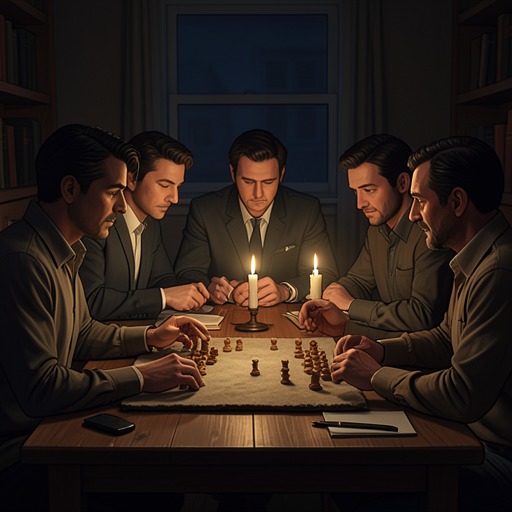
After a two-hour virtual concert, Cullen joins Joe and the others at Joe’s apartment for an after-party. The gathering is framed as a return to an old shared routine, with Benny declaring that the concert was a blast and Joe wondering why they had ever stopped attending such events. Cullen’s importance in these scenes is not that he directs the action, but that he helps restore the texture of ordinary companionship around Joe. The world may contain cosmic entities, altered realities, and unstable supernatural relationships, yet Cullen still occupies the familiar social space of the friend who comes over for entertainment and drinks.
His later conversation with Joe also shows that the friendship can carry embarrassing subjects without becoming cruel. During a tense discussion about Joe’s relationship with Maggie, Cullen says that Joe and Maggie have experienced things that people like Cullen and Benny are unlikely to experience. The remark is envious and self-deprecating, but it is also an assertion of intimacy: Cullen feels sufficiently close to Joe to demand an explanation and to complain that Joe owes his friends some account of his extraordinary luck. The scene makes Cullen a representative of the ordinary human perspective confronting a life that has become increasingly impossible to compare with normal experience.
Gaming Skill and Adaptability
Cullen is part of Joe’s squad in Underwater Yoga Blaster, a team game played through the Full Immersion Pod 3,000™ and V-Life. When Ryan Foster withdraws after becoming exhausted by the group’s nonstop training, Joe brings Maggie to replace him. Cullen is present in the virtual hanger, wearing a retro and space-pirate fusion avatar whose eye-patch, peg-leg, and hook-hand are visually inventive but potentially inconvenient during play. Even in a competitive setting, his first contribution is therefore aesthetic experimentation.
The replacement creates a tactical problem. Joe assesses Maggie as a fast learner with strong reflexes and accuracy but poor strategy and teamwork, so Huey suggests that she take Cullen’s position as the roamer. Cullen immediately objects because the proposed rearrangement would force him into the support role, which he dislikes. Benny offers to switch positions and take over as tank instead. This exchange reveals Cullen as neither the unquestioned leader nor the most self-sacrificing player: he has clear preferences, complains openly, and still remains within the group’s practical negotiation. His gaming identity is shaped by both creativity and role-based frustration.
Cullen’s avatar expertise gives him a distinctive form of competence within the squad. He may resist an unwanted support assignment, but he is also the person capable of turning visual concepts into functioning digital bodies. The contrast between his dramatic skeleton and pirate designs and the strategic demands of team play captures the difference between expressing oneself in a virtual world and cooperating inside it. Cullen is good at making a persona memorable; the group must still decide how that persona fits a collective objective.
Attitude Toward the Uncanny
Cullen’s response to Maggie is notable for its lack of sustained fear. He treats her tentacles as a design achievement and asks technical questions about their movement. This reaction does not mean that he understands her true nature; rather, it shows how V-Life has trained him to interpret the bizarre through the language of customization, style, and performance. A semi-eldritch figure can initially register as another unusual avatar because the virtual environment has made extraordinary appearances commonplace.
The same normalization extends to Azgod’Kalar, Maggie’s pet orb python. Cullen is among the friends who encounter the snake as part of Maggie and Joe’s domestic life, and later accepts revelations about its unnatural condition with remarkable calm. Maggie explains that Azgod’Kalar’s subspecies has had much of its ferocity surgically removed, because orb pythons were genetically modified to serve as docile companions for space-faring humanity. The snake is small enough to travel tucked inside Maggie’s sleeve, yet it remains a living product of extensive human intervention. In another moment, Azgod’Kalar imitates Maggie’s thumbs-up by curling its tail into a spring-like gesture, demonstrating that the creature has been trained to perform tricks.
The most extreme revelation concerns the snake’s age. Maggie states that she granted Azgod’Kalar perpetual youth, explaining why the animal has not grown beyond its hatchling size. Cullen is not seriously disturbed by this disclosure. Joe’s relationship with a time-travelling supernatural being has already raised his tolerance for impossible information to extraordinary levels, and Cullen’s reaction shows the same comic recalibration spreading through Joe’s circle. The friends’ capacity to absorb the strange does not erase the strangeness; it turns cosmic impossibility into another fact to be discussed around the tea table.
Narrative Role and Significance
Cullen is a secondary character, but his presence gives the novel a stable social counterweight to Maggie’s otherworldly logic and Joe’s increasingly transformed circumstances. He is neither a supernatural adversary nor a heroic guide. Instead, he is an ally whose value lies in continuity: he returns to familiar gatherings, recognizes Joe’s old habits, participates in games, and reacts to revelations through banter, disappointment, and practical adjustment.
His avatar-making also embodies one of the book’s central contrasts between appearance and identity. Cullen’s steel skeleton, axe-mohawk, pirate fusion, and other designs are deliberately artificial, yet they express something personal about their maker. At the same time, Maggie’s apparently customized virtual strangeness conceals a reality far more consequential than ordinary aesthetic experimentation. Cullen’s talent helps make the virtual world feel socially lived-in, while his interactions with Maggie show how easily that world’s language of avatars can obscure the boundary between costume, body, and being.
Cullen ultimately remains recognizable through surprise without undergoing a major transformational arc. He can be vain about his preferred gaming role, curious about unusual bodies, envious of Joe’s romantic experiences, and cooperative when circumstances require it. Those small contradictions make him more than a single comic type. He is the friend who complains about support play, designs impossible bodies for strangers, wears a weapon on his skull, and then sits with the others while the impossible becomes ordinary. In the larger story, that mixture of flamboyance and normality is precisely what allows Joe’s friendship circle to survive contact with the uncanny.