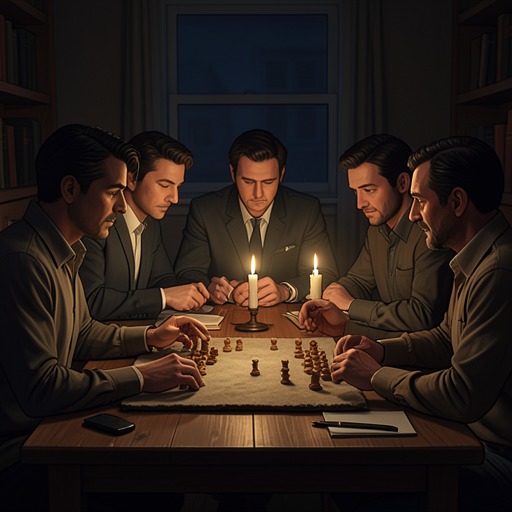
Hubert Peterson
The Stars Have EyesHubert Peterson, usually called Huey, is a member of Joe Mulligan’s gaming circle and the official captain of the team Triple Misfire. His decisive importance lies in the contrast between the identity he performs and the judgment he ultimately exercises: he presents himself as a military-tech fanatic who thrives on command, weaponry, and grand theories of institutional corruption, yet when the team’s unusual hardware attracts official pressure, he chooses to protect his friends rather than turn a recreational contest into a legal crisis.
Identity and Introduction
Hubert first appears in the virtual world of V-Life as the third member of Joe Mulligan’s squad, alongside Benny and Cullen. His avatar is a military commando dressed in body armor and camouflage and carrying a fully automatic assault rifle. The appearance deliberately evokes the soldiers who had previously tried and failed to prevent Magh'rathlak the Observer from entering reality, making Huey’s chosen image another example of the group’s casual transformation of serious military imagery into recreational self-presentation.
Joe introduces him to Maggie as Hubert Peterson, but the introduction is immediately complicated by Joe’s unflattering description of him as a hopeless nerd so obsessed with military technology that he would sell his own mother for the chance to ride an army gunship. Maggie repeats the description verbatim before realizing that she has reproduced Joe’s private assessment in front of its subject. The mistake establishes both Hubert’s nickname and his place in the group: he is familiar enough to be mocked, specialized enough to be useful, and sufficiently self-serious to become an easy target for the others’ humor.
Captain of Triple Misfire
When Ryan Foster withdraws from the team after inventing a story about a clogged Noot-Goop dispenser, Joe announces that Maggie will replace him. Hubert and the other players initially doubt whether she has enough experience to participate. Their concern is not entirely unreasonable. Joe judges Maggie to possess exceptional reflexes and accuracy but to be weak at strategy and teamwork, qualities that matter more in a coordinated squad game than raw piloting ability.
Hubert supplies the practical solution. He suggests that Maggie take Cullen’s position as the team’s roamer, while Cullen shifts into another role. The proposal recognizes that Maggie’s strengths are best used through mobility, scouting, and independent action rather than through tightly synchronized support play. Cullen complains about being pushed into support, and Benny proposes a further rearrangement in which Cullen takes the tank role. Hubert’s contribution is therefore organizational as much as tactical: he helps turn Maggie’s unusual abilities into a workable team composition.
As the registered captain, Hubert also chooses the team’s name, Triple Misfire. He leads the group into the Dave-156 bracket of Blastopia, an enormous competition that progresses from mega-city championships to planetary, star-cluster, national, and ultimately galactic titles. Triple Misfire has no realistic expectation of reaching the highest levels. Their immediate aim is merely to finish among the top eight teams in mega-city Dave-156, which requires four consecutive best-of-five victories in a field of more than one hundred teams. Hubert’s captaincy gives form to this modest ambition and makes the tournament a shared project rather than an improvised session of play.
Tactical Command and Team Dynamics
Hubert’s command style is direct, informal, and aggressively jocular. In the asteroid-field match against Quantum Crusaders, he opens the engagement with a crude exhortation to catch the opposing players off guard, then immediately assigns responsibilities. Benny is told to plot a course toward the enemy’s starting position; Joe, Cullen, and Hubert will provide cover; Maggie is ordered to scout ahead and report as soon as she detects an enemy ship, without moving more than five hundred meters away.
The battlefield makes those instructions meaningful. The virtual arena is a dense asteroid field filled with drifting mini-mountains, poor visibility, restricted maneuvering space, and heavy metals that interfere with instruments. Ambushes are possible for either side, so Hubert’s plan depends on disciplined reconnaissance and mutual support. His orders also show that he does not simply treat Maggie as an overpowering ace. He places her in a controlled forward position, balancing her extraordinary piloting ability against the danger that she might operate too far from the team.
Quantum Crusaders underestimate Maggie and the rest of Triple Misfire. Although the local players are not professionals, they possess enough game sense and technical competence to detect the opposing force even without their roamer’s assistance. Hubert’s team is therefore more capable than its casual appearance suggests. The match begins as an opportunity for an inexperienced but coordinated group to challenge professionals, and Hubert’s leadership helps create that numerical and tactical foundation.
Disqualification and Conspiracy
The team’s competitive progress ends when a Blastopia official arrives between rounds and announces that Triple Misfire has been disqualified. Hubert reacts with immediate disbelief and anger, demanding an explanation. The official offers a coercive choice: the team can withdraw voluntarily and keep the matter quiet, or the match can be suspended while police investigate the players’ activities, backgrounds, and hardware in search of grounds for trouble.
Hubert does not know the full extent of Maggie’s custom modifications to Joe Mulligan’s Full Immersion Pod 3,000™, but the rest of the team understands the danger. The pod is no longer merely a clinically white consumer machine. Its frame leaks pitch-black goo that evaporates on contact with the floor, its interior casing contains a gash exposing rhythmically pulsating pink flesh, and its ordinary red indicator light has been replaced by a glassy, tearful eye with a green iris and a square black pupil. Maggie later explains that she infused the pod with a shoggoth, a Class-1 cosmic entity possessing immense strength and durability, while its low intellect makes it easy to control and difficult to detect psychically.
Because Hubert sees the others’ unease, he decides that continued resistance is not worth the risk and agrees to forfeit the match. The decision is less heroic than a defiant stand and less humiliating than a forced investigation, but it protects the team from exposing the pod’s nature and possibly attracting legal or governmental intervention. His captaincy thus culminates in a defensive act: he accepts defeat to preserve the group’s safety.
Immediately afterward, Hubert interprets the disqualification as retaliation by frightened professionals and their corporate sponsors. He argues that Triple Misfire was being punished because the supposed experts feared losing to nobodies, and he launches into an extended conspiracy theory about megacorporations manipulating tournament organizers. The others know that Hubert frequently behaves this way on message boards, and they recognize the accusations as unsupported, yet their personal involvement makes the explanation emotionally attractive. Blaming faceless corporations is easier than confronting the possibility that Maggie’s presence and Joe’s altered pod created the real danger.
Character Function and Significance
Hubert is comic partly because his military persona is excessive but not entirely empty. His avatar, technical obsession, coarse commands, and conspiratorial tirades make him a recognizable caricature of the military enthusiast who converts every setback into evidence of a hidden plot. At the same time, his tactical suggestions are useful, his grasp of team composition is sound, and his final decision is cautious rather than reckless. The story allows his ridiculousness and competence to coexist.
His relationship with Maggie exposes another tension. He initially treats her as an uncertain substitute whose skills must be fitted into a team structure, but the tournament quickly reveals that she is far more capable than the others expect. The professionals underestimate her, while Hubert and the rest of Triple Misfire discover that their own informal training has produced a viable unit. Maggie’s presence therefore unsettles the hierarchy between human gamer and supernatural participant, even as Hubert’s role as captain supplies the human framework through which her abilities are deployed.
Hubert also belongs to the book’s larger network of distributed agency. He does not control the tournament’s outcome: the official, the suspicious hardware, Maggie’s concealed nature, and the threat of police investigation all shape what happens. Yet his response still matters. He converts panic into a team decision, accepts the forfeiture, and gives the group a story that makes the loss bearable. His value is not that he defeats the system, but that he commands the retreat when victory would expose everyone to consequences they cannot manage.