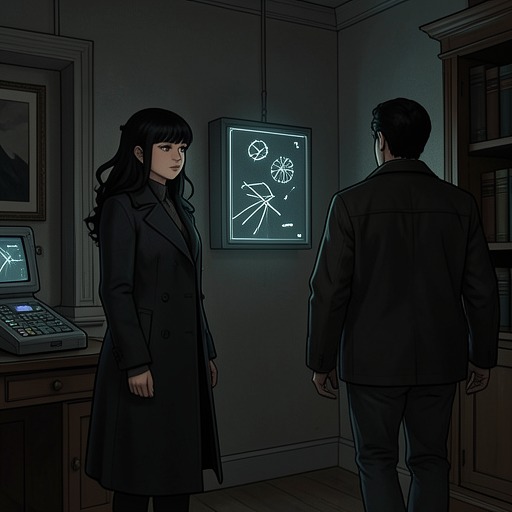
Joe’s Psychic-Anchor Bond
The Stars Have EyesJoe’s Psychic-Anchor Bond is the supernatural covenant between Joe Mulligan and Maggie, whose cosmic identity is Magh'rathlak the Observer. It is the structural foundation of their relationship: Maggie gains a human guide, a vessel through which to study reality, and protection against banishment, while Joe becomes the person on whom her manifestation and safety depend. What begins as an awkwardly negotiated promise therefore develops into a reciprocal attachment whose emotional consequences reach far beyond the original terms.
Formation and Terms
The bond is created when Magh'rathlak offers to bind itself to Joe in order to guard and nurture his fragile being, while Joe will serve as its guide and anchor in the dimension it wishes to understand. The proposal is simultaneously protective, investigative, and intimate. Joe reduces the arrangement to the possibility of becoming mates, and Magh'rathlak confirms that this is also acceptable if he desires it. The exchange makes the covenant unusual from the start: a cosmic obligation is translated into the language of romance and ordinary companionship without losing its metaphysical force.
The entity’s interest in Joe is not merely sentimental. Magh'rathlak explains that its earlier attempts to study the dimension were misguided because human minds and bodies could not survive its usual methods of inquiry. Joe’s participation is consequently required if it is to examine reality without destroying it. When Joe worries that the entity’s enormous, visibly inhuman form would frighten people in public, Magh'rathlak answers that creating a fleshly vessel capable of carrying its vast being would be trivial once he agreed to act as its anchor. The bond thus solves two problems at once: it gives the cosmic entity a socially viable incarnation and supplies the delicate human mediation its research requires.
Joe accepts the terms, and Magh'rathlak declares, “The pact is thus sealed.” The air trembles at the declaration, although no blood signature or physical contract is needed. The covenant is enacted through the entity’s power and Joe’s assent, emphasizing that its reality lies in binding intention rather than bureaucratic form.
Metaphysical Operation
The bond makes Joe the anchor that permits Maggie to remain in the human dimension. Maggie knows that if anything happens to him, she will lose the ability to manifest her otherworldly power and will become weak enough to be banished to wherever she came from. Conversely, while Joe remains alive, forcing her out of reality is nearly impossible. His continued existence is therefore not simply important to her emotionally; it is the material condition of her presence.
This arrangement gives the relationship an asymmetrical but reciprocal logic. Maggie possesses overwhelming strength, intelligence, and reach, yet her embodiment depends on a supposedly insignificant human being. Joe, who describes himself as neither strong, fast, nor smart and whose aptitude record labels him unemployable, becomes indispensable to a Class-3 cosmic entity precisely because of his ordinary human continuity. His vulnerability is also his power within the bond: the being that can overpower almost anyone must protect the one person whose survival secures its own.
The bond also explains Maggie’s otherwise disproportionate vigilance. She recognizes that Joe’s death would expose her to ejection from the dimension, so protecting him becomes an obligation she will fulfill at all costs. During one excursion, she entrusts his safety to the Full Immersion Pod 3,000™, which she has infused with the essence of a shoggoth. The possessed machine is intended to delay or repel an attack until she can return, showing how the bond converts an abstract metaphysical dependency into practical security measures.
Protection, Secrecy, and Conflict
Maggie’s obligation to Joe repeatedly shapes her dealings with institutions and enemies. When Major Gordon Archer questions why she wants a non-aggression pact, she identifies Joe’s safety and wellbeing as the reason. She refuses to disclose every detail but makes clear that she is bound to protect him from harm. The bond therefore becomes both a private relationship and a political stake: an agency or military authority negotiating with Maggie must account for the human whose safety can determine her conduct.
The bond’s secrecy is equally consequential. Maggie is aware that humans monitor her, yet she allows much of that surveillance to continue because concealment encourages further investigation. Joe’s role is different. She specifically wants the fact that he is her psychic anchor to remain unknown, since enemies could exploit his vulnerability. A marksman who believes he has eliminated the Class-3 does not know that Maggie can reconstitute herself so long as her anchor is alive. Once she traces the shot to its source, physical distance ceases to protect him; she seizes control of the elevator and confronts him with an infinite void filled with eyes. The failed assassination demonstrates the bond’s defensive value while also revealing its danger: Joe’s life is a hidden strategic weakness, and Maggie’s response to threats against it is overwhelming.
That protection can become possessive. Maggie admits that she does not trust Joe to remain exclusively connected to her because he is gullible, optimistic, and naive enough to have allowed a being like her into his life and thoughts. She fears that another person could eventually replace her, even if that person had no harmful intentions. Her anxiety reflects her growing understanding that human relationships change: friends forget one another, enemies reconcile, lovers drift apart, and acquaintances become intimate. The bond gives her extraordinary security against cosmic expulsion, but it cannot guarantee emotional permanence, and that limitation troubles her more deeply than any ordinary physical threat.
Human Consequences and Development
For Joe, the covenant offers companionship and meaning while also complicating his independence. He accepts the role of guide and anchor with characteristic ease, even though the arrangement joins him to a being capable of destroying minds and matter. His modest self-conception contrasts sharply with the scale of his responsibility. In V-Life, he explains that without Maggie he would be another faceless goon in the crowd, occupying virtual reality because he has nothing better to do. He does not aspire to become a soldier or genius; he is satisfied that he can make people laugh and live without anxiety. The bond consequently does not transform him into a conventionally powerful hero. Instead, it gives cosmic significance to a person who remains emotionally and socially ordinary.
At the same time, Joe’s attachment to Maggie begins to threaten the very agency he had accepted as part of their arrangement. His father, Barry Mulligan, warns him to become his own man rather than letting others guide him, insisting that Maggie cannot become his entire world. The advice identifies the bond’s central human tension: being needed by Maggie is not the same as possessing an independent life. Joe’s loyalty is genuine, but his dependence can make devotion resemble surrender.
After Maggie’s absence, that tension becomes a crisis of action. Joe tries to maintain her vessel, yet admits that this is not enough. Remembering his father’s warning, he decides to take control of his life and prepares for a third attempt to change his situation after two failures. His determination culminates in an extraordinary effort to restore the bond rather than passively await Maggie’s return. He revives the Cult of the Gazing Star and reconstructs the ritual that originally summoned Magh'rathlak the Observer, using the entity’s notes, recordings, and comments. The ceremony requires an annual planetary alignment, precise chants, props, and devices. Joe recruits forty-two robed participants, including his father and friends, despite recognizing that many of the other recruits are desperate, disturbed, easily manipulated, or dangerously foolish. His willingness to exploit their desperation is morally troubling, but the motive is unambiguous: he believes Maggie’s return would justify the cost.
Significance of the Bond
The bond joins cosmic scale to domestic ordinariness. Maggie can negotiate with governments, penetrate secure systems, control technology, and defeat a sniper without warning, yet her continued existence depends on Joe’s fragile body and on the mundane routines surrounding him. Her upgrades to his machine, her financial negotiations, and even the perpetual youth she grants Azgod’kalar all belong to the same pattern: vast supernatural power is repeatedly expressed through acts of caretaking, exchange, and practical attachment.
It is also a relationship of mutual exchange rather than a one-sided rescue. Maggie promises to guard and nurture Joe; Joe offers guidance, anchorage, and access to a world she cannot safely study through her normal methods. Later, Maggie’s willingness to secure a business arrangement for Oliver Millington in exchange for one of his pets, and her negotiation of a monthly stipend for assistance with cybersecurity, echo the covenant’s broader logic of defined obligations and compensation. Yet the bond exceeds a contract because its terms become emotionally inhabited. Joe’s attempt to summon Maggie is not a technical exercise alone, and Maggie’s fear of being replaced is not reducible to metaphysical risk.
Joe’s Psychic-Anchor Bond finally functions as both protection and constraint. It saves Maggie from easy expulsion and gives Joe a place in the life of an otherwise incomprehensible entity, but it also makes each vulnerable to the other’s absence, choices, and changing attachments. The covenant’s decisive significance lies in that contradiction: a promise intended to preserve reality and prevent destruction becomes the emotional center of a relationship in which love, obligation, survival, and personal freedom can never be cleanly separated.