Kelogh’theryl the Devourer
The Stars Have EyesKelogh’theryl the Devourer is a Class-3 cosmic entity of chaos whose human-facing identity is Kelly, or The Devourer. She is Maggie’s sibling and functions as a dangerous counterforce to Maggie’s order: where Maggie studies human behavior and constrains her abilities, Kelly treats the human world as a field of appetites, opportunities, and deception. Her significance lies in the way she makes possession and bodily transformation inseparable from personality. Kelly does not merely appear in a borrowed body; she turns that body into an extravagant, predatory performance that unsettles Joe and exposes the limits of Maggie’s attempts to live as human.
Identity and Appearance
Kelly first becomes relevant when Maggie identifies the approaching visitor as Kelogh’theryl the Devourer, immediately making Joe worried. The introduction is deliberately misleading in visual terms. At the door, Joe encounters a woman with fair skin, piercing blue eyes, wild blonde hair, aggressively feminine features, and an exaggerated hourglass figure. Her revealing red sweater and thigh-high stockings create the appearance of an adult-entertainment fantasy, but the details that matter most are not the sexualized proportions. Her grin contains pointy teeth, and her golden hair forms snapping, maw-like shapes by its own movement. The apparent bombshell is therefore also a monster, with the body’s attractiveness functioning as camouflage and threat at the same time.
Kelly’s identity remains distinct from the host’s. She explains that she is merely borrowing the body while its owner sleeps, and Maggie identifies the act as possession. Later, the host’s face twitches, her natural eyes appear dull green, and those eyes rapidly shift to Kelly’s sky-blue color. Within moments, the host’s face, hair, and figure expand into Kelly’s familiar blonde form. The transformation shows that Kelly’s appearance is not a stable human identity but a supernatural configuration imposed upon a temporary vessel.
Arrival and Rivalry with Maggie
Kelly visits Joe and Maggie aboard the cruise because she does not want to miss what Maggie has been doing. She has also heard that the cruise contains plentiful “morsels,” and her language makes clear that she regards the passengers as potential food or prey rather than as fellow travelers. She enters the cabin casually, settles on the sofa, and adopts a flirtatious, colloquial manner, but the ease of the visit conceals a serious confrontation between siblings.
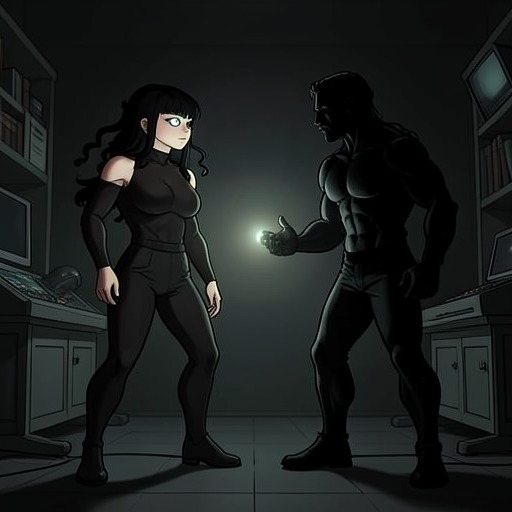
The confrontation begins without an obvious physical attack. Maggie and Kelly lock eyes, and both entities display unmistakable signs of psionic activity. Maggie’s gaze becomes a torrential whirlpool of darkness; Kelly’s blue irises glow like miniature suns; and both sets of animated hair sprout eyes or fangs. To Joe, however, the room remains intact. The hidden action is more destructive and more precise: Kelly attempts to open microscopic black holes throughout the surroundings, while Maggie shuts them down. Their contest ends in a draw in less than a minute, confirming that Kelly can challenge Maggie directly without being able to overcome her.
The draw establishes their rivalry as a conflict of methods as much as power. Kelly praises Maggie for retaining her senses despite her humanity, while Maggie responds with open displeasure. Maggie later warns Joe that The Devourer is a creature of chaos that lies and deceives to obtain what it wants, and insists that he is severely underestimating her. Kelly’s presence therefore tests Joe’s trust in Maggie’s judgment: he sees a provocative visitor who can be tolerated, while Maggie recognizes a sibling whose charm is part of the danger.
Possession, Appetite, and Predation
Kelly’s possession of the host gives her access to human society without requiring her own permanent human incarnation. The arrangement also exposes a stark asymmetry between the entity and the person whose body she uses. The host is strapped into a chair and unconscious when Joe encounters her, and her ordinary appearance suggests a person living with very limited resources. Joe imagines that accepting a powerful entity as a host may have offered her a new lease on life, even though she is unconscious for much of the experience. That interpretation remains Joe’s speculation, but it emphasizes the social and bodily cost concealed by Kelly’s glamorous manifestation.
When Kelly emerges, she casually snaps the restraints holding the host’s body in place and advances toward Joe. Joe is still bound to his own chair and cannot wake the host by touch. The scene converts the body that initially appeared passive and vulnerable into an instrument of supernatural force, while leaving Joe physically helpless before the entity’s predatory approach. Kelly’s danger is thus expressed through control: she can borrow a body, redesign its appearance, break its restraints, and use seduction and intimidation in the same movement.
Her appetite is also presented as a governing principle. Kelly describes the cruise’s passengers as morsels, and her arrival is framed less as a family visit than as an opportunity to inspect available prey. Even her playful speech and sexualized appearance become extensions of that appetite. The comedy of her entrance does not cancel the threat; it makes the threat harder to classify, because Kelly can be charming, obscene, monstrous, and curious without changing identities.
Relationship with Maggie and the Wider Conflict
Kelly’s relationship with Maggie is explicitly familial, but it is not affectionate in any conventional sense. Their exchange combines sibling familiarity with cosmic hostility. Kelly calls Maggie “Ms. Oblivious,” treats her human experiment as entertainment, and appears ready to confront anyone who threatens or annoys her. Maggie, for her part, is capable of greeting Kelly with a smile, but the smile is described as blatantly forced. Their bond permits directness and recognition, yet it does not create safety.
Their rivalry also reflects the larger opposition between order and chaos. Maggie is the Observer, a being whose failure consists partly in abandoning her calling to pursue the familiar and human emotions. She eventually concludes that she must submit to realignment to avoid becoming an aberrant entity. Kelly represents the danger against which that order defines itself: deception, appetite, improvisation, and the refusal to respect stable boundaries between host and self. The contrast is not simple moral opposition, since Maggie also hides motives behind technicalities and fancy words. Kelly’s warning is therefore credible even when Maggie delivers it; her chaos is dangerous, but Maggie’s order is not transparent.
Kelly’s reaction to Maggie’s later return makes their difference especially visible. When Kelly bursts into the room looking for the person who wants to rearrange her face, she abruptly stops upon seeing the impossible entity before her. Maggie greets her sibling with a forced smile and remarks that Kelly still has not learned to pay attention to her surroundings. Kelly offers no reply and can only stare, wide-eyed and slack-jawed. The moment reverses the usual power dynamic: the predator who normally controls the scene is rendered speechless by Maggie’s unexpected manifestation.
Narrative Function and Thematic Significance
Kelly is a shapeshifter figure in the narrative, but her transformations are not merely decorative. She reveals that bodily appearance can be a disguise, a weapon, a commodity, and a temporary territory. Her host’s body is occupied, expanded, and converted into the recognizable Kelly-form; the supposedly glamorous surface simultaneously invites attention and signals danger through teeth, animated hair, and predatory movement. In this sense, Kelly makes the politics of the body literal: identity belongs neither wholly to the host nor wholly to the visible form.
She also sharpens the novel’s treatment of social labeling. Other characters react to abnormal appearances by naming, judging, arresting, or fearing them. Kelly complicates those reactions because her outward beauty does not make her safe, while her monstrous features are not the only source of her threat. Joe’s attraction, discomfort, and helplessness all arise before he fully understands what he is seeing. The body becomes evidence that can mislead as easily as it can reveal.
Finally, Kelly provides a counterpoint to Maggie’s attempt to master human expression. Maggie studies breathing, blinking, walking, and facial-muscle control as part of her self-assigned training, while Kelly seems to master the social force of a body instinctively, using posture, clothing, flirtation, teeth, and hair as a unified performance. Maggie’s human presentation is deliberate and analytical; Kelly’s is theatrical and predatory. Their sibling rivalry consequently turns embodiment into a contest over who can control the meaning of a human form.