Lyfe Haxx
The Stars Have EyesLyfe Haxx is a small independent retail business in Dave-156 whose humble storefront becomes a crucial bridge between Maggie’s cosmic identity and the commercial routines of human society. Conceived as a shop selling inexpensive curiosities and companion animals, it briefly turns Maggie’s alien perception into a practical marketing advantage, while also providing the serpent Azgod’Kalar the Calm that she treats as far more than a mere commodity.
Setting and Appearance
Lyfe Haxx occupies a recent three-story storefront wedged between two hyper-scrapers in the lowest urban street tier, the area commonly called undertown. Its fresh white paint and large red holographic Lyfe Haxx™ sign mark it as a new arrival in a district otherwise dwarfed by the surrounding architecture. Although the building is substantial by ordinary standards, it looks like a tiny shack beside the neighboring feats of engineering. The shop’s interior is orderly and spacious, with rafters and shelves intended to display a broad range of merchandise, though the business is still being arranged when Maggie visits. Its novelty goods include self-propelled ashtrays, automatic back scratchers, a machine that simply switches itself off when activated, and running shoes that make quacking noises every third step. The deliberately absurd inventory gives the establishment a comic identity, but the back warehouse reveals a more practical commercial purpose.
Pet Business and First Encounter with Maggie
Mr. Charles, the owner of Lyfe Haxx, introduces himself as the proprietor of the small independent firm when Maggie arrives searching for a pet. In the warehouse, seven forklift-like cargo robots organize a mountainous collection of crates and boxes, including ventilated plastic containers holding live animals. Eight pets are available: a snow-white rabbit, an orange miniature giant space hamster, a baby hedgehog, a black gecko with yellow spots, a gold-and-brown snake, a vividly blue-and-yellow tarantula, a colorful parrot, and an over-excited budgie. Maggie assesses the animals with the detached precision of an extraterrestrial observer. Her analysis concludes that 96 percent of humans would find an appealing companion among the selection, with the hamster ranking as the cutest by scientific criteria. Yet the shop’s most important animal is not the one that wins her objective comparison. The gold-and-brown snake attracts her personal preference, establishing the distinction between measurable appeal and attachment based on an apparently arbitrary whim.
The Bargain and Its Unexpected Success
Because Lyfe Haxx lacks both a steady customer base and a fully organized premises, Mr. Charles proposes a trade: if Maggie helps establish the business, he will give her one of the pets as recompense. The arrangement converts the shop into an informal testing ground for her attempts to understand human behavior. Maggie initially interprets his idiom about getting the business off the ground literally, but she recognizes the intended meaning and accepts the commercial logic of the exchange. Within two hours of her departure with the shop’s catalogue, more than seventy potential customers visit Lyfe Haxx, and at least half purchase something. Mr. Charles is astonished, while the customers leave satisfied and the store receives exactly the boost he wanted. Maggie achieves this result without coercion or overtly unethical methods: she passively monitors subconscious desires, approaches people whose wishes can be met by the merchandise, and allows her unusual charm to complete the persuasion. Her success makes the shop an example of social exchange operating across an enormous difference in power and cognition; a modest human retailer receives commercial rescue, while Maggie receives the living companion she sought. Mr. Charles even offers Maggie a full-time assistant-manager position after witnessing the result. She recognizes the offer as a considerable honor for someone who appears to be a young girl, but declines it, takes her chosen prize, and returns toward Joe Mulligan’s apartment. Lyfe Haxx therefore functions not as a permanent workplace for Maggie but as the site of a completed transaction whose effects continue beyond the store.
Azgod’Kalar the Calm and the Shop’s Afterlife
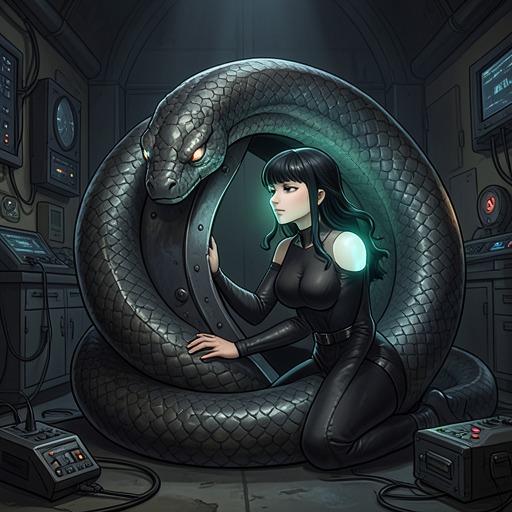
Maggie names the gold-and-brown serpent Azgod’Kalar the Calm. The selection is deliberately contrasted with her scientific judgment: the miniature giant space hamster remains the cutest animal by objective analysis, but the snake is the one she finds precious. That preference gives the shop’s merchandise a new status. What begins as an item in a warehouse becomes a named individual associated with Maggie’s choices, experiments, and later domestic routines. Azgod’Kalar is an orb python, a genetically modified offshoot bred for the space-faring human population. Its species is smaller and more docile than ordinary ball pythons, and much of its ferocity has been surgically removed as part of humanity’s broader effort to prevent people from adopting dangerous extraterrestrial animals merely because they look appealing. Maggie regrets that the serpent’s subspecies has lost much of its predatory capability, but she also treats its intelligence as worth cultivating. She teaches it to imitate her thumbs-up gesture, and the snake responds by coiling the tip of its tail into a spring-like shape and raising it. Maggie later uses Azgod’Kalar in a fear experiment concerning the possible loss of a being to which she has become emotionally attached. She identifies the snake as suitable precisely because it has sentimental value despite offering her almost no practical utility. The shop’s bargain thus has consequences beyond successful advertising: it supplies the test subject through which Maggie begins investigating an emotion that she cannot yet classify as ordinary human fear. The serpent remains part of Maggie’s movements and relationships. It travels tucked inside her sleeve during the high-speed journey from Dave-156 to Dave-157, its head peering from her shoulder, and it continues to appear as a familiar companion in her interactions with Joe. Maggie eventually grants Azgod’Kalar perpetual youth, explaining why the snake remains the size of a hatchling long after its acquisition. Through this continuing bond, Lyfe Haxx becomes the commercial origin point of a relationship that the narrative repeatedly treats as affectionate, strange, and consequential.
Investigative and Narrative Significance
Lyfe Haxx also becomes an investigative lead. Grant Maloney’s unofficial inquiry into Joe Mulligan and Maggie begins with neighborhood questions about Maggie’s singular appearance. Within an hour, he hears reports of a so-called “Pale Goddess” circulating on local message boards and follows that trail to Lyfe Haxx. The store consequently serves as a public trace of Maggie’s presence: a place where her appearance, unusual behavior, and ability to generate customers have already entered community rumor before the authorities understand what she is. The business embodies the book’s recurring collision between cosmic power and ordinary institutions. Maggie can bind herself to Joe as his protector, alter a device with upgrades, and perceive subconscious desires, yet one of her most revealing demonstrations of power takes place in a small shop whose shelves contain gag products and whose warehouse is managed by cargo robots. Lyfe Haxx makes the supernatural legible through retail. It turns an eldritch being’s perception into foot traffic, a contractual exchange into a pet, and a minor commercial success into the beginning of Azgod’Kalar’s long place in Maggie’s life.