Order and Chaos
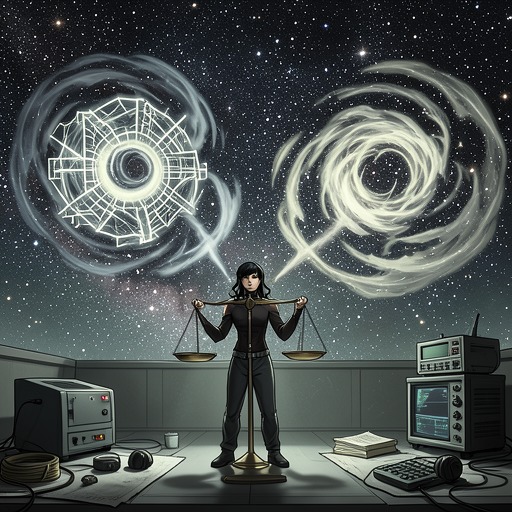
The Stars Have EyesOrder and Chaos is the novel’s central cosmic polarity: a division between forces associated with structure, restraint, and intelligibility on one side, and forces associated with disruption, appetite, and unpredictability on the other. The opposition gives the supernatural setting its deepest organizing principle, but the narrative repeatedly complicates it by showing that neither side remains perfectly pure. In particular, Magh’rathlak the Observer’s study of humanity and its rivalry with Kelogh’theryl the Devourer reveal a tension between cosmic nature and acquired feeling.
Cosmic Definition
The distinction between Order and Chaos belongs to the deepest layer of reality, yet it does not operate like an ordinary physical force. From the perspective of beings such as Magh’rathlak the Observer, matter and gravity are foreign concepts, while time exists but behaves strangely under material forces. Order and Chaos, by contrast, are described as little more than ideas or concepts in Joe Mulligan’s universe. Thought is the principal bridge between the two realities: it allows entities from beyond the veil to contact inhabitants of the Milky Way and to interpret the material realm through them.
This conceptual status makes the opposition both powerful and elusive. The Federation’s Triple-A classification system attempts to categorize otherworldly entities, but its broad and vague categories reflect how little the material universe understands the dimension beyond the veil. Mortal observers cannot reliably assess entities whose native reality is fundamentally alien, while those entities themselves struggle with basic features of the material universe. Order and Chaos therefore name a genuine cosmic structure without reducing it to a fully intelligible scientific system.
Magh’rathlak and the Discipline of Order
Magh’rathlak the Observer embodies Order most clearly through its insistence on measured self-regulation. After months of studying humanity, the Class-3 cosmic entity recognizes that the experience has made it impatient and even addicted to the rapid acquisition of knowledge. Its curiosity extends indiscriminately from the science of wormhole generators to nearly a thousand hours of soap operas. Yet when an intriguing psionic-repelling layer of shielding appears, Magh’rathlak notices that it has begun dismissing familiar subjects merely because they seem less interesting.
The recognition matters because it shows Order turning its analytical gaze inward. Magh’rathlak could have examined maintenance droids, accessed their electronic brains through the local network, and investigated their manufacture, designers, and programming without alerting anyone or violating its obligations. Instead, it decides to reorganize itself first. The entity compartmentalizes thought patterns, purges overly chaotic ideas, and reaches mentally toward peers beyond the veil. Change is acceptable, but only in moderation; Magh’rathlak must learn from humanity without deviating too far from its essential nature.
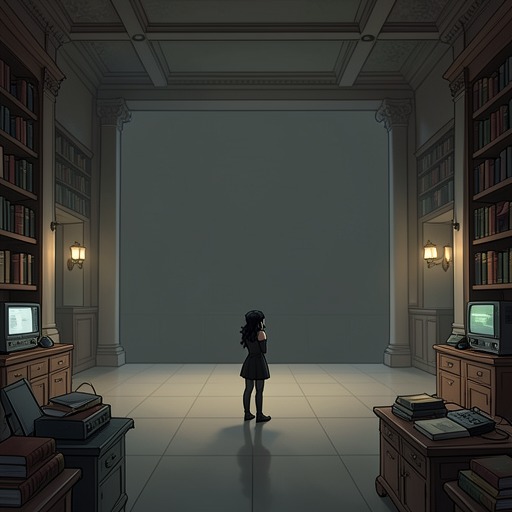
This self-correction is invisible to an external observer. In material form, Maggie appears only as a pale, raven-haired woman hovering in a cabin while Joe Mulligan sleeps nearby. Beneath that apparently simple image, however, an unfathomable intelligence is performing an internal maintenance operation. The contrast captures the dual condition produced by Order: immense complexity is rendered as controlled stillness, and cosmic instability is managed through classification and mental compartmentalization.
Kelogh’theryl and the Pressure of Chaos
Kelogh’theryl the Devourer functions as Magh’rathlak’s opposite, but the opposition is not equivalent to complete alienation. During a visit to Joe Mulligan and Maggie, the two cosmic entities display sharply different natures, yet Joe notices that they share a basic misunderstanding of what he means when he discusses becoming or appearing different. Maggie’s confusion arises from excessive literalness, whereas Kelly’s appears to stem from stupidity, but the shared mistake creates an unexpected point of common ground.
The visit itself is an expression of Chaos. Kelly intrudes on the couple on a whim, apparently pursuing a plan to “sample” Joe in a metaphorical sense. Joe and Maggie would prefer to eject the unwanted visitor, but force is unavailable as a solution. They therefore remain on guard and try to entertain Kelly until boredom or another impulse carries her away. Her behavior is described as aggressive, impulsive, and consuming rather than sustaining: she may pursue flings, but she does not maintain relationships in the ordinary sense.
Joe nevertheless interprets Kelly’s conduct sympathetically. He argues that she wants companionship, conversation, and the kind of sustained closeness that Joe and Maggie possess. Her repeated argument with them and her disappointment when it ended can be read as envy of their relationship. Maggie could immediately dismantle this hopeful interpretation by invoking Kelly’s past, but she recognizes that doing so would make her a hypocrite. Maggie has also committed objectively terrible acts, including throwing Azgod’Kalar the Calm from a hyperscraper, though she later learned to care for the small serpent. Rather than destroy Joe’s optimism, she concedes that she may have judged her sibling too harshly and promises to try to be more understanding.
Rivalry, Contracts, and Shared Contradictions
The relationship between Order and Chaos becomes especially concrete through the pact between Magh’rathlak the Observer and Kelogh’theryl the Devourer. Kelly agreed to stop trying to seduce Joe Mulligan in exchange for a quantity of pancakes. Magh’rathlak considers itself to have honored the agreement, but Kelly’s later conduct comes close enough to seduction that it might constitute a violation, even if it was not technically an attempt to seduce him. Magh’rathlak cannot simply decide the matter according to its own preference, because the laws of Order require uncertainty to be submitted to Yagraactah the Adjudicator for a final ruling.
The episode turns cosmic philosophy into procedural comedy. Order appears not as serene perfection but as an obligation to resolve ambiguity through an authorized judgment. Even Magh’rathlak’s motives are not wholly detached: it suspects a breach partly because it desires further payback. Its literal reply to Kelly’s insult, “Well played, you googly-eyed bitch,” insists that it is not a canine of the female variety while conceding that the “googly-eyed” description is technically accurate and, in its own way, cute. Precision and affection coexist inside the supposedly orderly entity.
The rivalry also reveals that Order and Chaos are structurally opposed but psychologically entangled. Magh’rathlak and Kelly both form attachments, both misunderstand aspects of human life, and both have histories of harmful behavior. Their natures remain diametrically different, yet their similarities become harder to deny. The opposition thus produces conflict without preventing recognition: each side becomes a distorted mirror of the other.
Narrative Significance
Order and Chaos provide the novel with a flexible model for thinking about change, identity, and relationship. Magh’rathlak’s humanity study changes the Class-3 entity, but Order demands that the change be bounded. Kelly’s intrusions threaten boundaries altogether, yet her apparent hunger for connection suggests that even destructive impulses can conceal a desire for companionship. Neither cosmic category is therefore presented as a simple moral label. Order can become controlling, literal, and vindictive; Chaos can be cruel while also revealing vulnerability.
The opposition also explains why contact between realities is so unstable. Powerful cosmic entities are naturally pulled back toward their native dimension because their psionic abilities depend on deep attunement to that reality. A vessel-and-anchor connection, such as the one Magh’rathlak established with Joe Mulligan, allows an entity to remain in the material universe, but wormhole travel can separate the vessel and anchor from the alien consciousness and pull it back beyond the veil. The material and cosmic realms resist one another just as Order and Chaos do, yet thought, attachment, and pact-making create temporary forms of mediation.
Ultimately, Order and Chaos are most important not as a settled cosmological answer but as a pressure placed upon every relationship that crosses the boundary between worlds. The novel repeatedly asks whether identity is a fixed nature or something altered by experience. Magh’rathlak responds by carefully pruning its own changes; Kelly responds by consuming the situations and people that attract her. Their conflict shows that the categories remain real, but their lived expression is unstable, relational, and full of contradiction.