Pale Goddess
The Stars Have EyesPale Goddess is the title used by the public for Maggie, the human-looking manifestation of Magh'rathlak the Observer. It begins as an exaggerated internet label for an unusual celebrity figure, but gradually acquires the force of a religious name. By the time Joe discovers how far the phenomenon has spread, Pale Goddess identifies not merely Maggie's appearance or online popularity, but an expanding system of devotion that threatens her agreement with the Supernatural Eviction Agency and makes Joe a target of its followers.
Appearance and Public Image
Maggie's physical presentation gives the title its immediate visual logic. When Magh'rathlak the Observer first binds itself to Joe, it condenses into a human girl with extremely pale skin, raven-black hair that seems to move of its own accord, and irises resembling swirling gateways into an unknowable void. Her beauty is deliberately recognizable as human, but the living hair and impossible eyes reveal that the attractive body is a vessel for something fundamentally nonhuman. The title therefore joins conventional idealization with a residue of cosmic terror: the figure being praised as a goddess is also an entity whose true form lies beyond ordinary reality.
That contrast persists across Maggie's different appearances. In V-Life, her avatar retains a celebrity-like upper body while her lower body and hair revert into dark, eye-filled tendrils. Joe is accustomed to bizarre forms because he spends more time in virtual reality than in the waking world, and he consequently treats the revelation with less alarm than many people would. At a Chronal Impact concert, Maggie appears in this same supernatural configuration, her upper body emerging from a mass of shadowy tendrils, while Joe adopts the appearance of an alien cyberdemon so that they fit the monstrous aesthetic of the crowd. Pale Goddess thus names an image that can move between human beauty, virtual performance, and visibly eldritch embodiment without losing its appeal.
From Fan Label to Cult Name
The expression first circulates as part of the internet's tendency to turn a joke or striking image into an exaggerated public identity. Joe finds online praise for Maggie under the name Pale Goddess unsurprising; what disturbs him is the hostility directed toward him. Commenters treat an ordinary man as fundamentally unworthy of Maggie and claim that self-styled romantic rivals would be better matches for her. The title therefore creates a hierarchy around Maggie: she is elevated into an object of worship, while Joe is diminished as an intruder contaminating the image of perfection.
The danger becomes explicit when a small group accosts Joe and orders him to stop polluting the Pale Goddess's eyesight with his presence. Maggie later explains that these attackers belong to a much larger organization. She estimates that approximately 120,000 members follow the movement, and that its numbers are growing rapidly. Joe initially calls the organization a fan club and insists that it is not a cult, but Maggie identifies the signs of worship more literally. Its adherents create effigies that venerate her, including digital artwork displayed in the couple's home, and sacrifice personal wealth and possessions while expecting nothing in return. Joe's ordinary language of fandom cannot contain the scale or intensity of the behavior; Pale Goddess has become the central name in a popular religion.
The comparison is sharpened by the existence of the Cult of the Gazing Star, whose members perform chants, use ritual objects, and attempt to summon Magh'rathlak the Observer through human sacrifice. The later movement around Maggie is not identical to that original cult, but the shared language of worship, sacrifice, and supernatural authority makes the connection unavoidable. The title shows how organized ritual can arise from mass media and admiration just as readily as from occult ceremony. In one case, devotees deliberately seek an obscure Class-3 cosmic entity; in the other, public fascination with Maggie hardens into devotion without her intending it.
Contractual and Social Consequences
Maggie has not authorized the religious identity imposed upon her. Her agreement with the Supernatural Eviction Agency specifically prohibits her from forming, encouraging, or participating in organized worship of herself. Since the people who attack Joe are part of the movement, the Pale Goddess phenomenon is not a harmless branding issue. It is evidence that Maggie's public presence has produced an organizational consequence forbidden by her contract. Joe realizes that the agreement may be void as a result, while Maggie regards the uncontrolled following as an urgent breach of its terms.
The title also exposes the difference between Maggie's own authority over her identity and the authority claimed by outsiders. When Dolores Castlebridge condemns Maggie's hair, eyes, skin, and alleged gene modifications, Maggie states that her appearance is for herself and Joe to decide. The Pale Goddess label performs the opposite operation: it takes her appearance and converts it into a public object of reverence. Even admiration becomes a form of control when devotees use it to define who may approach her, whom she should desire, and what kind of relationship she is permitted to have.
For Joe, the social consequences are personal and potentially violent. Online admirers regard him as a plain man who has no right to be Maggie's boyfriend, and the physical confrontation with her followers translates that resentment into intimidation. His relationship with Maggie is treated as an offense against the imagined purity of the Pale Goddess. The expression therefore does not simply elevate Maggie; it creates a standard against which Joe is judged and punished.
Ritual Reproduction and Narrative Significance
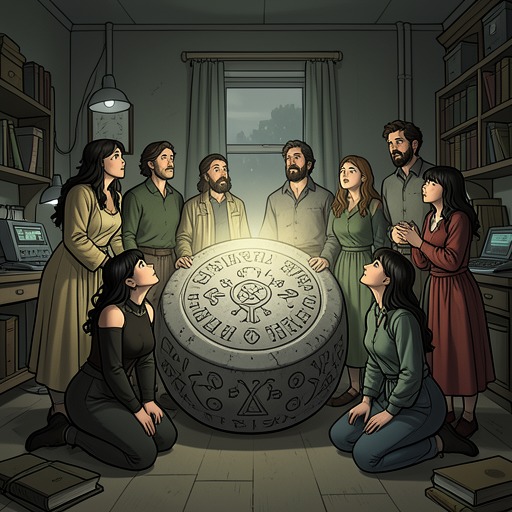
The title becomes especially resonant when Joe tries to bring Maggie back after her departure. In desperation, he revives the Cult of the Gazing Star and reproduces the ceremony that originally summoned Magh'rathlak the Observer into this reality. He relies on the entity's surviving notes, recordings, and comments to reconstruct the necessary conditions, including an annual planetary alignment, prescribed chants, props, and devices. The ritual is performed by precisely forty-two robed figures, while the chant associated with the summoning fills the chamber.
Joe's plan reverses the direction of worship. The original cult seeks to draw a cosmic entity into reality for the sake of ending the universe; Joe uses the same apparatus to draw Maggie back to himself. He recruits his father and friends, along with desperate, disturbed, manipulable, or dangerously foolish strangers, and admits that exploiting them is morally wrong. Nevertheless, he decides that Maggie's return would justify the abuse. Pale Goddess consequently links celebrity devotion to intimate desperation: the public's worship is involuntary from Maggie's perspective, while Joe consciously reconstructs a cult because ordinary means cannot restore the person he loves.
The expression's central irony is that Maggie is both the object and the critic of worship. Her beauty and otherness encourage the title, her publicity magnifies it, and her supernatural history supplies imagery that makes divine language seem plausible. Yet she neither seeks the movement nor benefits cleanly from it; instead, the unauthorized devotion jeopardizes her contract and destabilizes her relationship with the human world. Pale Goddess is therefore a compact name for the story's recurring collision between appearance and essence, fandom and faith, and personal affection and collective possession.