Post-Scarcity Unemployed Society
The Stars Have EyesPost-Scarcity Unemployed Society describes the social order in which most citizens no longer need conventional employment to obtain food, water, clothing, shelter, medicine, or security. Its decisive contradiction is that material abundance has not produced a society without hierarchy or anxiety: employment has become an exceptional status, virtual platforms have become the principal arena of everyday life, and dangerous or punitive labor remains necessary at the system’s industrial margins.
Material Abundance and Social Provision
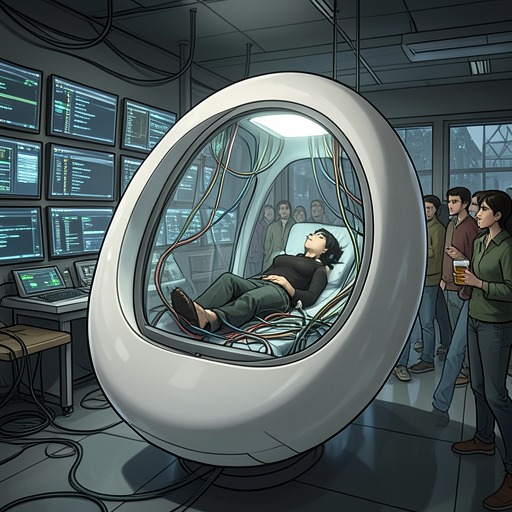
Butterpond-4 supplies the economic foundation for this order through rare minerals and metals processed by an automated workforce into immense profit. The residents of its megacities can therefore live without ordinary worries about basic necessities, a condition that would resemble a utopia were it not for the densely packed living environment. Public provision is concrete rather than rhetorical. Joe Mulligan receives a tiny apartment, a monthly allowance, and a Full Immersion Pod 3,000™; retaining those benefits requires only that he wave at a picture of Eternal God-Queen Mechalizabeth II at least once every twenty-four hours.
The system’s distribution of comfort is nevertheless marked by status. Fewer than 0.1 percent of the population enjoy employment, so anyone with a steady job is treated as a prestigious and important person. Joe lacks that distinction and lives on state provision, while Greg’s employment helped him recruit followers into the Cult of the Gazing Star because work conferred social authority. The contrast makes clear that scarcity has not disappeared altogether. It has shifted from survival goods to recognition, occupation, and the symbolic power attached to being needed.
Virtual Life as the Ordinary Public Sphere
V-Life mitigates the social and psychological problems created by crowded megacities while satisfying the enormous demand for entertainment that emerges once basic needs have been met. Joe spends most of his time connected to the network because, without it, he believes he would have nothing better to do and might begin performing strange rituals simply to introduce novelty into an otherwise empty existence. He does not regard this arrangement as a personal tragedy. His school record labels him “Unemployable,” and he insists that poor aptitude scores did not result from a lack of effort; he simply was not suited to anything important or influential. From his perspective, a worry-free life with virtual interaction and amusement is a good bargain.
The platform also turns private aspiration into mass cultural production. People can pursue passions and dreams without risking financial failure, producing millions of amateur performances. Most are poor, while the few hidden gems are immediately monetized. Joe spends six of his fifty monthly poundingtons on two virtual concert tickets after choosing a performance by Chronal Impact for Maggie, hoping to impress her. His decision shows how V-Life is more than passive escapism: it mediates friendship, courtship, artistic expression, and the limited forms of distinction available to unemployed citizens.
The network’s abundance can also become a form of social containment. Joe and his friends train in the competitive space-combat simulation Underwater Yoga Blaster, preparing for a tournament whose lower prizes seem attainable even though they have no realistic chance of winning the championship. Their training feels like work, but it remains voluntary, recreational, and virtual. After what feels like eight days of practice, Joe must observe V-Life’s mandatory eight-hour break for every forty-eight hours of real-world use. The regulation acknowledges that a society organized around immersion still has to discipline bodies that would otherwise remain inside the platform indefinitely.
Work, Automation, and Unequal Necessity
The society’s post-scarcity appearance depends on labor that has not vanished so much as been automated, concentrated, or displaced. On Butterpond-4, automated systems extract and process the wealth that supports the megacities. In space, however, mining and industrial maintenance remain demanding occupations. Barry Mulligan works in deep-space mining under conditions far removed from Joe’s protected civilian life, and the station where he resides provides simple meals, pubs, a casino, and other leisure facilities because workers need comfort and distraction after high-stress shifts.
The station’s canteen serves bread, potatoes, beans, dried fruit, and occasional sausage rather than the nutritionally balanced but flavorless Noot-Goop that sustained Joe for most of his life. The difference is revealing. Automated welfare can optimize survival, but the mining station’s managers recognize that morale affects performance and therefore provide texture, flavor, and recreation as part of the labor environment. Scarcity and abundance coexist according to location: the megacity citizen is materially protected but socially idle, while the miner receives basic hospitality because his dangerous work remains indispensable.
Barry’s history exposes another weakness in the system: responsibility can be transferred downward until individual workers absorb institutional risk. He repeatedly covered colleagues’ shifts, accepted more duties than he could safely perform, and improvised shortcuts such as stacking crates improperly or placing ore in containers without checking them. His desire not to disappoint others gradually became a mechanism through which other people’s laziness and incompetence were loaded onto him. When unrefined magnesium was mixed with tungsten ore and sent into a smelting furnace, the resulting explosion injured several people and caused millions of poundingtons in damage. Barry was convicted of fifteen counts of gross negligence and sentenced to thirty years of hard labor. The post-scarcity state thus contains a punitive labor regime in which abundance for the majority does not protect workers from catastrophic consequences or prolonged coercion.
Institutions, Risk, and the Limits of the Utopia
The social order is also sustained by institutions that manage dangers produced by its own infrastructure. The Supernatural Eviction Agency monitors Magh'rathlak the Observer, a Class-3 cosmic entity living in human form in the hyper-dense megacity Dave-156. A direct confrontation could kill tens of thousands of civilians and cause millions of poundingtons in property damage, so the Agency tolerates the entity’s presence while it gathers information, provided it does not become an immediate threat. The abundance of the city makes mass casualties and property loss administratively calculable, but the density of the population makes intervention extraordinarily expensive.
Interstellar infrastructure reveals a similar contradiction. Breach events have increased in frequency and severity for roughly three hundred years, especially in heavily populated systems. Maggie identifies the cause as the wormhole generators, whose energy output is sufficient to create and sustain an artificial black hole while generating a counter-gravitational field. The shielding around the generator on the ICF-M42 Trafalgar is so extensive that it blocks even Maggie’s ability to see through solid matter and might be connected to the lasting damage inflicted on reality. The society’s prosperity and mobility therefore rely on machines whose hidden hazards are borne by bodies, cities, and the structure of reality itself.
Political ideology further shapes which technologies are permitted. The 3rd British Empire outlaws and reviles synthetic life, while the Mostly United Republic of Inter-Cosmic America embraces artificial intelligence. Both belong to the Federation of Allied Governments, but their rivalry prevents the open exchange of potentially catastrophic technical knowledge. Post-scarcity provision is consequently not a neutral economic condition; it is organized through competing states, incompatible doctrines, and infrastructure whose benefits and risks are distributed unevenly.
Narrative Significance
Post-Scarcity Unemployed Society provides the setting’s central social irony. It frees most people from hunger and financial desperation, yet leaves them searching for stimulation, prestige, and purpose. V-Life supplies an apparently limitless answer through entertainment, but its algorithmic abundance also turns attention into the chief object of organization: performances are sorted by popularity, amateur creativity is produced at industrial scale, and exceptional work is rapidly converted into a commodity.
Joe’s contentment offers the society its most humane defense. He does not pretend to be talented, ambitious, or destined for impact; he values safety, companionship, jokes, and accessible pleasure. His position contrasts with Sarah Johanson, who prefers dangerous military service to spending every day in a virtual pod, and with Maggie, whose vast intellect initially treats human art and music as incomprehensible before gradually learning to appreciate them. Through these contrasts, the society appears neither simply dystopian nor genuinely utopian. It has solved material deprivation while leaving meaning unresolved, and it has made work optional for most citizens without making labor, punishment, status, or danger disappear.