Puppers
The Stars Have EyesPuppers are genetically modified canine-derived companion animals whose near-mythical status in mega-city Dave-156 turns an ordinary pet into an object of prolonged investigation. Their friendly appearance and demanding material needs expose the economic and spatial limits of the setting, while Maggie’s unsuccessful attempt to find one redirects her toward other animals and eventually toward Azgod’Kalar. The creature is therefore important less as a character that appears directly than as a recurring absence: a promised form of companionship that remains just beyond reach.
Definition and Appearance
Puppers are described as quadrupedal mammals descended from the canine species represented in Joe Mulligan’s games. Their recognizable traits include soft fur, floppy ears, a cold nose, an expressive tail, and a generally friendly nature. Edith Mandrake’s emotional response to seeing one on her way to the museum establishes the animal’s immediate appeal: she found it so cute that her eyes watered. For Maggie, however, cuteness is initially a classification problem rather than an automatic emotional response. She infers from Edith’s context that “pupper” probably means an animal, likely a pet, and treats that inference as the first clue in a self-directed inquiry.
The animals are uncommon because they are expensive and difficult to maintain. Ownership requires permits as well as continuing upkeep, and only people with employment can generally afford them. Their scarcity is therefore not simply biological. It is produced by a society in which animals have become regulated, costly companions, separated from the daily environment of most urban residents.
Maggie’s Investigation
Maggie refuses to obtain an instant answer through online articles because solving an unknown through direct inquiry is part of her pleasure. She questions random pedestrians in Dave-156, despite the fact that the people she approaches are surprised that someone so striking would ask about information that ought to be common knowledge. After approximately forty hours and nearly five hundred interviews, she learns that an exotic pet shop supposedly has puppers in stock. The shop is roughly eighty kilometers away, in another part of the mega-city, too distant for Maggie to leave Joe Mulligan without compromising her proximity to him.
This failure changes the direction of her search rather than ending it. Maggie learns that pet shops exist and begins looking for one within five kilometers of Joe’s apartment. Her inquiries reveal how thoroughly the city has been detached from animal life. Food stalls cannot explain where their meat comes from because they are operated by androids that imitate human behavior without free will or responses beyond their programming. The absence of a nearby shop becomes part of a larger ecological puzzle: even before the later train journey, Puppers mark how little living fauna remains in the urban landscape.
Rarity, Space, and Urban Life
When Maggie reaches a local establishment, she finds eight small animals for sale: a snow-white rabbit, an orange miniature giant space hamster, a baby hedgehog, a black gecko with yellow spots, a golden-and-brown snake, a vivid blue-and-yellow tarantula, a colorful parrot, and an over-excited budgie. Her analysis concludes that the selection would appeal to most humans, with the hamster ranking as the cutest by her scientific assessment. Yet the shop has no Puppers. The owner explains that they are high-maintenance animals unsuited to common apartments and too large for the shop to sell.
The decisive limitation is physical space. Some Puppers can grow as large as a person and need substantial real-world exercise to remain healthy. A standard four-by-five room cannot provide adequate care, so a permit to raise one there would not be granted. The smaller animals in the shop can instead be kept in cages or terrariums occupying very little room. The contrast makes Puppers a measure of the city’s priorities: urban housing accommodates creatures that can be contained, while an animal requiring room, movement, and sustained attention becomes effectively inaccessible.
Maggie later notices that a larger residence would be suitable for a Pupper and points out that the home would give Azgod’Kalar room to run and play, adding the qualification that she is unsure whether snakes run. Joe Mulligan answers that they should handle one thing at a time. The exchange preserves the animal as a continuing possibility, but it also shows that the practical conditions for keeping one have not yet been met.
Ecological and Ethical Context
The scarcity of Puppers connects to the broader devastation of the world outside civilization. During the supersonic train journey between Dave-156 and Dave-157, Maggie discovers that the wilderness is a dull, nearly lifeless wasteland. Mobile mining rigs have carved canyon-like wounds into the terrain, and industrial colonization appears to have driven away or killed much of the indigenous flora and fauna. Puppers are not presented as wild survivors of that environment; they are costly, permitted, selectively bred companions maintained within a technological society that has otherwise made animal life difficult to encounter.
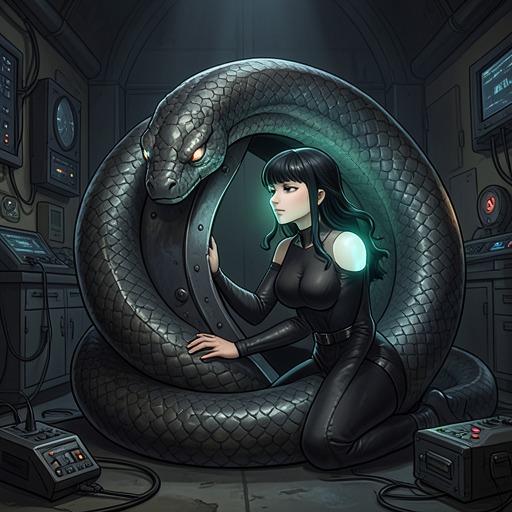
The setting also distinguishes Puppers from the smaller creatures that Maggie can acquire. Azgod’Kalar is an orb python, a genetic offshoot bred to be smaller and more docile for the space-faring human population. Such animals were altered through Project BFF after humans repeatedly adopted dangerous extraterrestrial life merely because it looked appealing. The comparison reveals a continuum of animal commodification: Puppers are desirable but too demanding for ordinary apartments, while other species are redesigned until they fit the available cages, terrariums, and domestic expectations.
Narrative Significance
Puppers function as a delayed and displaced object of desire. Maggie begins by investigating them as an unknown species, but the search teaches her about class, employment, permits, apartment design, automation, and ecological loss. The animal she hoped to study never becomes available; instead, the investigation leads her to the pet shop and to Azgod’Kalar, whose presence becomes far more consequential. That substitution is significant because Maggie’s relationship with the snake develops through observation, training, protection, and attachment.
Azgod’Kalar can imitate Maggie’s thumbs-up gesture by coiling and raising the tip of its tail, and Maggie later reveals that she has granted the snake perpetual youth. Those facts make the small reptile an individualized companion rather than merely a replacement purchase, even though its existence begins within Maggie’s attempt to understand animals. Puppers remain the absent standard against which the available pets are measured: larger, more demanding, and more fully associated with ordinary human companionship, yet excluded from the cramped and economically stratified world that Maggie is trying to decode.