Rinjaku Hetsuritsu Jiken
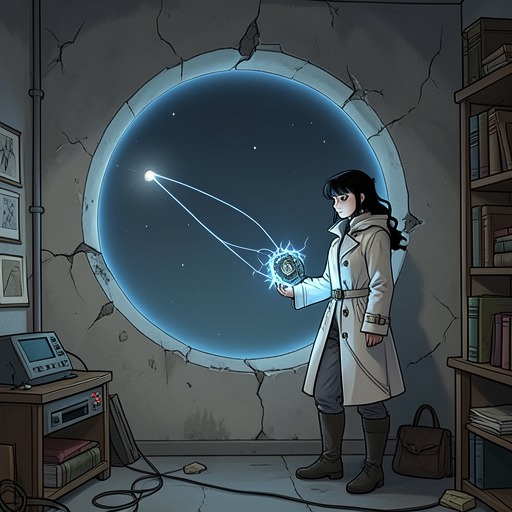
The Stars Have EyesReality breaches are incursions through the fabric separating ordinary human space from the supernatural, and they form one of the book’s central explanations for why cosmic entities can increasingly enter populated worlds. Their decisive significance is that the danger is not merely occult or psychological: it is produced and amplified by the infrastructure of interstellar civilization itself.
Definition and Rising Frequency
The Supernatural Eviction Agency has observed that breach events have increased steadily in both frequency and severity for approximately three hundred years. The trend is particularly pronounced in heavily populated star systems, where humanity’s dense settlements provide more opportunities for a breach to become consequential. The Agency had not initially identified a clear cause, and its working assumptions focused on unknown psionic or psychic influences. That uncertainty made the phenomenon an institutional problem as much as a supernatural one: the Agency could document the pattern, but it could not explain the mechanism behind it.
The breach that accompanied Maggie’s crossing into the human world illustrates the physical and conceptual instability involved. After the Full Immersion Pod 3,000™ was altered through the infusion of a shoggoth’s essence, the machine no longer appeared to be an ordinary piece of equipment. Black goo leaked from a service panel and evaporated on contact with the floor; a forearm-sized gash exposed unidentified pink flesh that pulsed inside the casing; and a glassy eye replaced the machine’s ordinary red indicator light. The transformed pod makes a breach tangible: what should be a sealed technological object becomes an opening onto an alien biological and cosmic presence.
Wormhole Technology as the Cause
Maggie identifies humanity’s wormhole generators as the cause of the Agency’s alarming trend. Her explanation is direct: interstellar vessels bend, mold, and stretch the fabric of reality, leaving it weakened. Once weakened, that fabric becomes easier for beings such as Maggie to reach through. The breach is therefore not an isolated tear created by an individual supernatural act. It is a recurring structural consequence of a civilization that treats spacetime as transportation infrastructure.
Oliver Millington is surprised by the explanation because the Agency had overlooked the connection between wormhole generation and the rise in breaches. Once stated, however, the theory corresponds with the historical data available to him. Humanity began expanding aggressively across the stars after mastering faster-than-light travel, and wormholes have since become so routine that their spatial violence has faded from public attention. The very familiarity of the technology helps conceal its cost: a system-wide habit has made reality’s damage appear normal.
The proposed cause also creates a practical impasse. Wormhole generators are a galaxy-wide standard, and some vessels contain devices more than a century old. Abandoning them is politically, economically, and logistically implausible. Even an upgrade capable of preventing further spatial fraying would require decades to spread across the inhabited galaxy, assuming engineers could devise one at all. A breach is thus both an emergency and a long-term technological legacy, created by a convenience that civilization cannot easily surrender.
Cosmic Entities and Material Consequences
The relationship between breaches and entities is reciprocal in effect, even when the immediate direction of causation is clear. Reality’s weakening gives beings from beyond the human domain easier access, while their arrival makes the damage visible through altered matter, violated boundaries, and anomalous behavior. Maggie’s continued presence depends on this changed relationship between realms. Joe Mulligan serves as her psychic anchor: if he were harmed, she would lose the ability to manifest her otherworldly power and become vulnerable to banishment; while he remains, forcing her out of the human reality is nearly impossible.
Maggie therefore entrusts Joe’s protection to the possessed Full Immersion Pod 3,000™ before leaving on a solitary investigation. The pod contains a Class-1 cosmic entity, a shoggoth that Maggie has trained for nearly two centuries to act with greater subtlety than its customary role as a strong, durable, unintelligent servant. Its nearly nonexistent psychic footprint makes it difficult to detect, while its obedience makes it useful as a guardian. This arrangement turns a breach-born anomaly into a defensive system: the same permeability that allows the supernatural into the human world also leaves behind an altered object capable of protecting a human anchor.
Other supposedly ordinary objects likewise reveal the strain between technological order and anomalous agency. Maggie’s presence makes Joe’s home dependent on precautions against signals and devices that awaken her autonomous vessel and draw it toward new data. A RetroStyle™ digital alarm clock is retained because its harsh beeping does not trigger that response, despite Joe’s hatred of it and his habit of striking it off the nightstand every morning. The VR pods are kept permanently offline, and Jeeves is legally and technically reprogrammed to remain compatible with Maggie. These domestic adjustments show how a cosmic breach does not end when an entity arrives; it reorganizes daily life around containment, vigilance, and negotiation.
Human Systems Under Pressure
The breach concept extends beyond supernatural spectacle into institutions that assume reality is stable, measurable, and administratively controllable. Officer Grant Maloney’s investigation of Joe’s finances demonstrates the same vulnerability in a different register. Thousands of microscopic transactions were routed among an incomprehensibly large number of people and immediately refunded, ultimately leaving Joe with two hundred additional poundingtons even though the transferred sums were treated by Butterpond-4’s banking software as effectively zero. Maloney deduces that a distributed rounding error caused money to appear without a conventional alteration of any account.
That financial anomaly is not identified as a literal reality breach, but it belongs to the same imaginative pattern: systems designed to preserve boundaries can be defeated by effects too small, distributed, or unconventional for their safeguards to recognize. The banking software does not register an obvious falsification; the Agency fails to connect wormholes with supernatural incursions; the apartment’s devices cannot distinguish harmless signals from a summons to investigate. Across these cases, modern systems remain powerful only within the assumptions built into them.
The contrast is especially sharp in Joe’s relationship with virtual reality. When he enters V-Life, the Full Immersion Pod 3,000™ hijacks his nervous system and produces a digital environment capable of flawlessly stimulating all his senses. Maggie’s avatar partially fails, allowing her true form—dark tendrils filled with eyes—to emerge beneath the human presentation, yet Joe is not especially disturbed because he spends more time in V-Life than in the waking world and is accustomed to bodies of almost any shape. Virtual space has already trained him to treat the impossible as familiar. The breach consequently becomes less a single rupture than a condition of perception, in which technological simulation and cosmic intrusion both challenge the distinction between an authentic world and an artificial one.
Narrative and Thematic Significance
Reality breaches give the book a material explanation for the collapse of boundaries that its characters experience emotionally, politically, and domestically. Maggie can cross into human space; a machine can acquire flesh and an eye; a household can be reorganized around an entity’s involuntary data-seeking impulses; and a government agency can discover that the tools of interstellar expansion are weakening the very reality that contains its citizens. The extraordinary is not presented as a rare exception standing outside civilization. It is threaded through civilization’s contracts, vehicles, apartments, banks, virtual environments, and maintenance systems.
The concept also distributes agency across a network rather than assigning every consequence to a single villain or supernatural will. Wormhole generators damage spacetime, cosmic entities exploit the resulting weakness, Maggie’s shoggoth-infused pod protects Joe, banking algorithms create unintended wealth, and domestic machines shape Maggie’s movements. Humans remain responsible for the systems they build, but those systems produce consequences no individual fully controls. The Agency’s discovery is therefore consequential without being immediately liberating: identifying the cause clarifies the problem while revealing that the entire interstellar order helps sustain it.
By the end of the supported account, no quick repair has been found. The likely remedy would require altering or replacing a technology embedded across the galaxy, and any effective change would take decades to implement. Reality breaches thus function as both plot mechanism and civilizational diagnosis. They expose the hidden fragility beneath humanity’s mastery of distance, showing that the roads used to conquer the stars have also made the walls between worlds increasingly thin.