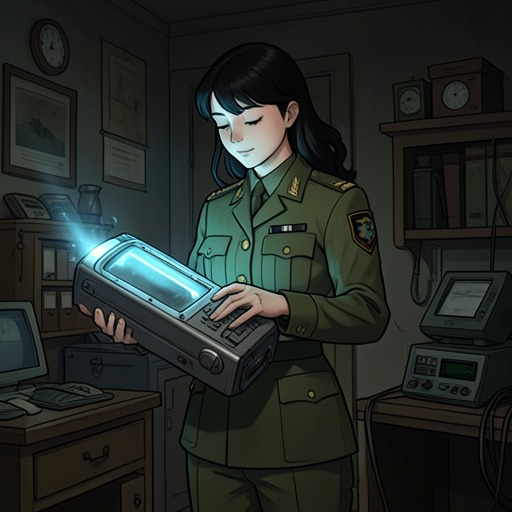
Sarah Johanson
The Stars Have EyesSarah Johanson, also called Agent Johanson or AJ, is a psionic soldier of the 3rd British Empire whose importance lies in the contrast between coerced service and genuine mastery. Initially presented as a tightly controlled operative assigned to monitor Magh'rathlak the Observer’s human vessel, she gradually becomes a more capable and more emotionally integrated force. Her arc is marked by physical cost, professional frustration, reluctant attachment, and a decisive expansion of her abilities: she learns to turn positive feeling into telekinetic power and eventually strikes with force powerful enough to send a Class-3 entity through a concrete wall.
Identity and Military Condition
Psionic Agent 2nd Grade Sarah Johanson is a career soldier because the 3rd British Empire gives people with significant psionic potential a choice between military enrollment and lobotomy, with desertion punishable by remotely frying the brain through implanted technology. Her service is therefore not simply a profession or a personal calling. It is a state-enforced condition that places her body, mind, and exceptional abilities under permanent institutional control. The rank later attached to her name, Psionic Agent 1st Grade Sarah Johanson, signals advancement, but it does not erase the coercive structure that produced her career.
Her work nevertheless carries real responsibility. After Sarah and her team failed to contain Magh'rathlak the Observer several weeks earlier, she was assigned to monitor the entity as it adopted human form and attempted to integrate into Dave-156. The assignment was unusually dangerous because the subject lived primarily inside a hyper-scraper packed with civilians. A direct confrontation was projected to kill tens of thousands of people and cause millions of poundingtons in property damage. Sarah’s frustration comes from being armed with extraordinary powers while being unable to use them freely: containment is constrained not by lack of force, but by the scale of collateral harm.
Surveillance, Overload, and First Encounters
Sarah’s surveillance of Maggie turns professional observation into a confrontation with the unknowable. The Agency has almost no reliable intelligence on Magh'rathlak the Observer, having learned of it only after receiving a tip about the Cult of the Gazing Star. The researchers’ discoveries fit on a single page of a report, leaving Sarah to watch a cosmic entity whose origins, capacities, and intentions remain largely obscure. During one live feed, she sees Maggie rise deliberately while the men at the table fail to react. Maggie then turns toward the security camera and looks directly into it with eyes described as bottomless pits. The scene makes surveillance reciprocal: Sarah is not merely watching the target; the target appears to recognize the watcher.
Her psionic sensitivity has a severe bodily price. After a mission in which the team finds no additional targets and briefly celebrates with fist-bumps, high-fives, down-lows, and too-slows, Sarah is the lone member unable to join the festivities because she is vomiting in a corner. Blood is not the cause, and neither is the suspicious mega-burrito from lunch. The episode is an overload, and her usual recovery time ranges from several minutes to several hours depending on its severity. Even her typical splitting headache, which normally fades after several breaths, instead continues worsening until she clutches her forehead and winces. Her power is therefore never presented as effortless competence; it is an ability that can overwhelm its wielder.
Sarah’s military presence also creates immediate visual pressure. When officers arrive at Maggie’s location, she appears in military fatigues, heavily armed, and salutes the others. Later, she enters a breached chamber in the same institutional mode, standing at the front while her squad takes cover. The contrast between her formal discipline and the panic surrounding Class-3 entities emphasizes how little ordinary military procedure can contain the forces she is ordered to confront.
Conflict, Care, and Uneasy Cooperation
Sarah’s relationship with Maggie is defined by fear, resistance, and repeated exposure rather than uncomplicated trust. When Maggie gestures minimally, Sarah is slammed against a wall by an invisible force, losing the air from her lungs as pressure makes breathing difficult. The violence confirms the danger Sarah has been trying to manage, but it also exposes the mismatch between institutional expectations and the entity’s actual power. In another encounter, Maggie’s cold smile causes two troopers to recoil and clutch their heads as though struck by a deafening, bone-shaking screech. Sarah had previously reacted to Maggie’s presence with cringing, jerking movements, eye twitches, and headaches, but her symptoms had been far less pronounced than those of the strangers. Joe consequently recognizes that Sarah has become unusually capable of enduring Maggie’s psychic presence.
That endurance is not the same as acceptance. Sarah can be bored by her assignment, angered by the Agency’s restrictions, and openly suspicious of the entity while still occupying a role that repeatedly brings her into Maggie’s orbit. Her distrust is made explicit when another character presses the question of whether she does not trust him. The moment belongs to a broader pattern in which every alliance around Maggie is tested by unequal information and overwhelming power. Sarah’s position is especially unstable: she is both guardian of public safety and an agent of the institution that seeks to control the being she is observing.
Yet Maggie is not only a threat to Sarah. After a violent psychic episode, Sarah’s strain rapidly diminishes, and she awakens with her head resting on Maggie’s thighs. Maggie strokes her forehead, holds the top of her skull, and smiles kindly while a warm un-light radiates from her swirling eyes. The scene does not cancel the danger of their earlier confrontations; instead, it makes their connection harder to classify. Maggie can injure Sarah, overload her, soothe her, and perhaps understand her in ways the military institution does not. Their relationship therefore moves between containment, vulnerability, and an improvised form of care.
Sarah also becomes protective of people connected to Maggie. When Maggie disparages Grant, Sarah suddenly enters the room and orders her to stop bad-mouthing Grant. The intervention shows that her loyalties are not reducible to military obedience or anti-entity hostility. She is willing to confront cosmic power on behalf of an ordinary personal bond, even while her own history has taught her to treat uncontrolled psionics as a public danger.
Growth into the Mags-Burst
Sarah’s strongest development occurs during the later assault involving Kelly, an unexpected and unknown Class-3 entity. Kelly stops dislodged bulkheads in midair with a toothy grin and sends the steel back toward the entrance. Sarah responds by snapping the damaged doors in half, standing in front of her squad with her gaze fixed on the new threat. This is not the exhausted operative who vomits after an overload or clutches her head while waiting for psychic pain to subside. She is now a first-grade psionic agent able to act decisively under extreme pressure.
Without hesitation, Sarah throws a fist forward. A surge of telekinetic force beyond Kelly’s expectations breaks through the entity’s defenses and sends the blonde flying through the concrete wall on the opposite side of the chamber. The blast is described as powerful enough that even Maggie would struggle to repel it. Its importance lies not only in magnitude but in method: Sarah has learned to harness emotion as an amplifier of psionic ability.
The technique is formally known as the Mags-Burst, a name that ties Sarah’s advancement to her difficult relationship with Maggie. Earlier, Sarah relied primarily on negative emotions, which made her power dangerous and costly but also trapped it within the emotional economy of fear, pain, and anger. By this point she has learned to draw on positive feelings as well. The attack on Kelly is explicitly an example of that change: the force comes from an emotional resource Sarah was previously unable, or perhaps unwilling, to use. Her mastery is thus both tactical and psychological. She does not become powerful by eliminating feeling; she becomes powerful by broadening what feeling can do.
Narrative Role and Significance
Sarah embodies the story’s tension between autonomy and external control. The 3rd British Empire treats psionic citizens as hazards to be conscripted, restrained, or destroyed, yet Sarah’s greatest achievement emerges when she develops an internally directed command of her emotions. Her competence is born inside the same system that denies her meaningful choice, making her progress neither a simple liberation nor a simple success story. The military gives her training and a structure for action, but it is her evolving relation to fear, pain, affection, and responsibility that allows her abilities to mature.
Her position also supplies a human-scale counterpoint to Magh'rathlak the Observer. Maggie represents an entity whose power exceeds ordinary categories, while Sarah represents a human mind and body forced to meet that power through surveillance, discipline, and adaptation. The contrast is visible in their encounters: Maggie’s presence can make soldiers clutch their heads, but Sarah learns to withstand it; Maggie can treat a human body with unnerving tenderness, but Sarah remains alert to the danger; Maggie’s cosmic force is innate, while Sarah’s later strength is cultivated through arduous emotional integration.
By the time Sarah confronts Kelly, she has become more than a functionary assigned to monitor a cosmic anomaly. Her promotion, tactical decisiveness, protective interventions, and Mags-Burst all establish a character who converts imposed service into chosen competence without escaping the contradictions of her world. The formerly overloaded operative who could barely participate in a team celebration becomes the soldier capable of launching a Class-3 entity through a wall. That transformation gives Sarah Johanson a distinctive narrative role: she is proof that constrained agency can still grow, and that emotional connection—especially the dangerous connection represented by Maggie—can become not merely a vulnerability but a source of extraordinary power.