Shoggoths
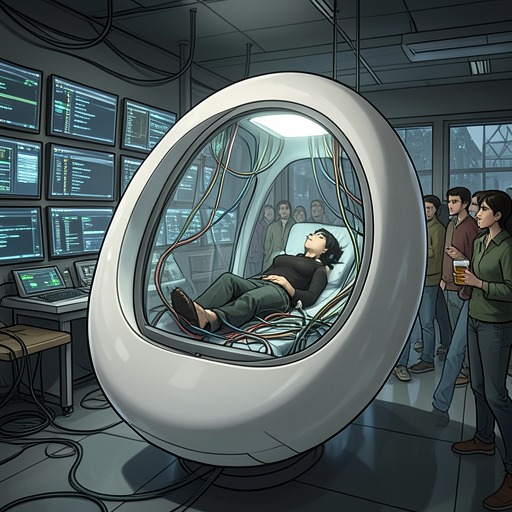
The Stars Have EyesShoggoths are the book’s most striking example of a nonhuman being reduced to a tool and then made impossible to regard as merely a tool. Maggie keeps one as a familiar, binds it into Joe Mulligan’s Full Immersion Pod 3,000™, and programs it to protect him. Its defining traits are immense strength, extraordinary durability, and an intellect so limited that its psychic presence is nearly imperceptible and its obedience is comparatively easy to secure. Yet the creature’s actions repeatedly exceed the status of inert equipment: it learns, reacts, pursues protective directives, and becomes a living force capable of transforming an ordinary domestic machine into a biomechanical guardian.
Nature and Training
Shoggoths are identified as Class-1 cosmic entities whose physical power and resilience make them effective laborers or combatants, while their “doornail-level intellect” makes them unusually manageable. The wider cosmic order commonly uses them as grunts or slaves, but Maggie has spent nearly two centuries training her own familiar to become more subtle than its species’ usual reputation suggests. The training remains imperfect, yet it has been sufficient for her purposes: the familiar can remain concealed within the pod, obey complex protective instructions, and avoid attacking merely because a situation appears superficially threatening.
That mixture of overwhelming body and restricted cognition produces an important ambiguity. Maggie does not describe the familiar as a person deserving a name; when Joe asks whether the living pod has one, she says it is not worthy of carrying one. At the same time, the familiar is not disposable in practical terms. Maggie has invested centuries in refining its behavior, and its strength is dedicated to preserving Joe’s safety. The creature is therefore positioned between an enslaved cosmic species and a meticulously maintained companion organism, with Maggie’s control preventing any easy distinction between care, ownership, and exploitation.
The Possessed Pod
Maggie infuses Joe’s Full Immersion Pod 3,000™ with the essence of her shoggoth when she needs to leave Joe alone. Because Joe is her psychic anchor, his injury would weaken her ability to manifest and could ultimately make her vulnerable to expulsion from reality. The possessed pod is her answer to that vulnerability: it is intended to buy enough time for her to return if Joe is attacked, while allowing her to pursue her own investigations away from the apartment.
The transformation is initially almost invisible. The machine continues to open its glass door and attach its small mechanical collar to Joe, but its altered interior includes a fleshy bulge that presses against his lower back like an orthopedic support. Its true nature becomes apparent only when the pod erupts from the apartment wall as a part-machine, part-shoggoth monstrosity. Tentacles thrust from its plastic shell, propelling the creature forward like a grotesque crab, while a single unblinking eye fixes on the person who appears to be endangering Joe. The familiar’s hidden presence thus turns a familiar domestic convenience into a body with its own interpretation of danger.
Joe’s friends discover the consequences when AJ holds Joe in a headlock. The pod senses that the person under its protection is in a fight and bursts into the room to rescue him. Its intervention is not malicious in the ordinary human sense, but its instructions are powerful enough to make a misunderstanding lethal. The creature’s arrival forces Joe to place himself between it and his friends, trusting that Maggie’s conditioning will make it stop once it recognizes that no genuine harm or hostile intent is present.
Combat Behavior and Control
When Agent Sarah Johanson responds as a trained psi-ops operative, the domestic crisis becomes a full confrontation. She fires three sky-blue bolts of superheated plasma into the creature, melting metal, plastic, flesh, and furniture, but the shoggoth absorbs the attack and continues its charge. Additional blasts fail to halt it, and telekinetic force only throws it against a wall. The familiar then demonstrates a surprising degree of tactical intelligence by tearing up what remains of an armchair and hurling it as a weapon.
The encounter shows both sides of the species’ characterization. The shoggoth is durable enough to shrug off energy attacks and strong enough to turn furniture into ammunition, but it is also governed by external programming rather than an independently explained moral judgment. Its violence follows a protective directive. Maggie’s control is what keeps that directive from becoming indiscriminate slaughter: she previously prevented it from doing anything unsightly when Officer Grant Maloney arrived, and she insists that the creature has been trained to obey her in all things and to defend Joe with all the strength and ferocity it can muster.
Maggie finally ends the confrontation while still half asleep. She floats into the damaged room, freezes the shoggoth in place, and orders it back to its position in the games room. Her immediate response is not to destroy or punish it, but to recognize a programming fault and decide that the shoggoth’s behavior must be adjusted. The ruined furniture and shattered wall make the danger concrete, while her calm correction reveals that the familiar is treated as a system requiring maintenance as much as a creature requiring restraint.
Relations to Other Creatures and Humans
The shoggoth is contrasted with the other animals Maggie encounters on Butterpond-4. A pet shop offers eight creatures, including mammals, reptiles, a tarantula, and birds, all selected as affordable companions. Maggie evaluates them scientifically, deciding that the miniature giant space hamster is the cutest, while the shoggoth is absent from the marketplace because its physical and cosmic nature places it outside ordinary pet commerce. Nevertheless, both kinds of creatures are shaped by human and posthuman systems of domestication.
The contrast becomes sharper beside Azgod’Kalar, Maggie’s small orb python. The snake is genetically modified to be smaller and more docile for space-faring humans, and its species has had much of its natural ferocity surgically removed. Maggie nevertheless trains Azgod’Kalar to imitate gestures, including a snake-shaped version of a thumbs-up, and later grants it perpetual youth. The shoggoth receives a different form of domestication: rather than genetic redesign or affectionate trick training, it is molded through psychic control and centuries of disciplined instruction. Both animals reveal Maggie’s tendency to make nonhuman life answer to human-scale companionship, protection, and experimentation, but the shoggoth makes the ethical violence of that process far harder to ignore.
The creature also exposes the limits of Joe’s understanding. He recognizes shoggoths from the survival-horror game Crucible of the Dead God 2: Eclectic Boogaloo and worries that Maggie’s familiar might eat him. Maggie reassures him that it is “a good boy,” using air quotes to indicate that the words are not literal; Joe points out that the gesture is inappropriate, since a shoggoth is neither morally good nor biologically male. The exchange is comic, but it also establishes the problem at the center of the creature’s role. Human language forces the familiar into categories such as pet, boy, and good creature even when its actual nature is alien, genderless, and governed by obedience rather than morality.
Narrative Significance
The shoggoth gives physical form to the protective logic of Maggie and Joe’s relationship. Maggie’s promise is to bind herself to Joe, guard and nurture his fragile being, and rely on him as her guide and anchor. The possessed pod translates that promise into an autonomous defense mechanism. Protection becomes something with tentacles, an eye, and enough force to melt through a room; care is therefore never separable from danger when the protector is a cosmic entity.
Its recurring appearances also reverse the usual boundary between machine and animal. The pod looks like consumer technology until its organic interior and shoggoth essence become visible, after which it behaves like a trained beast while retaining the shell and functions of a machine. The result is not simply a monster hiding in a device, but a hybrid guardian whose identity depends on the connection between technology, alien biology, and psychic command. The familiar’s supposedly negligible intelligence does not make it narratively insignificant. On the contrary, its limited but forceful responsiveness makes every command consequential.
Finally, the shoggoth’s treatment illuminates Maggie’s uneven ethics. She regards the familiar as lacking enough sentimental value to serve as a suitable subject for her fear-of-loss experiment, while Azgod’Kalar qualifies because she has developed an attachment to the snake. Yet she also devotes centuries to training the shoggoth, equips it to protect Joe, and intervenes when its programming causes collateral damage. The creature is thus both dismissed as emotionally replaceable and relied upon as an irreplaceable safeguard. That contradiction is the shoggoth’s lasting significance: it is a living weapon presented through domestic routines, a slave-like familiar made companion-shaped, and an apparently mindless monster whose enforced loyalty becomes one of the clearest material expressions of attachment in the story.