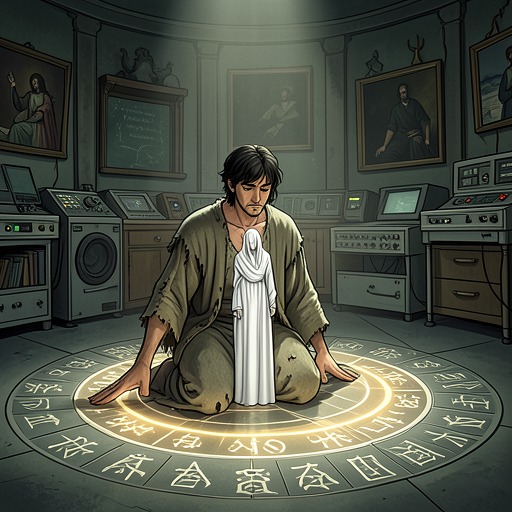
The Cult of the Gazing Star Summoning
The Stars Have EyesThe Cult of the Gazing Star Summoning is Joe Mulligan’s desperate effort to recover Maggie after her prolonged absence. It deliberately reproduces the ceremony that first brought Magh'rathlak the Observer into reality, but its emotional center is no longer apocalyptic worship: it is Joe’s refusal to accept separation. The ritual transforms his loneliness into an organized supernatural incident, drawing in his father, friends, recruited cultists, and an armed Agency team while placing an unknown entity at the threshold of manifestation.
Causes and Background
The summoning arises from a private crisis that has lasted over five years. The date marks six years since Joe first met Maggie, and the anniversary has become a source of crushing loneliness rather than celebration. He has continued caring for Maggie’s human vessel as though it were a person, providing food, rest, companionship, and occasional dates while refusing to treat the body as a substitute for the woman he loves. His patience is therefore not passive acceptance. It is an extended act of loyalty, shadowed by the fear that Maggie may not return until he is old or dead.
Joe’s plan is consequently an act of agency born from helplessness. If Maggie cannot come back to him, he reasons, he may be able to draw her out himself. He revives the Cult of the Gazing Star and reconstructs the ceremony used to summon Magh'rathlak the Observer into reality. The attempt depends on materials left behind by the entity, including notes, recordings, and comments. Joe also persuades Maggie’s vessel to transfer that information into digital form, enabling him to learn the exact requirements: an annual planetary alignment, prescribed chants, ritual props, and specialized devices.
The original Cult of the Gazing Star had pursued annihilation as its means of leaving a mark on an uncaring universe. Its members sought to call forth Magh'rathlak the Observer, an obscure Class-3 cosmic entity, through human sacrifice. Joe’s revival preserves the cult’s ritual machinery while redirecting its purpose. He recruits his father and friends, then fills out the gathering with people attracted by vague promises of happiness. The narration openly identifies these recruits as the desperate, mentally disturbed, easily manipulated, and dangerously stupid—the same vulnerable population the earlier cult exploited. Joe recognizes that his recruitment is predatory and feels sorry for those involved, but he accepts the moral cost because Maggie’s return matters more to him than his own innocence.
What Happens
The ceremony takes place in a dark chamber containing precisely forty-two robed figures arranged around a central altar. Their dark red garments carry golden embroidery, and each hood bears the insignia of three vertical eyes arranged in a triangle. The participants repeat the chant “Hoom ge’sore, ihm ge’sara” while Joe lies on the altar. The scene is designed as a precise recurrence of the first summoning: a ritual space, a patterned congregation, a central stone, and a human body placed at the point where ordinary reality may be breached.
Barry Mulligan serves as master of ceremonies, a role Joe entrusts to him above everyone else. As the ritual progresses, the stone beneath Joe’s bare back and buttocks grows hot, indicating that the runes carved into the altar have begun to glow. The signal reassures Joe that the ceremony is working, but it also recalls the danger of the original event. Gunfire approaches through the surrounding complex, announcing that the Supernatural Eviction Agency has discovered the gathering.
The Agency’s intervention creates a conflict between rescue and completion. Its commandos are delayed by automated security, while Barry chooses to continue rather than order the cultists to disperse. He understands that people Joe cares about are inside the chamber, yet he decides not to fail his son. When the steel bulkhead finally buckles under telekinetic force, Joe’s contingency is revealed: Kelly leaps from hiding and stops the dislodged doors in midair before throwing them back toward the entrance. Sarah Johanson then snaps the damaged doors in half, confronting the unexpected Class-3 entity blocking the Agency’s path.
The soldiers’ assumptions are immediately disrupted. They know Magh'rathlak the Observer through Maggie, also known officially as Mags Oh, and they possess the entity’s earlier assurance that it would be temporarily unable to return and would resume cooperation when able. They had allowed Joe to use resources and assets associated with Maggie because the Agency wanted that cooperation preserved. Nevertheless, they did not know Joe was conducting the ritual, and they could not safely assume that the opening would admit Maggie. Another entity might have hijacked the dimensional breach, making intervention necessary even if the intended result seemed harmless.
The ritual reaches its decisive moment when the lead cultist raises a blood-covered arcane sickle and begins proclaiming revelations. Joe’s blood is the offering, but the apparent sacrifice is not what the commandos expect. Joe sits up while still chained and insists that he is unharmed apart from a small cut on his palm. He points to a red spot on the altar beside his left buttock, showing that the blood has touched the stone. The detail forces Sarah to recognize that the ritual may already be complete.
Above the altar, the gathered energy has formed a tiny black sphere about the size of a golf ball. Unlike the earlier manifestation, it does not explode into shadow or emit a mind-rending screech. Its quietness makes the development more ominous rather than less. A single white dot appears at the sphere’s center, resembling the iris of an eye, and the event ends at the instant the summoned presence begins to look back.
Consequences and Aftermath
The Agency arrives expecting to dismantle a revived cult before a dangerous ritual can mature, but the intervention comes too late to prevent the critical activation. Its personnel are left with questions because the ceremony is not simply an attempted return by Maggie. The commandos know that Magh'rathlak the Observer has not communicated its ability or willingness to return, and they have no way to know what other presence might emerge through the dimensional gap. The manifestation of Kelly, whose identity as Kelogh’theryl is still unknown to them, compounds the confusion.
The incident also exposes the limits of institutional knowledge. Earlier Agency research had reduced Magh'rathlak the Observer’s known history to a single page: a first recorded encounter one hundred and fifty years earlier, seven minor incidents involving enthrallment, disintegration, matter manipulation, and mental corruption, and a Class-3 designation. No known record showed the entity using lower-class beings as proxies or serving higher-class entities in that way. The revived ritual therefore forces the Agency to confront a situation its archive does not adequately explain.
Joe’s blood changes the moral and practical stakes of the ceremony. He is not a passive victim in the manner of the original young man bound to the altar; he deliberately places himself in the offering position and treats the ritual as a controlled attempt to contact the woman he loves. Yet his control is limited. The machinery, the planetary alignment, the cult structure, and the dimensional opening belong to a system whose consequences he cannot fully command. His small cut is enough to activate a process that may summon something other than Maggie, confirming that emotional intention does not guarantee supernatural identity.
Narrative Significance
The event is a grotesque mirror of the first summoning. The original Cult of the Gazing Star sought to end the universe so that its members would matter within it; Joe seeks to restore one relationship so that his own continued existence remains bearable. Both motives convert dissatisfaction with ordinary life into ritual action, but Joe’s motive is more intimate and therefore more morally complicated. Love does not make the ceremony safe. It merely gives the dangerous repetition a human face.
The ritual also turns recurrence into a form of resistance against time. Joe has spent six years measuring absence, and the once-a-year planetary alignment gives his grief a fixed, almost sacred date. By repeating the earlier ceremony, he attempts to break the linear force of waiting and return to the moment when Maggie first entered his life. The result is not a clean restoration of the past. The black sphere and its newly opened white eye suggest that repetition can reproduce the doorway without reproducing the original arrival.
Finally, the summoning reveals how personal devotion can become institutional and collective. Joe’s longing recruits forty-two bodies into a ritual formation, persuades Barry to risk another confrontation, and draws the Agency into a major incident. The gathering resembles a religion in its robes, insignia, chant, altar, and promises of happiness, yet its organizing principle is not shared doctrine so much as Joe’s private hope. The ceremony therefore stands at the intersection of cult formation, bureaucratic containment, and intimate grief: a public supernatural crisis created because one man cannot bear to keep waiting alone.