The Pale Goddess Cult Formation
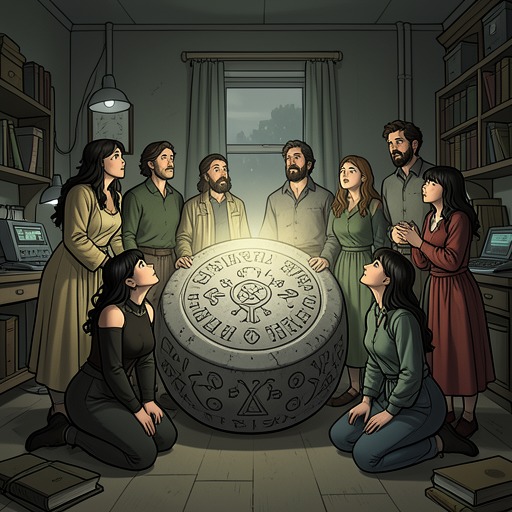
The Stars Have EyesThe Pale Goddess Cult Formation marks the point at which admiration for Maggie ceases to be merely private enthusiasm and becomes a social force with its own name, members, mythology, and capacity for violence. The movement grows from public fascination with Maggie, especially the viral presentation of her Lancaster-3 copyright trial, but its development is also shaped by the Supernatural Eviction Agency’s covert manipulation. Its importance lies in the collision between fan culture and genuine religious organization: Joe calls it a fan club, Maggie treats it as a dangerous cult, and the surrounding institutions respond as though a new political and supernatural threat has emerged.
Origins in Public Fascination
The movement’s immediate popular label is “The Pale Goddess,” a title attached to Maggie by people discussing the trial online. The name is not created through a formal revelation or doctrine. It spreads through the neighborhood message boards after a highlight reel of the Lancaster-3 proceedings becomes viral, reportedly within an hour. Joe initially assumes that Eugene Charles must have produced and distributed the video, since he was the only nearby person with both access to the trial and a plausible reason to circulate it. The rapid spread of the footage turns Maggie’s public appearance into a spectacle and gives strangers a shared image around which to gather.
The audience’s admiration is inseparable from its hostility toward Joe. The message-board discussions praise Maggie as “The Pale Goddess,” but many participants attack Joe as an ordinary, unsuitable boyfriend who supposedly has no right to be with her. Their comments range from contemptuous to malicious, and the self-proclaimed admirers present themselves as more deserving partners. The movement therefore begins with a possessive form of identification: its members do not simply admire Maggie from a distance, but judge her relationship and claim a voice in who may stand beside her.
Maggie’s appearance makes that process even more volatile. Dolores Castlebridge condemns her hair, eyes, skin, and alleged dependence on gene-modifications, insisting that she barely looks human. Maggie rejects the idea that anyone else may determine how her body should appear, asserting that only she and Joe have authority over it. The confrontation exposes the same mechanism later visible in the cult: outsiders convert Maggie’s body into a public object, then treat their interpretation of it as a legitimate basis for control.
From Fan Club to Cult
Joe first learns that the movement has become dangerous when Maggie explains that the men who accosted him outside the elevator belong to it. Seven men around his age, all with similarly unhealthy physiques but far more aggressive demeanors, wait for him after he retrieves Jeeves from maintenance. Their insults and coordinated hostility convert online resentment into physical intimidation. The incident gives the supposed fan club an organized face and demonstrates that its fixation on Maggie has consequences for anyone perceived as standing between her and its members.
Maggie estimates that the group has approximately one hundred and twenty thousand members and is expanding rapidly. That scale changes the meaning of the word “cult.” Joe recognizes that a following of that size could become a religion, while Maggie focuses on the threat posed by its growth. Joe objects that the organization is only a fan club, but the objection is semantic rather than reassuring. The group has already developed a collective identity, a revered figure, an enemy in Joe, and enough members to function as a mass movement.
The formation is also connected to the machinery of publicity. Joe finds dozens of message-board topics, each with hundreds of comments, surrounding the highlight reel. The video itself is less alarming to him than the reaction it generates, because the sheer volume of discussion shows that Maggie’s image has become reproducible and portable. Public attention no longer depends on Maggie’s presence. Once the image circulates, strangers can elaborate it, defend it, and weaponize it without her participation.
Institutional Manipulation and Escalation
The movement’s growth is not entirely spontaneous. Joe, Sarah Johanson, and Maggie eventually determine that the Supernatural Eviction Agency orchestrated the highlight reel and arranged for it to reach the local boards so quickly. Maggie investigates through the eyes appearing within her coiling hair and uncovers the Agency’s efforts to conceal its involvement. The discovery reveals that the cult’s formation is partly the product of an institutional operation rather than a simple grassroots response to a charismatic figure.
The Agency’s motive is connected to Damian Benett’s attempt to exploit a manufactured violation in order to void Maggie’s contract and renegotiate it on more favorable terms. Sarah’s experience working under Oliver Millington allows her to recognize the likely strategy: create a public or contractual problem, use it as leverage, and force a new arrangement. The plan is reckless because it treats Maggie’s public image as an administrative instrument while underestimating the power of a Class-3 cosmic entity. The Agency’s manipulation thus helps create the very mass devotion that makes Maggie harder to govern.
The episode also shows how official labels intensify the danger. Before Maggie’s identity is fully understood, the Agency has almost no intelligence on Magh'rathlak the Observer, despite records of enthrallment, disintegration, matter manipulation, and mental corruption across seven minor incidents. Agent Johanson’s report identifies the entity as Class-3 and notes no known history of using lesser entities as proxies or serving higher-class beings as one. The Agency’s uncertainty encourages containment and surveillance, while the public’s fascination encourages worship. Both responses turn Maggie into a category before they understand her as a person.
Ritual Form and Religious Precedent
The Pale Goddess movement echoes the older Cult of the Gazing Star, though the two formations arise in opposite directions. The Cult of the Gazing Star deliberately seeks to summon Magh'rathlak the Observer and intends to end the universe as a way of leaving its mark upon an uncaring cosmos. Its members rely on desperation, manipulation, ritual repetition, and human sacrifice, binding a young man to a stone altar while chanting “Hoom ge’sore, ihm ge’sara.” A sinister parchment appears as part of the summoning process, and Joe ultimately signs a contract in his own blood after requesting that it be moved within reach of his handcuffed arm.
The later cult formation reverses that pattern. Maggie does not initially seek worshippers, and Joe does not begin with a formal religion in mind. Nevertheless, the fan movement inherits the older cult’s vocabulary of devotion, sacrifice, and dangerous access to the supernatural. The contrast is deliberately comic and unsettling: one organization summons a cosmic entity through an explicit ceremony, while the other develops from a viral video and an argument over who is worthy to date Maggie. Yet both treat an extraordinary being as a means of escaping ordinary insignificance.
This resemblance becomes literal when Joe later revives the Cult of the Gazing Star to summon Maggie back after her departure. He reproduces the original ritual using notes, recordings, and comments left by the entity, while Maggie’s vessel helps transfer those materials to digital form. He learns the required planetary alignment, chants, props, and devices, then gathers precisely forty-two participants in dark red robes embroidered with gold and marked by three vertical eyes arranged in a triangle. The later ceremony demonstrates how quickly the Pale Goddess phenomenon has become entangled with the older ritual tradition: fan devotion provides the social energy, while the Gazing Star supplies the supernatural template.
Consequences and Narrative Significance
The cult formation places Joe in a new and humiliating position. He is not merely Maggie’s partner but the movement’s symbolic obstacle, a plain man whom online admirers believe has usurped a place meant for them. Their resentment becomes sufficiently organized that a group confronts him in person, while Joe’s attempt to dismiss them as “all talk” is immediately disproved by the armed hostility waiting at the elevator. The movement therefore makes his relationship public in the most intrusive way possible and turns intimacy into a matter of collective dispute.
For Maggie, the formation is a violation of agency. She has already resisted other people’s attempts to define her body and identity, and the cult repeats that intrusion at a larger scale by converting her into an icon. Its adherents worship an image they do not control, while the Agency manipulates that image for contractual purposes. Maggie’s ability to see through the Agency’s concealment prevents the public narrative from remaining entirely outside her grasp, but the estimate of one hundred and twenty thousand members shows that knowledge is not the same as control.
The movement also creates a risk of escalation beyond ordinary fandom. Sarah fears that Maggie might respond to Oliver Millington’s scheme by erasing him from existence, and she urges restraint because his misconduct does not justify such a response. That fear is grounded in the same transformation that produced the cult: a public image has become attached to a being capable of extraordinary acts. The followers’ worship, the Agency’s manipulation, and Maggie’s actual power reinforce one another until a media spectacle can generate a supernatural emergency.
The formation’s final irony is that its apparent object, Maggie, is temporarily unavailable to return to reality. When commandos later interrupt Joe’s ritual, they know Magh'rathlak the Observer through Maggie’s human alias, Mags Oh, and they possess an “insurance” arrangement stating that the Class-3 entity cannot immediately return and would communicate when cooperation could resume. The commandos intervene because they cannot know what might emerge from the dimensional rift, not because they expect Maggie herself to appear. The Pale Goddess cult has therefore outgrown its supposed goddess: it continues organizing, threatening, and summoning even when the entity at its center has not consented to any of it.