The Queen Mary
The Stars Have EyesThe Queen Mary is a yacht-class civilian cruiser whose importance lies in the tension between luxury and vulnerability. Designed to make interstellar travel resemble an upscale holiday, it offers spacious public interiors, entertainment, artificial day and night, and views of planets and stars; yet for Joe Mulligan, its metal hull and position in the void make spaceflight impossible to ignore. The ship therefore functions not merely as transport but as the controlled environment in which Maggie helps Joe confront his Astrohodophobia while the cruise carries them toward a family reckoning.
Design and Physical Profile
The Queen Mary is approximately four hundred meters long and one hundred fifty meters high, expanding to roughly two hundred meters in width when its horizontal wings are included. A vessel of that scale would qualify as a corvette if it were military, but the Queen Mary is explicitly civilian. Its sleek hull tapers toward the top and has a flat underside interrupted by a massive steel fin. Unlike the more pragmatic and visually ambiguous forms of warships, it has a clearly defined top and bottom, a shape chosen as much for aesthetic appeal as for utility.
Its passenger-oriented design is especially evident in its windows and engines. Around fifty windows are distributed unevenly across seven or eight decks on the visible side, including an observation dome at the top. The engines are mounted in the wings rather than built into the hull. Although that arrangement is less structurally sound, it substantially reduces the vibrations felt by passengers, making bodily comfort a design priority. The result is a ship that presents itself as a yacht first and a machine second, even though its scale remains modest beside the enormous freighters that dominate interstellar cargo travel.
A Hotel in Space
The Queen Mary’s exterior does not overwhelm Joe in the way a star-hopping freighter does. It is much more attractive than a flying hyper-scraper, but it cannot compete with the cargo vessels’ immense scale. Inside, however, the contrast reverses. The cruiser is spacious, perfectly air-conditioned, well lit, and extravagant enough to resemble Maggie’s apartment when she first acquired it. Passengers disembarking from the bright-red shuttle-bus could plausibly feel that they were entering a luxury hotel rather than a spacecraft, a resemblance made literal by the ship’s facilities.
The interior contains a restaurant, casino, swimming pool, synthetic park, and star-gazing lounge. Its lights follow a programmed day–night cycle intended to synchronize passengers’ biological clocks, preserving recognizable mornings and evenings aboard a vessel moving through interstellar space. The arrangement supports familiar rituals such as an English breakfast and afternoon tea-time, translating terrestrial routine into a technologically manufactured environment. The cruise thus sells not only movement between worlds but the preservation of ordinary social habits while moving through an extraordinary setting.
The ship’s amenities also reveal the limits of its promise. Maggie is denied entry to the casino after counting cards and causing losses so severe that the casino could no longer function with her present. She objects that optimal play was not expressly forbidden, but relents once she understands that her continued participation would deprive other passengers of the facility. Her exclusion turns one of the Queen Mary’s signature entertainments into a small demonstration of the ship’s regulated, commercial order: leisure is available, but only within boundaries that protect the operation and the experience of the wider passenger body.
Observation Deck and Joe’s Exposure
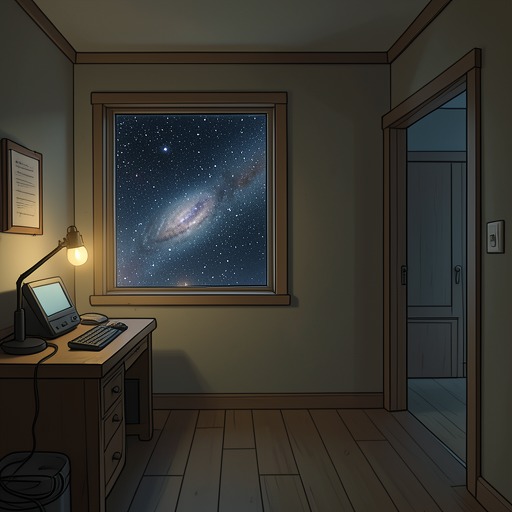
The Queen Mary becomes most significant when Maggie brings Joe to its observation deck. The deck’s reinforced glass ceiling is positioned to divide the view evenly between the planet below and the cosmos beyond. It is intended as a relaxing and romantic attraction, and other passengers recline on loungers to enjoy it. For Joe, the same arrangement makes the ship’s protective barriers newly visible. He ordinarily avoids external video feeds because they remind him that only sheets of metal and plastic separate him from the vacuum of space. Maggie insists that he stop averting his eyes, and he eventually enters the observation room after she assures him repeatedly that he will not be harmed.
The couple’s method is intimate but conspicuous. Joe lies on a lounger with his head in Maggie’s lap, looking directly into the void while keeping her reassuring smile in view. From the outside, the scene is bizarre; as an improvised treatment, it is nevertheless effective enough to reduce his twitching and shivering after several minutes. His heart continues racing and he still wants to return to solid ground, but the observation deck converts the ship’s greatest psychological threat into a controlled exercise. The Queen Mary’s glass, loungers, reinforced ceiling, and artificial gravity are not passive background details: together they create the conditions under which fear can be approached without being allowed to become an immediate physical danger.
For the first several weeks of the cruise, stargazing occupies much of Joe and Maggie’s time. Joe passes through varying degrees of panic while Maggie attempts to soothe him, hoping repeated exposure will acclimate him to spaceflight. Maggie possesses an immense store of psychological knowledge and treats the process as both a duty to Joe’s mental health and a valuable learning experience, while recognizing that expertise in manipulating minds does not make her a psychiatrist. The Queen Mary consequently operates as a moving laboratory for an uncertain form of exposure therapy, with its attractions doubling as instruments of emotional pressure and support.
Route, Transfers, and Safety Systems
The cruise is deliberately slow and relaxing. The Queen Mary spends four or five days sailing around a solar system before attaching to a freighter for the next wormhole transfer. Early stops collect or release passengers while the ship passes curio worlds that appear interesting from orbit but are inhospitable in practice. In the third week, it emerges from a freighter’s unusually large docking bay beside two pale-blue stars in a binary system. The ship approaches as closely as safety regulations permit, allowing the paired stars to dominate the starboard view, though the visit lasts only about a day before the scheduled route requires another transfer.
For a wormhole jump, the Queen Mary docks inside a freighter’s super-sized bay and is secured with docking clamps. A ship-wide announcement instructs passengers to strap themselves in. In their cabin, Joe and Maggie sit in armchairs while automated belts and cuffs hold them in place because artificial gravity will be temporarily disabled. The jump begins with a distinctive sound, followed by several seconds of total sensory deprivation; when gravity returns, Joe is thrown back against the cushions. The sequence demonstrates the practical machinery beneath the ship’s hotel-like surface: comfort is carefully engineered, but it remains contingent on restraints, docking hardware, scheduled transfers, and procedures designed for the hazards of wormhole travel.
The ship’s schedule also limits the freedom implied by its leisurely atmosphere. At one point, an unusual transfer forces the Queen Mary to leave the binary-star system after only a short visit. A longer stay would have required passengers to remain there for thirteen weeks, so the brief stop is judged preferable despite the disappointment. Later, the cruiser reaches orbit above Marlton-3 seven minutes behind schedule. That delay is financially meaningful because every minute of operation costs a great many poundingtons, but it has no practical effect there because Marlton-3 is only a layover awaiting a freighter transfer three days later.
Marlton-3 and the Ship’s Narrative Function
The Queen Mary provides transport to Marlton-3, but the destination matters to Joe and Maggie for a reason unrelated to tourism: it is the system where Barry Mulligan has been sentenced to hard labor. The couple intends to leave the cruise at roughly this point and travel to Barry’s mining station in the asteroid belt. Maggie would prefer to continue because she has not seen enough of the Milky Way and has paid for the entire cruise, yet helping Joe resolve his familial problems takes priority. Their plan depends on a meticulously prepared timetable and on reaching the distant station before the Queen Mary continues along its route.
Passengers going planetside at Marlton-3 must sign a waiver because there is no official guided tour. The document releases the cruise organizers from legal responsibility for accidents away from the ship and warns that the Queen Mary will not wait for anyone who misses its departure. The warning gives the cruiser a quiet authority over the travelers’ choices: even as it advertises leisure and freedom, its itinerary is fixed, its transfer windows are narrow, and departure is indifferent to personal complications.
The Queen Mary therefore embodies a recurring contrast in the cruise narrative. It is a vessel built to soften the strangeness of space with air conditioning, restaurants, artificial evenings, observation lounges, and carefully reduced vibration, yet it repeatedly exposes the mechanical and cosmic realities those comforts conceal. For Maggie, it is a luxurious itinerary and a manageable system of schedules, facilities, and probabilities. For Joe, it is an unavoidable encounter with the void. By carrying them from romantic stargazing toward Barry Mulligan’s mining station, the cruiser joins private emotional repair to the infrastructure of interstellar society: a hotel in appearance, a restraint system in emergencies, and a moving threshold between familiar life and the hostile scale beyond it.