Wormhole Transit Safety Protocols
The Stars Have EyesWormhole Transit Safety Protocols are the practical rules used aboard interstellar vessels when an artificial wormhole is opened. Their central requirements are straightforward: passengers must be warned before the jump, artificial gravity must be disabled during transit, bodies must be secured against drifting, and onboard virtual-reality networks must be shut down. In the wider setting, however, these procedures are not merely routine shipboard etiquette. They are defensive adaptations to machinery powerful enough to create an artificial black hole, and they reveal how ordinary life depends on infrastructure whose failures can threaten bodies, consciousness, and reality itself.
Definition and Operating Requirements
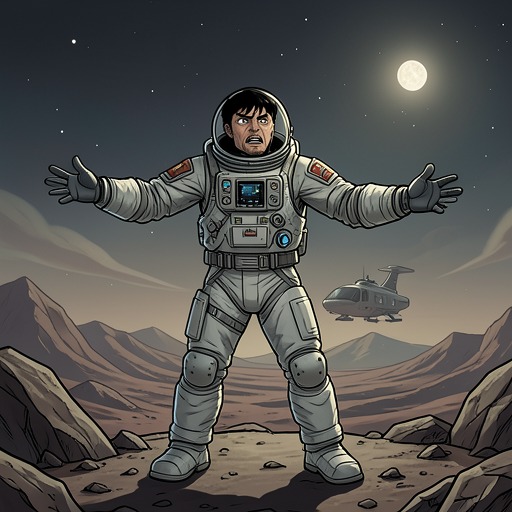
The protocols begin with formal announcements from the ship’s captain or automated systems. Before the ICF-M42 Trafalgar makes its jump, Captain Grace announces that the vessel has cleared the orbital plane of the Butterpond system and will enter transit in ninety seconds. She explains that artificial gravity will be disabled for the duration and instructs passengers either to strap themselves in or hold onto something. A second warning follows thirty seconds before the jump, advising everyone to brace for the bump expected when the ship emerges on the far side.
These instructions address the immediate mechanical danger of weightlessness. A passenger who remains unsecured will drift upward while gravity is absent and may be thrown against furniture or the floor when the field returns. Joe Mulligan initially treats that possibility as an inconvenience rather than a serious hazard, reasoning that a fall would probably hurt without causing an injury. The protocol nevertheless converts the cabin into a controlled environment: restraints, handholds, and synchronized gravity systems replace the ordinary stability that passengers take for granted.
The same safety logic extends into virtual reality. An automated notice later informs passengers that the internal VR network will be disabled ten minutes before a scheduled jump, in compliance with standard safety procedures. The interruption irritates Joe Mulligan and Maggie, while Kelly reacts with much greater hostility, but the notice makes clear that immersion systems cannot remain connected during transit. The protocol therefore protects not only bodies floating in physical cabins but also minds whose ordinary experience is mediated through digital environments.
Shipboard Implementation
On The Queen Mary, the procedure is performed after the yacht docks with another freighter for the next wormhole jump. The yacht enters the freighter’s oversized docking bay and is secured with docking clamps. Once the ship-wide warning is issued, Joe Mulligan and Maggie take seats in their cabin, where automated belts and cuffs secure their ankles, wrists, chests, and waists. Their restraint is gentle but firm, designed to prevent them from drifting when artificial gravity is temporarily disabled.
The jump itself is marked by a distinctive sound, followed by several seconds of total sensory deprivation. When gravity returns, Joe Mulligan is forced back against his chair’s cushions. The sequence is sufficiently familiar that the couple treats it as a recurring part of travel rather than an extraordinary crisis. External docking adds another infrastructural layer: The Queen Mary is held to the larger vessel by clamps, while the two ships’ artificial-gravity systems must synchronize for the arrangement to remain safe. The rules thus depend on cooperation among passengers, automated restraints, docking hardware, gravity generators, and shipboard computers.
The procedures also accommodate different kinds of vessels and schedules. The Queen Mary’s visit to a binary-star system is cut short because its cruise itinerary has been fixed months in advance and the alternative would strand passengers for thirteen weeks. The yacht therefore docks with a freighter and accepts another jump sooner than expected. Safety regulation does not remove the commercial timetable; it makes that timetable possible by allowing passenger ships to hitch rides on larger construction freighters rather than waiting indefinitely for a more convenient route.
Consciousness, Virtual Reality, and Nonhuman Passengers
For Maggie, wormhole transit has a consequence that the ordinary safety announcements do not anticipate. During interstellar jumps, her consciousness is repeatedly ejected from her physical vessel, leaving the body on what is effectively autopilot. She normally returns after roughly fifteen minutes, and Joe Mulligan often accelerates her recovery with a kiss. The ritual has become commonplace for the couple, but it demonstrates that the protocol’s definition of a safe journey is not universal: a process that is routine for human passengers produces a recurring separation between Maggie’s mind and body.
The same transit exposes Kelly to a more severe transformation. When the jump disconnects her from The Devourer, her host reverts to an older and horribly disfigured woman, with burn scars across much of her left face, a large bald patch, a modest and malnourished frame, rough skin, and calloused hands. Her outward appearance changes because the entity inhabiting her is no longer present. Wormhole transit therefore interrupts not only communications and gravity but also a possession-based bodily arrangement, revealing a hidden host that ordinary travel normally keeps concealed.
The disabling of VR has a related significance. Maggie’s consciousness can be connected to Butterpond-4’s virtual-reality servers, and her unusual online activity includes consuming media, eating virtual junk food, researching arbitrary subjects, and inflating Joe Mulligan’s bank account by two hundred poundingtons through distributed transactions. The transit rules temporarily sever that digital access. In a society where most people survive through virtual immersion and state-provided Full Immersion Pod 3,000™ units, the interruption is a reminder that virtual life remains dependent on physical systems and can be suspended by the demands of interstellar movement.
Infrastructure, Risk, and Reality Damage
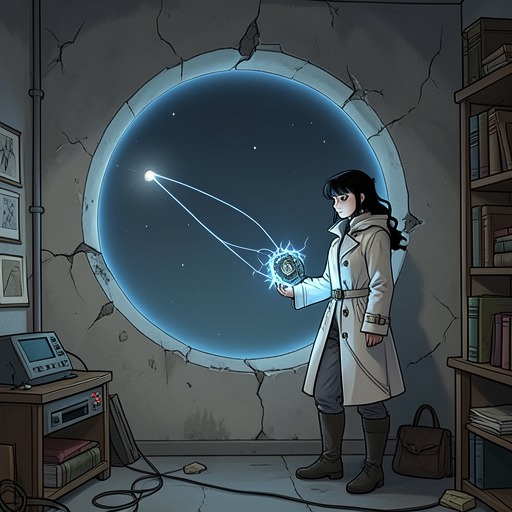
The protocols exist against a technological background far more dangerous than the passenger announcements acknowledge. The wormhole generator aboard the ICF-M42 Trafalgar is surrounded by extensive radiation and energy shielding. The generator creates and sustains an artificial black hole while emitting a counter-gravitational field to preserve the vessel’s integrity; its output would otherwise liquefy every living creature within a hundred kilometers. The shielding unexpectedly blocks Maggie’s ability to see through solid matter, despite not being deliberately designed to impede psionics.
That accidental interference may be connected to the lasting damage wormhole generators inflict on the fabric of reality. The Supernatural Eviction Agency has observed that breach events have increased in frequency and severity for roughly three hundred years, particularly in heavily populated systems. Maggie identifies the cause immediately as the wormhole generators. The protocols consequently appear as a narrow, local response to a much broader systemic problem: they reduce the immediate risk to travelers while leaving unresolved the technology’s accumulated damage to reality.
The rules also dramatize unequal exposure to infrastructure. Butterpond-4’s society provides Joe Mulligan with a tiny apartment, a monthly allowance, and a Full Immersion Pod 3,000™, while employment is restricted to less than 0.1 percent of the population. Elsewhere, banking software permits a distributed rounding error to generate two hundred poundingtons in Joe’s account without technically altering the balances of the people whose transactions triggered it. These details parallel wormhole travel: complex systems promise stability, but their hidden assumptions and failures distribute consequences unevenly, often leaving ordinary people to absorb risks created by institutions and machines they cannot control.
Narrative and Thematic Significance
Wormhole Transit Safety Protocols recur as a mundane ritual that steadily reveals extraordinary conditions. Passengers strap themselves down, gravity vanishes, sensory input disappears, and the ship resumes normal operation. Joe Mulligan’s sleepy confusion, his reliance on cot bars, and his later habit of kissing Maggie back into awareness turn a hazardous technological procedure into domestic routine. The contrast is central to the rule’s significance: the more often the journey is repeated, the less its participants notice how much violence and contingency the routine contains.
The protocols also establish a boundary between human regulation and nonhuman experience. They can instruct people to brace themselves, shut down VR networks, and secure a yacht to a freighter, but they cannot prevent Maggie’s consciousness ejection or account for Kelly’s hidden host. Their apparent universality is therefore limited by bodies and minds that do not fit the assumptions of ordinary passenger safety. At the same time, the rules are indispensable. They transform an artificial-black-hole transit system from an intolerable threat into a repeatable social practice, even as the story keeps visible the reality damage, bodily vulnerability, and dependence on automated infrastructure that such normality conceals.