Aging and bodily frailty
The Summer BookAging and bodily frailty in The Summer Book emerge through specific tasks that become harder without making Grandmother merely an object of care. Her stiff legs, aching body, and need to pause alter how she moves through familiar spaces, while her attention, practical judgment, humor, and concern for others remain active. The novel sets these bodily limits beside a social question: whether growing old means losing the right to decide what to do, or whether a person can still claim room for their own choices.
Physical Limits in Everyday Life
Before dawn on a cold morning, Grandmother finds the guest room so chilled that she drags a rag rug onto the bed and pulls down raincoats, without getting much warmth from them. The oil stove has gone out. At three o’clock, she gets dressed, takes her walking stick, and hobbles down the stone steps because she wants to hear the Long-tailed ducks. The movement is effortful, but it is also purposeful: physical discomfort does not keep her from going out to attend to the spring night.
Her body’s limitations become more pronounced as the seasonal work of closing the island gathers around her. Grandmother’s legs ache, perhaps because of the rain, and she cannot walk as far as she would like. Still, she goes out briefly each day just before dark to clear away traces of human presence. She collects nails, paper, cloth, plastic, oil-stained lumber, and bottle tops, then makes fires on the shore for what can be burned. The routine is both housekeeping and a deliberate response to the changing landscape: she feels the island becoming cleaner, more distant, and almost uninhabited. Her reduced range changes the scale of her work, not its purpose.
The Room and the Burden of Dependence
As autumn approaches, the guest room fills with objects waiting for spring or no longer needed: nets, nail kegs, coils of wire and rope, and sacks of peat. Grandmother takes pleasure in these practical things, and studies old boat nameplates, storm notes on the wall, records of dead seals and a mink, and a picture of a hermit in an open tent. The room’s accumulated objects offer familiarity and interest, even as her difficulty moving around it makes ordinary acts more demanding.
Getting undressed and opening the window take effort; only after managing them can she lie down and stretch her legs. From the other side of the wall, she hears Sophia and Sophia’s father preparing for bed. In the room’s smell of tar and wet wool, she remembers the chamberpot beneath the bed and resents what it represents to her: helplessness. She accepted it out of politeness, although it is useful in bad weather and becomes a burden the next day, when it must be carried down to the water. The object makes dependence concrete—not an abstract condition, but something that has to be accommodated, concealed, and physically dealt with.
Darkness, Balance, and Preserved Knowledge
One night, Grandmother wakes and takes time to decide whether to go outside. Her legs ache; the stairs are too high and narrow, and the rock beyond them is slippery on the way to the woodyard. She knows that a light could make her sense of direction and distance worse, and that darkness can close in when she loses her hold. The narration dwells on the sequence required to move: swinging her legs over the bed’s edge, waiting for balance, taking four steps to the door, opening the latch, and descending while holding the rail.
Yet Grandmother’s caution is not the same as fear or confusion. She knows the darkness is absolute, but also knows where the house, sea, and woods are without seeing them. She releases the handrail and finds the descent less difficult than she expected. In the woodyard she sits on the chopping stump until her balance comes back, then remains there. The scene gives bodily vulnerability its full weight—the need to wait, the risks of stairs and uneven ground—while showing how knowledge of a familiar place continues to guide her. Her independence is not presented as effortless: it consists in judging the conditions, moving carefully, and choosing to stay once she has arrived.
The sounds around her sharpen that combination of limitation and perception. A coastal freighter passes east toward Kotka, its diesel noise fading; later, she hears what seems to be a small boat heading out to sea. She recognizes that the sound is actually her own heart, not a herring boat, and decides to remain outside for a while. Her body supplies an unexpected sound, but she can still interpret it, correct her first impression, and make her own decision about what comes next.
Age, Autonomy, and Being Considered a Burden
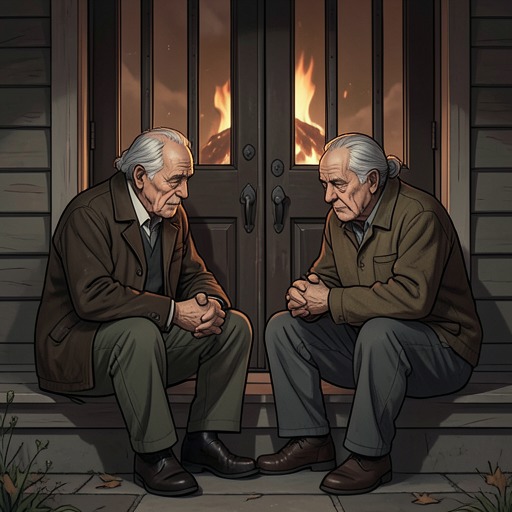
Verner’s account of old age brings social pressure into view. He admits that he took a boat that was not his and left in it because he disliked having people worry about him all the time. Grandmother is astonished that, at seventy-five, he does not simply feel free to do as he likes. Verner explains that other people have some responsibility for him and that he can feel he is in their way. His predicament is not described only as a consequence of bodily decline: care itself can become a form of constraint when it makes an older person feel watched, indebted, or obstructive.
He also speaks of depression and of the difficulty of saying what matters, then complains that he always seems to say the wrong thing now. His frustration over hobbies extends the same conflict into the question of how a person is expected to occupy old age. He wants to make things with his hands but believes he is not good at it; when Grandmother suggests that he could make things grow, he recognizes the possibility, while also resenting that others have repeatedly prescribed gardening as the proper hobby. The exchange connects companionship with a shared resistance to being managed by well-meant advice. Grandmother’s response is not to deny his difficulty, but to recognize a desire that the routine suggestion has obscured.
Judgment, Care, and the Meaning of Frailty
Grandmother’s physical uncertainty does not displace her ability to assess danger. When she sees Sophia high on the channel marker, she understands that shouting could startle the child and cause her to fall. She waits and encourages her instead. In rising too quickly, however, Grandmother loses her walking stick to the pool, and the rock surface seems to become unstable around her. The episode places her own bodily vulnerability beside her careful protection of Sophia: she can judge the child’s risk even as her balance and support become uncertain.
Across these scenes, frailty is neither denied nor made synonymous with incapacity. The stick, the chamberpot, the painful legs, the stairs, and the pauses for balance all register real limits; the same passages also show planning, perception, work, affection, and choice. Grandmother’s life is increasingly shaped by what her body can manage, but the narration preserves the distinction between needing to move carefully and being unable to act for herself. Verner’s experience adds the danger that other people may mistake responsibility for permission to take over. Together, their stories make aging a negotiation between bodily change and the continuing claim to direct one’s own life.