August
The Summer BookAugust is the season of retreat on the family's island, when summer remains in the landscape but no longer feels fully alive. Its significance lies in a measured reversal: daylight and activity give way to darkness, people draw their equipment and possessions toward the house, and Grandmother works to erase the signs that they have been there. The month makes seasonal change visible as both household routine and the island’s recovery of distance from human life.
The return of darkness
Every year, the bright Scandinavian nights fade so gradually that the change may go unnoticed until an evening errand ends in sudden darkness. Summer has not yet withered, and autumn has not properly begun; instead, the island enters a still interval without stars. The kerosene can comes up from the cellar, and the lamp returns to its peg by the door. These small preparations register a change in the terms of island life: the light that had made outdoor activity easy can no longer be taken for granted.
The shift is not presented as a single dramatic departure. It gathers through incidental adjustments, day by day, as the family’s working world contracts toward the house. August thus has a distinctive in-between quality: the season is still summer by name, but the brightness and momentum that defined it have begun to recede.
Moving life toward the house
The change takes practical form as equipment is brought in or secured for the coming season. Sophia’s father takes in the tent and water pump, removes the buoy, and attaches its cable to a cork float. The boat is hauled ashore on a cradle, while the dory is hung upside down behind the woodyard. After the potatoes are dug, the water barrel is rolled against the house. Buckets and garden tools follow; ornamental pots disappear, and Grandmother’s parasol is put away among the temporary objects of summer. In their place, the fire extinguisher, axe, pick, and snow shovel appear on the veranda.
This rearrangement is both useful preparation and a repeated seasonal order. Grandmother has always liked the August change partly because it is dependable: things return to their places as the island’s use changes. The household is not simply packing up; it is converting an exposed summer dwelling back into a place prepared for colder, darker conditions. As the objects move inward, the landscape changes with them.
Cleaning away habitation
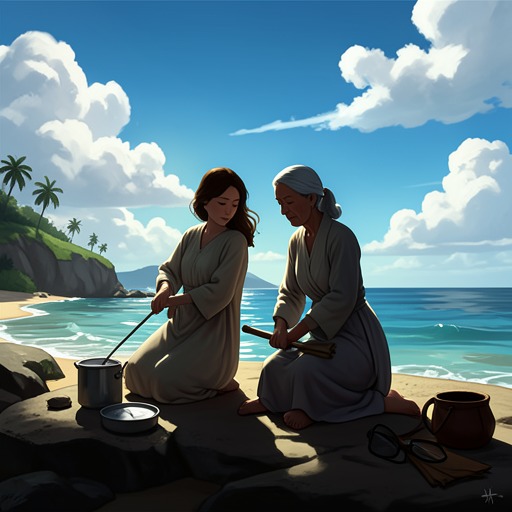
Grandmother understands the transition as a time to remove the traces of human presence and let the island approach its original condition. Exhausted flower beds are covered with banks of seaweed, while long rains level and rinse the ground. The remaining flowers are red or yellow, vivid against the seaweed, and a few enormous white roses in the woods bloom for just one day. These brief and distinct displays belong to a landscape that is changing without yet becoming fully autumnal.
Her own body limits how much of this work she can do: her legs ache, and she cannot walk around the island as often as she wants. Still, she goes out briefly every day before dark to tidy the ground. She gathers nails, scraps of paper, cloth and plastic, oil-covered pieces of lumber, and an occasional bottle top. At the shore she makes fires for burnable debris. Each small act of clearing makes the island cleaner, but also makes it seem more foreign and distant. Grandmother senses that it is shaking off its human occupants; the return to an uninhabited state is nearly, but not quite, complete.
The island beyond summer
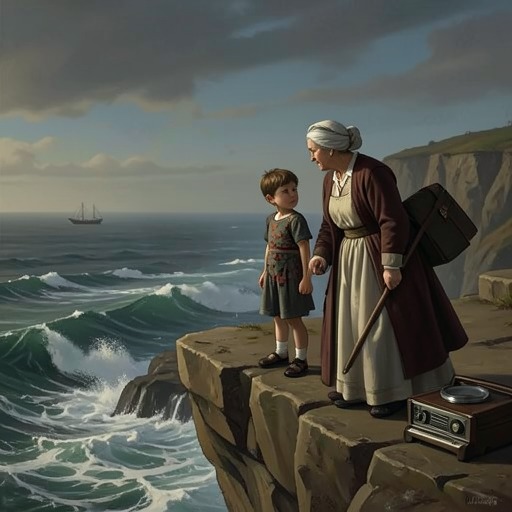
August’s quiet withdrawal gives a seasonal frame to the more exposed pressures of island life. Earlier summer scenes show the Gulf of Finland as a working route and an unpredictable force: boats converge on Outer Skerry during the Midsummer salvage, and rough water carries the work through the night; in the drought, heat makes the journey to Bog Skerry oppressive, and towing the enormous water-filled plastic sausage nearly overwhelms the boat. When Sophia’s storm arrives, waves push the boat against the shore and force her father to row out to his nets. These episodes are not identified as August events, but they clarify what the seasonal retreat follows: a summer in which the sea, weather, and need for supplies have repeatedly shaped what the family can do.
Human boundaries, too, remain visible as the season turns. The new house on Blustergull Rock interrupts the familiar horizon, and Grandmother and Sophia challenge its owner’s no-trespassing sign by going ashore in protest. Later, Grandmother judges that Malander will build his dock despite wanting to be left alone; when storms come, the family thinks about him and how they might save his boat. Against these unsettled relations, August’s clearing is not a claim that human concerns have vanished. It is the gradual work of withdrawing from the island while leaving the sea, the altered horizon, and the approaching dark to mark what remains.