Cats
The Summer BookThe cats in The Summer Book are not simply household companions: through Moppy and Fluff, the book sets human wishes for affection against animals’ independent habits. Moppy’s growth from bottle-fed kitten to elusive hunter changes Sophia’s daily life, while the family’s exchange of him for a more docile cat tests whether attachment can be redirected by substitution. The return to Moppy makes the cats’ contrasting temperaments—and Sophia’s loyalty to the difficult one—central to the episode.
Arrival and Domestic Life
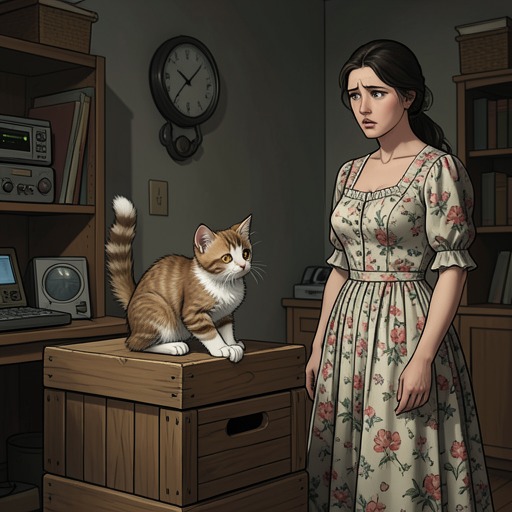
Moppy arrives as a tiny kitten unable to drink without a nipple. The family finds Sophia’s baby bottle in the attic and uses it to feed him. At first he sleeps in a tea cosy to stay warm; once he can move about, he is given a place in Sophia’s bed in the cottage, with his own pillow beside hers. His earliest life is therefore organized around close human care and a shared domestic space.
That arrangement changes as he grows. A fisherman’s cat, Moppy develops quickly and leaves the cottage for the house, where he sleeps beneath a bed in the box used for dirty dishes. Sophia carries him back and tries to win his affection, but he repeatedly returns to the dish box. When the dishes accumulate, his howling alerts the household that they need washing. The cat’s preferred sleeping place thus has a small but recurring consequence for human routine: Moppy makes his needs known, but on his own terms. Although his original name is Ma Petite, the family calls him Moppy.
Attachment and Hunting
Sophia interprets the distance between them as a problem of love. She continues to pursue Moppy, offering comfort and understanding, while admitting that she sometimes feels unable to keep loving an animal who does not return her affection. Her attention grows so consuming that she stops playing and begins having nightmares. On rare occasions she loses patience, yelling at him or pulling his tail; he responds by hissing and retreating under the house. The pattern is a persistent approach and withdrawal: Sophia tries harder to establish closeness, while Moppy preserves his independence.
Moppy’s absence one June night marks a shift in their life together. He has become lean and wild, and the next morning he returns to the house, stretches, sharpens his claws on the rocking chair, and sleeps on the bed. Grandmother recognizes the implication: he has begun hunting. Soon Moppy brings a small bird to the doorstep. Sophia is distressed by the sight and avoids him, while Grandmother points out that a wild cat does not distinguish between the kinds of prey people regard differently. Sophia consequently stops speaking to Moppy for three days.
The conflict becomes a daily pattern. Moppy goes into the woods at night and brings his catch into the house in the morning; the bird is then taken away and thrown into the sea. Sophia asks whether the remains have been cleared and reproaches the cat, so the household’s morning coffee loses its former ease. Moppy eventually conceals his hunting. Grandmother discovers a row of cleaned bird skeletons beneath a floorboard after her cigarette holder falls through a crack in the veranda floor and she lifts a plank to retrieve it. The discovery confirms that Moppy has continued hunting even when the family can no longer see the evidence. Grandmother draws away when he rubs against her leg, and his food dish remains untouched, attracting flies.
Wildness and Exchange
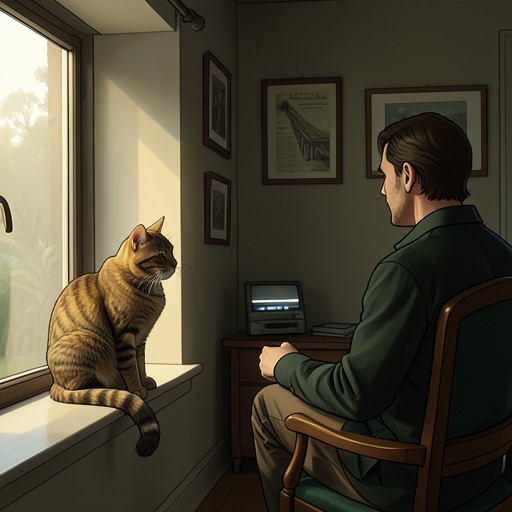
As Moppy spends less time in the house, his life becomes increasingly difficult for the family to observe. His light yellowish-grey, striped coat resembles the island’s granite. He crosses the meadow, waits motionless in the thicket, and moves under the creeping pines; the narrator also notes his grooming and his habit of eating grass and vomiting hair. These details give him a life beyond Sophia’s efforts to make him affectionate. He is described as happy, but he shares little with anyone, and what he does between his visible appearances remains unknown.
The contrast becomes practical when the Övergårds visit for coffee. Sophia finds a large white cat in their boat, among bags, jerry cans, and baskets. Anna Övergård explains that the cat is not a mouser and that they intend to give him to friends. The animal licks Sophia’s hand, purrs when she picks him up, and settles submissively on her lap. The families make a bargain, completed with a bottle of rum. Moppy is taken aboard the departing boat for town before he understands what is happening; the white cat, named Fluff, moves into Sophia’s cottage.
Fluff supplies nearly the opposite kind of companionship. He eats fish, likes being petted, sleeps in Sophia’s arms, and joins her for morning coffee before settling beside the stove. Yet his compliance does not make him a replacement in Sophia’s affections. When he rolls on warm granite in Moppy’s usual spot, she moves him and insists that the place belongs to Moppy. Even in Moppy’s absence, she preserves his claim to a familiar part of the island.
Return and Significance
Sophia recognizes that exchanging the cats will be painful, but says that Moppy is the one she loves. The family exchanges them again. The decision reverses the apparent solution offered by Fluff: a cat who welcomes affection can make the cottage more companionable, but cannot erase the attachment Sophia has formed to Moppy.
The episode does not turn Moppy into a pet who changes to satisfy Sophia. He remains a hunter, resists her attempts at closeness, and eventually lives largely beyond the household’s notice. Nor does the return of Fluff settle the mismatch between Sophia’s desire for affection and Moppy’s independence. Instead, the cats make that mismatch concrete through sleeping places, food, hunting, and repeated comings and goings. Moppy’s return matters because Sophia chooses the relationship as it is, rather than the easier companionship Fluff offers.