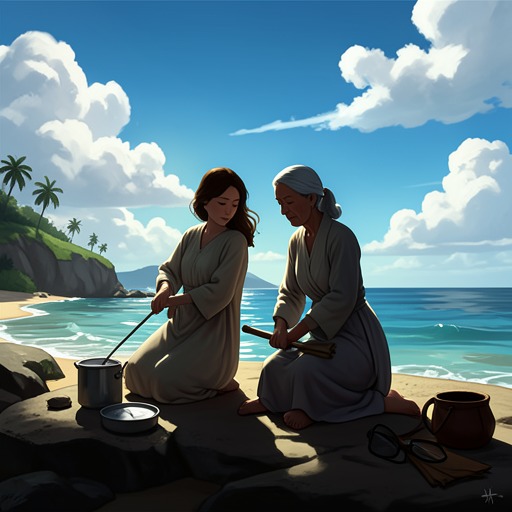
Cave
The Summer BookThe Cave is the hidden destination at the end of a path Sophia has patiently cut through the dense coastal growth of the largest nearby island. Its black, damp walls and natural moss-covered altar make it both a physical refuge and a place that Sophia can invest with sacred meaning. Reaching it is part of its character: the route passes from an open bay through a thicket, beneath trees, and up a hill, until the cave appears with startling suddenness.
Setting and approach
At the far end of a deep bay, grass grows directly from the sand. Its roots twist into a tough, knotted mass: waves arriving over the sandy bottom flatten when they meet it, while the grass adjusts as the water shifts the sand into hills and gullies. It grows outward from seaweed and inland into a tangled stretch of salt-loving plants, including spiraea, nettles, and vetch. The vegetation is sustained by dead seaweed and rotten fish, and grows among low-reaching sallow, rowan, and alder branches. Moving through it means pushing between branches and plants rather than following an established way.
Sophia has made a route through this growth with a pair of shears, working on it patiently whenever she feels like it. The path is secret; no one else knows about it before she takes Grandmother there. It circles Rosa Rugosa, a large rosebush known to visitors from the village for its enormous wild blooms. Waves wash its roots clean and leave seaweed among its branches. Salt and exposure kill the plant every seven years, but its offspring spring up around it, so that its apparent disappearance changes little in the landscape.
Beyond the rosebush, Sophia’s path crosses nettles, spiraea, currant bushes, and loosestrife beneath alder trees, then passes a large bird-cherry at the woodland edge. Under the bird-cherry, blossoms can fall all at once on the right day and with the right wind, although aphids will drop from the branches if they are shaken. Pines and moss follow; the ground rises from the beach, and the cave comes into view as an abrupt surprise. It is narrow, smells of rot, and has black, damp walls. At its far end, a natural altar is covered with green moss, fine and dense like plush.
A secret route shared
Sophia first makes the cave known through teasing secrecy: she tells Grandmother, “I know something you don’t know,” then asks whether Grandmother can guess what it is. The answer is no. They row over in the dory and tie it to a rock before creeping around the rosebush to find the concealed path. The outing accommodates Grandmother’s physical condition: she is dizzy and would rather crawl than walk. Along the way she identifies the nettles, while Sophia urges her to crawl faster because the distance is short.
The route also sets the pace of their visit. At the bird-cherry, Sophia turns back and offers Grandmother time to rest and smoke a cigarette, but Grandmother has left her matches at home. They lie beneath the tree and talk; later, in the cool shade of the pines, they sleep because there is no need to hurry. When they wake, they crawl onward. The journey makes the cave accessible to Grandmother as a companion, even though its narrow entrance will not admit her.
The altar and Sophia’s account
Grandmother is too large to get inside and asks Sophia to tell her what the cave is like. Sophia describes it as green, foul-smelling, and pretty, then explains that the back is holy because God lives there, perhaps in a little box. Grandmother can put her head only as far as the entrance. From there, she asks about the growth inside. Sophia calls the mushrooms old toadstools, but Grandmother recognizes that they are good mushrooms, removes her hat, and sends Sophia in to gather them. The hat is filled with the mushrooms.
Grandmother then takes out the little sacred box, Lupatro, which is empty, and Sophia crawls back into the cave to place it on the moss-covered altar. The act joins the cave’s actual features to Sophia’s imaginative explanation: the altar is a natural patch of moss, while the box gives her idea of a holy dwelling a concrete object. Grandmother neither enters far enough to inspect the altar herself nor dismisses Sophia’s account; the two make the place meaningful together through her questions, Sophia’s description, and the offering of the box.
Return and significance
They retrace the path around Rosa Rugosa. On the way, they dig up one of the rosebush’s offspring to plant by the guest-room steps. Its roots come out easily with a large amount of soil, and they pack it into a Gordon’s Gin crate protruding from the seaweed. A little farther along, they find an old Russian cap to replace Grandmother’s hat, which is full of mushrooms. The outing thus carries pieces of the landscape back toward home: a rose plant for the guest-room steps, gathered mushrooms, and an improvised replacement hat.
The Cave’s seclusion is not simply a matter of distance from the shore. It is reached through a way Sophia has made and kept to herself, and its restricted entrance gives the child temporary authority as guide and interpreter. Yet the visit becomes shared rather than closed off: Grandmother follows the route despite her dizziness, rests when she needs to, and contributes the empty Lupatro box. The cave’s damp darkness and rot sit beside Sophia’s perception of beauty and holiness, allowing the setting to remain at once an ordinary coastal hollow and the sacred place she describes.