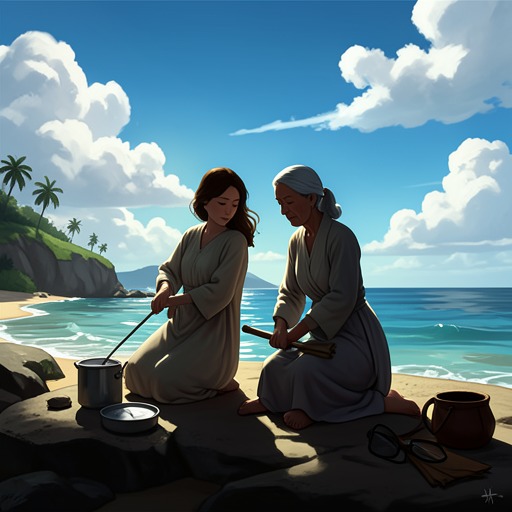
Grandmother
The Summer BookGrandmother is Sophia’s elderly companion and the household’s practical center: stiff-legged and increasingly constrained by her body, yet alert to the weather, the island, and the people around her. Her significance lies in that tension. She does not deny age or pretend that physical limits are trivial, but neither does she let them define the whole of her life. She climbs out into the dark, tends the island, shares difficult truths with Sophia, and meets uncertainty with a mixture of care, dry humor, and experiment.
Identity and Daily Life
Grandmother’s body makes itself felt in ordinary scenes. After a warm July night, she searches among the peonies for her false teeth, having lost them when they fell from her mouth. When Sophia finds her, Grandmother first says she is doing nothing, then angrily admits what she is looking for. The teeth go back in easily, making the mishap seem less momentous than her irritation initially suggested. The episode presents aging without solemnity: bodily vulnerability is real, but it can arrive as an awkward domestic interruption, met by a child’s curiosity and an old woman’s impatience.
That curiosity quickly turns toward death. Sophia asks when Grandmother will die, and Grandmother answers that it will be soon, while telling her that this is not the child’s chief concern. The exchange is striking for its matter-of-factness. Grandmother neither offers a promise nor makes death into a lesson; she acknowledges it directly and redirects Sophia toward the life still being lived between them.
Her knowledge is grounded in close observation. Before dawn in early May, cold from the bog reaches the guest room, and the oil stove has gone out. Grandmother pulls on her clothes, takes her walking stick, and goes outside to listen for Long-tailed ducks. The island is fogbound; branches drip in the silence, and snow remains in sheltered places. Their chattering call carries farther out over the water, while the birds’ seasonal return gives Grandmother a sense of anticipation and renewal. She thinks broadly about how birds mark changes in weather, seasons, and human life, but her attention begins with the immediate task of listening in the cold.
Grandmother’s physical limitations are concrete rather than abstract. Her legs are stiff, she walks carefully over bare granite, and the stairs and slippery ground later become obstacles she must assess step by step. Yet caution does not equal passivity. When Sophia climbs the high channel marker, Grandmother realizes that shouting could startle her and waits instead, calling encouragement when the child continues upward. She understands both the danger of the situation and the importance of allowing Sophia to complete the climb without panic. Her judgment is shaped by bodily experience, but it is not reduced to it.
Work, Autonomy, and Age
Grandmother’s past includes a public contribution to girls’ access to the Scouting movement: when she was young, she led Scouts, and it was through her efforts that little girls were allowed to join. Former members still write to her about campfire songs and incidents from their time together. She regards their memories with some distance, finding their sentimentality and the movement’s later loss of personal intimacy rather old-fashioned, but she nevertheless thinks of them with friendliness. Her own children never became Scouts; the opportunity simply did not arise in their busy family life.
That history throws her present circumstances into relief. She knows what it is to organize activity and make room for girls’ independence, while now she must negotiate a world in which others may feel responsible for her. In conversation with Verner, she hears him explain that his family worries about him and that consideration for them can leave him feeling in the way. Grandmother does not dismiss his difficulty. She pauses to set a piece of moss back in place with her walking stick, a small gesture of care amid a conversation about the restrictions old age brings. When Verner complains that everyone tells him to take up a hobby, she recognizes the contradiction: being told to garden or make things can make even a genuine desire feel imposed. Her response—that he might make things grow—gives his wish a practical form without treating it as a cure for the indignity he describes.
The scene also clarifies her own relationship to autonomy. At seventy-five, Verner has taken a boat that is not his because he resents being watched over, but he also knows that his family has responsibilities toward him. Grandmother hears the bind between freedom and dependence without pretending it can be solved by a simple declaration that an older person may do whatever he likes. Her life similarly involves accommodation: she waits for her balance, judges which surfaces are safe, and uses a walking stick. Those limits coexist with choices that remain hers.
Care, Faith, and Superstition
Grandmother’s care for Sophia is neither constant reassurance nor strict protection. During the island storm, she has prayed for the storm before Sophia did. She has also taken too little food and too few clothes, partly because she thought it might be exciting to see whether she could manage without them. Sophia challenges her about whether this showed trust, and then checks that she has taken her medicine. Grandmother confirms that she has. When the wind finally eases the next day, they can return home; the dory, its duckboards, oars, and bailing bucket are intact, and the window has been closed. The wind also rolls pots and pans back onshore, while a helicopter records their names and the island’s name. Grandmother’s prayer belongs to a trial that remains materially uncomfortable and uncertain, not to a miraculous escape from consequences.
Her dealings with superstition are more complicated than simple belief or disbelief. On a hot day, when Midges dance above the spruce, she recalls an inherited warning about being careful when the moon is full. She describes taboos against spilling salt or breaking a mirror, and the danger supposedly signaled by swallows leaving a house. When Sophia asks what superstition means, Grandmother explains it as refusing to explain what cannot be explained, and recalls her grandmother making secret elixirs for her priest husband. Because he rejected superstition, the woman had to let him credit the remedies to Innosemtseff’s Tonic when they seemed to help.
Grandmother also remembers that her grandmother used signs to frighten the family: crossed knives or a dream of black birds could be made into warnings that someone would die. She says the old woman invented such portents because she was bored and wanted to tyrannize her household. That explanation does not protect Sophia from fear when she finds a knife and pen crossed on her father’s desk. Sophia is convinced that the sign concerns her father and will not be comforted by an explanation. Grandmother responds not by arguing her out of fear but by getting dressed and gathering ingredients for an elixir, despite noting that Sophia’s father may refuse to drink it.
The night walk turns Grandmother’s practical attention into a form of ritual care. She tells Sophia to remain silent while they collect what they need, then plucks the head of a beach pea, takes two small pebbles and dry beach grass, and later gathers tree moss, fern, and a dead moth. Sophia follows as Grandmother crosses the island in the moonlight, bending to pick up each additional ingredient. Her stiff legs and walking stick remain visible, but her movement is steady; to Sophia, she seems to carry the moon above her. The child’s nerves settle as the pocket fills. Grandmother does not need to establish that the ritual is objectively effective: she gives Sophia a sequence of actions to perform, and the walk itself helps contain the fear.
Relationships and Emotional Intelligence
Sophia and Grandmother can speak about subjects that adults often soften or evade. Their exchanges encompass death, bodily embarrassment, fear, prayer, and the possibility of failure. Grandmother does not treat Sophia’s questions as foolish simply because the child is young. At the same time, she can be blunt, impatient, or teasing. When Sophia worries about the crossed objects on her father’s desk, Grandmother’s explanation of the family history of superstition is reasonable but insufficient; Sophia asks her to stop talking and walks away. The episode shows both the intimacy between them and its limit: understanding the origin of a fear does not automatically relieve it.
Her connection with Verner offers a different kind of recognition. He speaks of being depressed, of feeling in the way, and of being told to cultivate a hobby; Grandmother responds from within a comparable world of aging rather than treating him as a problem to be managed. Their conversation moves between serious reflection and mundane interruptions. When he makes a toast to old age and the quiet sea, Grandmother answers by asking about the motor’s horsepower and later asks for a light for her cigarette. Such turns do not cancel the feeling in his words. They keep the conversation in the texture of their shared lives, where contemplation and practical questions occupy the same evening.
Grandmother’s emotional intelligence is also visible in what she does not insist upon. In the storm, she lets Sophia question her and keeps the child’s confidence about the trouble they have caused. In the night ritual, she follows the child’s urgent need for action even though the remedy may be doubted and may never be taken by the person it is meant to help. Her care is not presented as perfect foresight; it is a readiness to accompany another person through distress with whatever useful action is available.
The Island, Decline, and Ending
As August advances, Grandmother participates in the island’s gradual preparation for autumn. The bright summer nights fade into darkness; the tent and water pump are brought in, the boat is hauled ashore, the dory is stored upside down, and tools and household objects move closer to the house. Grandmother has always liked this dependable rearrangement, but her own part in it is now limited by aching legs. She goes outside before dark for a little while each day and collects traces of human presence: nails, scraps of paper, cloth and plastic, oil-stained lumber, and bottle tops. At the shore she makes fires for burnable rubbish. The island grows cleaner and, in her perception, more distant, as if it were shaking off its inhabitants and approaching its uninhabited state.
Her final night scene gives that seasonal withdrawal a bodily counterpart. The guest room is crowded with practical things waiting for spring or no longer needed: nets, nail kegs, coils of wire and rope, peat sacks, boat nameplates, notes about storms, and records of dead seals and a mink. Grandmother studies these objects with tenderness and wonders how she can ever leave the room. The room holds the accumulated evidence of island life, while the August work outside removes its human traces.
When she wakes in the dark, her legs ache and the stairs seem difficult: the steps are too high and narrow, the rock is slippery, and the way back must also be negotiated. She is not afraid of falling so much as conscious of what it means to lose her hold when there is nothing to see by. Still, she knows the house, sea, and woods by their positions and makes her way outside without a light. After waiting for her balance on the chopping stump, she hears a boat-like thumping pass the island and eventually recognizes that the sound is her own heart, not a vessel heading out to sea. She chooses to remain seated for a while. The moment neither turns her into a symbol of helplessness nor erases her frailty: she is alone in the dark, attentive to her body, and still capable of deciding how long to stay. Across the book, Grandmother’s life is defined by that continuing negotiation between dependence and self-direction, between the island’s seasonal retreat and her own insistence on meeting each change in her own way.