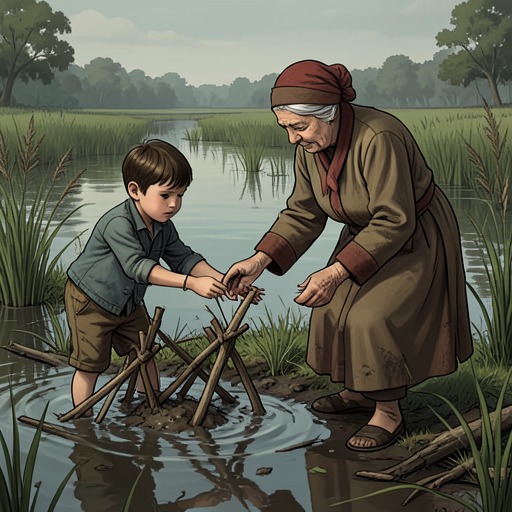
Grandmother’s Doge’s Palace model
The Summer BookGrandmother’s Doge’s Palace model is both a work of miniature architecture and a shared imaginative refuge. Built first as part of a playful Venice populated by families, it is swept away when rain transforms the marsh into a bay. Grandmother answers that loss by rebuilding the palace before morning, then marks it with water and ashes so Sophia can recognize it as a place that has endured a storm. The model’s importance lies not in remaining untouched, but in being remade and carrying a story of survival.
Making a Family in Miniature
Grandmother sits on the veranda and constructs the palace from balsa wood. When it is finished, she paints it with watercolours and gold, and Sophia comes to inspect it. The crafted object quickly becomes a setting for invention: Grandmother places a mother, a father, and their daughter inside, and proposes that the girl has thrown dinner plates through a window onto the piazza. Sophia supplies the imagined mother’s reply and the daughter’s promise to throw only golden plates next time. In this exchange, the model becomes less a replica of a building than a small stage where the two can give characters voices and consequences.
The play continues beyond the first palace. Grandmother sets it by the piazza and makes more palaces, filling their Venice with families who call to one another across canals. Their talk makes sinking part of ordinary domestic life: one mother estimates that a palace has gone down only about a foot, while another family discusses perch for dinner. At night, the families sleep, and the only sound is the footsteps of Ants crossing the bridges. The miniature city combines threatened buildings with untroubled routines; its inhabitants treat the gradual sinking as a condition of home rather than a reason to abandon it.
A City Built from Memory
As Grandmother becomes absorbed in the city, she adds a hotel, a trattoria, and a campanile topped by a little lion. Her work expands the model from a single palace into a populated urban world, with structures and street names drawn from memory. The narration connects her command of Venice’s old street names to the way her memory holds on most clearly to things that happened long ago. Making the city gives those remembered details a present form: she can place buildings and routes before her even as their original setting belongs to the past.
The imagined city also accepts interruptions that make it unmistakably a place of play. When a green salamander appears in the Grand Canal, traffic has to take a long detour. This tiny disruption sits alongside the repeated threat of sinking, but neither stops the city’s life. The palaces, conversations, and detours accumulate through Grandmother’s handiwork, and the fictional families acquire a continuing existence that Sophia can return to. The model’s vulnerability is built into this imaginative world from the outset: the city is already described through how far its palaces have sunk.
The Storm and the Rebuilding
Rain begins in the evening, and the wind shifts to the southeast. Although the radio reports a low-pressure system and winds of thirty miles an hour, nobody initially treats the forecast as alarming. Waking repeatedly during the night, Grandmother hears the rain and waves and grows concerned about the sinking city and Sophia. The next morning, after going to the shore, she sees that the marsh has become a bay: waves wash into the heather and back to sea, and the alders stand out in the water. Venice has disappeared beneath the sea.
Grandmother looks at the changed shore, returns home, lights the lamp, takes out her tools and a suitable piece of balsa wood, and puts on her glasses. The narrative moves directly from the vanished city to the concentrated labor of reconstruction. By seven o’clock the palace is ready, just as Sophia comes to the door asking whether Grandmother found its inhabitants. Grandmother answers that they were all still there. The rebuilt palace looks too new to have survived a flood, so she pours water from her drinking glass over it and rubs its cupolas and walls with ashes from the ashtray. These small alterations make the replacement bear the visible trace of disaster without destroying its role in the story.
Survival as a Shared Story
Sophia examines the palace carefully, sets it on the nightstand, and listens for the fictional daughter. Grandmother has rebuilt the object, but Sophia completes the rescue by imagining what has happened inside it: the daughter’s mother calls the storm perfectly dreadful, is cleaning up the mess, and is worn out. The mother and daughter remain characters in their game, yet their imagined recovery gives Sophia a way to register the storm’s damage and its aftermath. Grandmother’s reply that the mother must indeed be tired accepts the fiction rather than correcting it.
The model therefore holds two versions of survival together. Its first version is physically lost when the real marsh floods; its second is made by Grandmother’s hands before Sophia returns. The water and ashes turn a fresh construction into a palace that seems to have passed through the night’s ordeal, while the invented family carries on with the work of cleaning up. The closing act is not simply the restoration of a miniature building: it is the renewal of a shared story in which loss can be acknowledged and the people inside the palace can still be heard.