Grandmother’s old age and physical decline
The Summer BookGrandmother’s old age and physical decline are not a single condition but a changing set of bodily limits, memory losses, and negotiations over independence. Her legs are weak, she sometimes feels dizzy, and ordinary movement can demand careful planning; yet she remains lively in wisdom and imagination, attentive to the natural world, and determined to keep participating in the life she shares with Sophia. The contrast between what she can still do and what is slipping away gives aging a daily, practical presence on The island.
Identity and the Body’s Limits
The account introduces Grandmother as old, with weak legs and a head that can feel dizzy, but also as Sophia’s active companion through the summer. Her age does not place her outside the child’s world: the two roam together, sleep under bushes, discuss religion and tents, and tend the clearing in the Magic Forest. The bodily decline is real, but it coexists with curiosity, humor, and a capacity to make shared adventures possible.
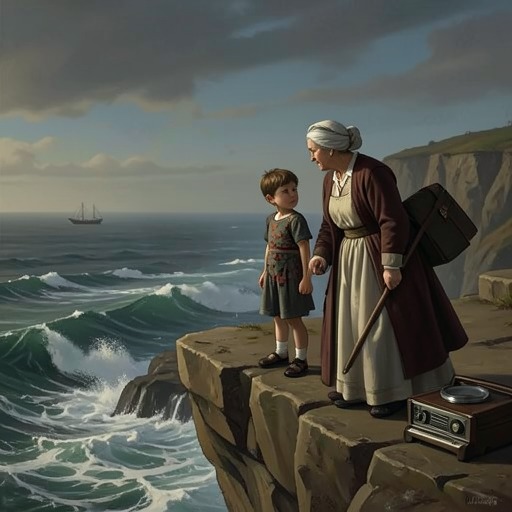
The limits appear in specific movements rather than as an abstract label. On a cold night in early spring, Grandmother wakes in a guest room chilled by the bog, finds that the oil stove has gone out, and sees that the clock reads three. She dresses, takes her walking stick, and hobbles down the stone steps because she wants to listen to the long-tailed ducks. Fog covers The island; water drips audibly from the branches, and snow remains in sheltered places. Her careful walk across bare granite places physical effort beside the landscape’s seasonal renewal: she moves stiffly through a world poised to begin again.
That persistence has its costs. After a demanding episode, Grandmother thinks that on returning home she should take a nap, and remembers that she must tell Sophia’s father that Sophia is still afraid of deep water. Weariness approaches not as a dramatic collapse but as the need to rest after exertion—and as a reminder that her care for the child must continue to be organized around what the child can and cannot yet manage.
Care, Risk, and Shared Activity
Grandmother’s relationship with Sophia reveals how bodily vulnerability changes the balance of their companionship without ending it. When Sophia climbs the channel marker, Grandmother sees that the child has climbed nearly to the top and is frightened. She knows that shouting could startle her into falling, so she waits and calls encouragement instead. But as Grandmother stands too quickly, her walking stick rolls into the pool, and the rock seems to twist into an uncertain surface before her. In the same moment, she has to manage her own instability while judging how best to protect Sophia.
The scene makes their dependence reciprocal. Grandmother is the experienced adult, able to read the danger and restrain her impulse to intervene; her body, however, cannot simply be taken for granted as a secure support. Her encouragement helps Sophia continue, while the pause and her careful attention keep fear from becoming a greater hazard. The child’s boldness and the old woman’s caution meet on the marker, with neither role cancelling the other.
A conversation with Verner makes this practical negotiation more explicit. During a walk toward the potato patch, Grandmother remembers to lean on his arm whenever the ground is uneven. Asked about her legs, she answers plainly that they are bad, though sometimes they seem to work all right. The distinction matters: her condition is neither imagined away nor treated as constant incapacity. It varies with circumstance, and she adjusts to the terrain by accepting an offered arm.
Memory, Work, and the Feeling of Loss
Grandmother’s account of aging also concerns the erosion of memory and the changing meaning of past achievement. She tells Sophia that, at her age, there are many things she can no longer do, and that experiences once full of pleasure seem to shrink and glide away. The loss feels unfair because it threatens not only activity but the value of having lived it: she wants to be able to talk about what mattered, and fears that the past is becoming inaccessible just when she needs it.
When Sophia insists that Grandmother does everything she does, Grandmother objects that she has spent an exceptionally long time doing everything and living as fully as she could. Now, she says, she has the feeling that everything is gliding away; she does not remember, and does not care, even though this is precisely when she needs those memories. The contradiction is painful: the experiences remain important enough to mourn, while the ability to summon their texture is failing.
The memory she names is sleeping in a tent. Grandmother had helped make it possible for girls in Sweden to sleep outdoors, and she and others had once had a wonderful time. Yet she can no longer tell Sophia what the experience felt like. The difficulty is not that she has forgotten the fact of her achievement; she can still explain what she did and why the opportunity mattered. What has receded is the remembered sensation that would let her pass the experience on as living knowledge. Her accomplishment and her present inability to retrieve its felt detail occupy the same conversation.
Independence, Dignity, and the Late-Night Test
Verner’s troubles offer Grandmother a pointed comparison with another older person’s diminished autonomy. Verner has taken a boat that is not his because he dislikes having others worry about him all the time. He explains that people feel responsible for him and that, in the end, he is mostly in the way. Grandmother responds with amazement that a seventy-five-year-old should not be able to do what he likes, but his explanation exposes the pressure behind apparent care: responsibility can become a reason for restricting the person being cared for.
Their exchange also connects aging to frustrated purpose. Verner is depressed and resents the expectation that older people should take up hobbies such as collecting things. He would rather make things with his hands, although he doubts his skill. When Grandmother suggests growing things, he agrees, then points out that other people have repeatedly told him to get a garden and watch things grow. Her practical idea is sound, but the exchange recognizes how advice can feel like another form of control when it merely repeats what others expect an older person to want.
Near the end of the evidence, Grandmother’s body is tested by the darkness and the built environment. Her legs ache, and the stairs are too high and narrow; the rock is slippery on the way down toward the woodyard. She considers each stage of the route: swinging her legs over the bed, waiting for her balance, taking four steps to the door, then descending five steps with the handrail. She is not afraid of falling or losing her way, but she knows the absolute darkness and the vulnerability of having nothing left to hold on to.
Even so, she proceeds without lighting a lamp, which she believes would make her lose her sense of direction and distance. She trusts her knowledge of the room and the island’s layout, releases the railing, and crouches in the woodyard, knowing where the house, sea, and woods are. The scene does not reverse her physical decline: the stairs remain difficult and her legs still ache. Instead, it shows an independence adapted to those limits, sustained by pacing, balance, memory of place, and a decision about when to let go. Old age narrows Grandmother’s options, but it does not erase her judgment or her authority over how she moves through the world.