Imaginative Play
The Summer BookImaginative Play is a way Sophia and Grandmother remake what is at hand without losing sight of its material reality. A branch can suggest an animal, a marsh pool can become Venice, and a scientific account can give imagined inner lives to worms and moths. Their play is not confined to make-believe: it opens questions about change, vulnerability, and what cannot be known for certain.
Making Worlds from Materials
In the Magic Forest, Grandmother carves animals from branches and driftwood, giving them paws and faces while deliberately leaving their identities indistinct. Rather than shaping finished, lifelike figures, she lets each retain what she calls its wooden soul: the backs and legs keep the enigmatic curves of growth, and the carvings remain part of the forest as its wood decays. She sometimes cuts directly into a stump or tree trunk, making the boundary between found form and made figure especially difficult to separate.
The forest gradually fills with these presences. Some cling to trees or sit astride branches; others lean against trunks, settle into the ground, or sink into the marsh with arms outstretched. A few curl up by roots as if asleep, while profiles emerge from shadow and groups appear entwined in battle or love. Grandmother works only with old wood that has already acquired a shape: she selects pieces that seem to express what she wants to say. The imaginative act is therefore partly an act of attention. She does not impose a complete image on blank material so much as discover and extend possibilities already present in it.
A large white vertebra found in the sand resists carving, and Grandmother leaves it unchanged because it could not be made more beautiful. Other white and grey bones, also washed ashore, enter the forest. These are not carved into reassuring imitations of living creatures; they remain bones among the wooden animals. When Sophia crawls in and asks what Grandmother is doing, the answer is simply, “I’m playing.” The word places imaginative making alongside the forest’s real textures and remains, rather than setting it apart from them.
Playing Venice
A postcard addressed to Sophia introduces Venice through a picture of pink and gilded palaces above dark water, gondolas beneath a full moon, and a woman standing alone on a bridge. Grandmother’s account of a city sinking into the sea gives Sophia a setting for invention: canals, mud, buried golden plates, and buildings gradually claimed by water. Sophia is drawn especially to the city’s dark canals and the idea of elegant domestic life continuing as rooms disappear beneath the flood.
She proposes a game in which Grandmother is to call her “Dear Child” and she will call Grandmother “Mama.” Grandmother initially answers that she is Sophia’s grandmother, but Sophia clarifies that this is a game and gives them a Venetian family to inhabit: she is the daughter and has made a canal. Grandmother then changes the premise, suggesting that they become old Venetians building a new Venice. The shift makes play collaborative: the two do not merely repeat the postcard’s doomed city but begin constructing another one together.
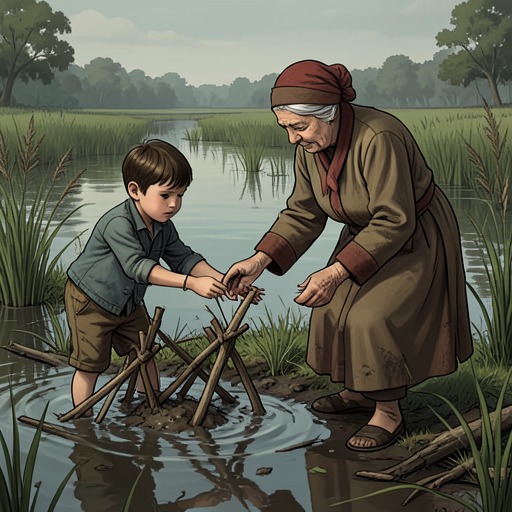
Their building takes place in the marsh pool. Small wooden plugs become pilings for the Piazza San Marco, flat stones cover them, and newly dug canals receive bridges. Black ants cross those bridges while, in the imagined city below, gondolas glide in moonlight. Sophia gathers white marble from the shore and announces a new palace. Ordinary objects and living insects retain their actual scale and activity even as the players assign them a second, urban world.
The game also tests the roles it creates. When a boy gets to say “Mama,” Sophia protests that he should not be the only one allowed to use the name, throws the palace into the water, and walks away. Grandmother continues the imaginative exchange by making Grandmother’s Doge’s Palace model from balsa wood, then painting it with watercolours and gold. She proposes a domestic scene in which a daughter throws china dinner plates out of a window onto the piazza. Sophia answers with her own version of the mother’s response, turning the imagined family’s mishap into a fresh exchange rather than a fixed script. The game can be interrupted by hurt or disagreement, but its shared world can also be revised through another act of making.
Giving Animals an Inner Life
Sophia’s A Study of Angleworms That Have Come Apart begins as a book of blank pages, but spelling frustrates her until Grandmother offers to write while Sophia dictates. The collaboration lets the child keep control of the account while borrowing Grandmother’s hand and practical help. Their subject is a worm that may stretch itself to avoid a hook and then come apart. The explanation does not claim certainty: they cannot tell whether the worm breaks through overstretching or acts intelligently, and they do not know how much the separation hurts.
Sophia’s account moves beyond observable behavior into imagined experience. She considers the worm’s fear of pain, its sense that something sharp is approaching, and the moment when the two halves lie beside one another, recognize their changed condition, and crawl apart. The story does not erase the scientific unknowns; it gives them form by imagining how an animal might feel within them. Grandmother proposes wording that preserves the question of whether the break is accidental or intelligent, while Sophia insists that the account should be understandable. Play here includes a serious attempt to think from beyond the limits of direct knowledge.
The pair continue the next evening under the heading “Other Pitiful Animals.” Sophia describes moths flying into a lamp, returning to it after burning themselves, and finally lying on their backs with their legs quivering. She rejects instinct as a sufficient explanation for behavior that seems so self-defeating, and she imagines that the moths simply do not understand. The compassionate, speculative account is at once playful and grave: an animal’s smallness does not make its possible suffering unworthy of attention.
What Play Makes Possible
Across these episodes, imaginative play changes form without abandoning concrete things. In the forest, it is a way of seeing shapes in old wood; in the marsh pool, it turns construction into shared role-playing; in Sophia’s dictated book, it becomes a method for approaching questions about animal intelligence and pain. Each form allows the players to go beyond what is immediately given, while the selected materials, the sinking city, and the uncertain science keep the inventions connected to limits and change.
The play is also negotiated between generations. Grandmother does not only provide stories or instructions: she accepts Sophia’s invitation to be assigned a new family role, proposes a different game, builds alongside her, and later helps make the child’s book possible. Sophia, in turn, alters the stories and determines what she wants them to say. Their imaginative worlds are therefore acts of companionship, not simply private fantasies. They can hold a disagreement, a ruined palace, or an unanswered question without requiring a single final interpretation.