Magic Forest
The Summer BookThe Magic Forest is a wind-shaped thicket on the outer edge of the family’s island, where decaying trees, hidden animals, and delicate ground cover make a living landscape that cannot safely be tidied or remade. It is at once an ecological exception to the island’s carefully maintained paths and a place where Grandmother’s art grows out of the forms already present in the woods. Its fragility sets limits on human intervention, while its shadows offer room for solitude, play, and an encounter with death that unsettles Sophia.
Terrain and ecological balance
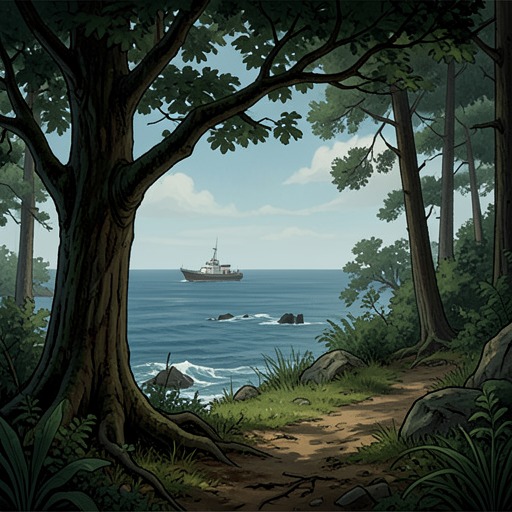
Beyond the island’s bare rock, the Magic Forest stands directly in the wind’s path. For hundreds of years, its trees have tried to grow against the storms: some lean and twist away from the wind, while others crouch or creep along the ground. Trunks break or rot and sink, supporting or crushing trees that remain green above them. Their interlocked remains form a dense, tangled stand shaped by prolonged exposure rather than by any plan for beauty or order. Brown needles shine on the ground; spruces that crawl instead of stand spread glossy greenery through the damp undergrowth.
The forest’s precarious balance makes even apparently modest improvements risky. Clearing a space or separating fallen trunks could undo what has slowly formed. Marshy places cannot be drained, and the dense sheltering wall leaves no ground behind it for planting. Beneath the thicket, where sunlight never reaches, birds and small animals live unseen. Their presence is registered in calm weather through the rustle of wings and the quick scurry of feet, not through a clear view of the creatures themselves. The woods are therefore not simply wild-looking scenery: their obscurity and interdependence are part of their life.
An exception to the island’s order
Elsewhere, the family makes the island into an orderly park, tidying it down to the smallest twig and following narrow paths across moss between granite outcrops and the beach. The Magic Forest is the exception to that work of arrangement. The book makes the contrast consequential: moss can recover after one footstep and fail to rise after another, while repeated disturbance kills it; eider ducks, too, abandon their nests after being flushed a third time. The island’s apparent neatness depends on respecting limits that are easy to overlook.
That vulnerability gives the forest’s tangled condition a different meaning from neglect. Its trunks are left together because pulling them apart might destroy the balance they have acquired, and its marsh is not treated as land awaiting improvement. Elsewhere on the island, the arrival of a businessman’s house on Blustergull Rock breaks the familiar horizon and prompts anxiety about a new neighbor and possible disturbance to the moss. The account does not make the house an event within the forest, but the contrast underscores how island life depends on a landscape that can be altered by human presence even when its most fragile places remain out of sight.
Grandmother’s solitude and carved figures
At first, the family tries to make the Magic Forest more frightening. They collect stumps and dry juniper bushes from neighboring islands and row them back. Large, weathered pieces are dragged across the island, splintering and cracking as they leave broad, empty paths toward the places where they are to be set. Grandmother can see that the effort is not working, but says nothing. She cleans the boat and waits until the others lose interest. Then she goes into the woods alone, crawls past the marsh and ferns, and, when tired, lies down to look up through grey lichens and branches. Asked later where she has been, she says perhaps she slept a little.
Her later work belongs to the forest rather than to an effort to impose a finished design on it. Sitting among the trees, she carves strange animals from branches and driftwood, giving them paws and faces without defining them completely. Their wooden character remains visible; their backs and legs echo the shapes of growth, and the figures stay part of the decaying woods. Some are cut directly from stumps or trunks. As the carvings accumulate, they cling to trees, sit astride branches, rest against trunks, or settle into the ground. Others seem to sink into the marsh with arms outstretched, sleep beside a root, or appear only as profiles in shadow. A few are grouped together, locked in battle or intimacy.
Grandmother works only with old wood that has already taken form. She selects pieces that seem to express what she wants them to say, allowing the found material to guide the image. This practice is distinct from the family’s first attempt to add dramatic-looking debris: rather than making the forest into a set, she recognizes figures in its existing remains. The works stay provisional, neither fully separated from the trees nor made wholly distinct from them.
Bones, fear, and disappearance
Sophia and Grandmother also gather bones along the shore and carry them to the Magic Forest, usually at sundown. Searching changes what they notice: when looking for bones, they begin to see the white shapes everywhere. Some are as thin and delicate as needles; others are heavy thighbones, or ribs buried in the sand like the timbers of a wreck. In the forest they arrange their finds on the ground in intricate patterns, then sit and talk while listening to movement in the thicket. On one outing they flush a grouse; on another they see a tiny owl silhouetted on a branch, the first owl anyone has seen on the island.
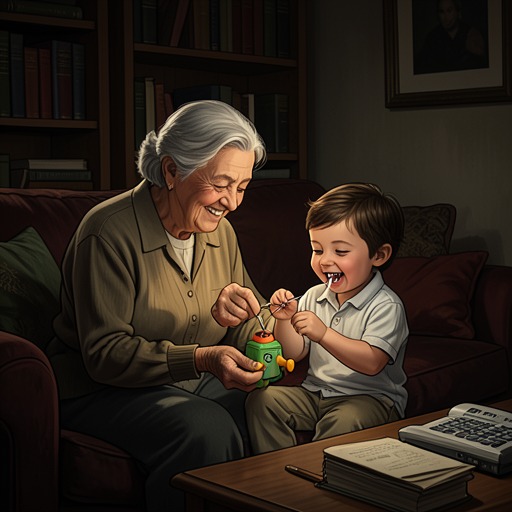
One morning Sophia finds a complete skull belonging to a large animal. Grandmother thinks it may be a seal’s. They conceal it in a basket and wait until evening to place it in the woods. In the red light of sunset, the skull lies on the ground, its teeth showing. Sophia suddenly screams for it to be taken away. Grandmother picks her up and holds her without speaking; after a while Sophia falls asleep. The episode shifts the collecting from shared fascination to acute fear. Rather than explain the skull away, Grandmother turns in thought toward a different project: a matchbox house on the sandy beach by the blueberry patch, with a dock and windows made of tinfoil.
The works do not remain as a permanent exhibition. The wooden animals are allowed to vanish into the forest; the bone patterns sink into the ground and grow green with moss. The trees continue to slip deeper into one another as time passes. Grandmother often returns at sundown, while in daytime she sits on the veranda steps making boats from bark. The forest’s art is thus subject to the same processes as its wood and bones: it can be absorbed, obscured, and changed by the place that first made it possible.
Narrative significance
The Magic Forest joins ecological restraint to imaginative attention. Its conditions cannot be controlled without risk, and its hidden life does not become fully available to human view. The family’s initial effort to intensify its strangeness fails, while Grandmother’s quieter practice depends on patience, solitude, and materials already shaped by weather and decay. The distinction is not between nature and art, but between imposing an arrangement and noticing forms within what is already there.
The forest also holds contrasting responses to mortality. Grandmother can place bones among trees and make patterns from them; Sophia’s scream at the exposed skull shows that the same objects can become unbearable when they are seen as remains rather than as material for play. Afterward, the forest’s figures and bone designs gradually disappear into moss and decay, while Grandmother continues to visit. The place does not preserve the work unchanged. Its significance lies instead in the temporary meeting of people, found forms, and a landscape whose own processes continue beyond them.