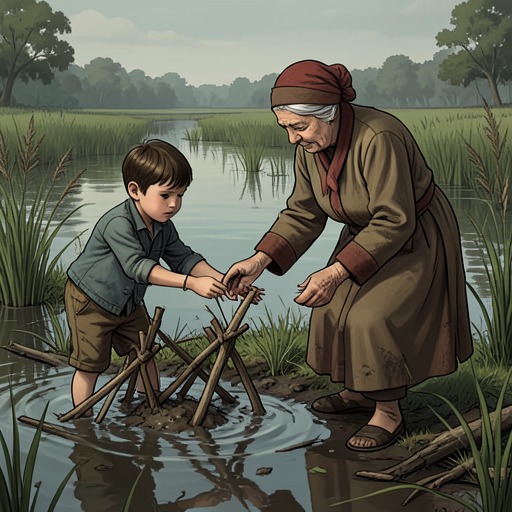
Micro-Venice rebuilt after being flooded
The Summer BookThe flooding and rebuilding of miniature Venice is a shared act of imaginative play that becomes a small drama of loss and repair. Sophia and Grandmother first make a city in a marsh pool; when rain and wind turn the marsh into a bay, Venice vanishes beneath the water. Grandmother answers Sophia’s distress not by denying the flood, but by rebuilding the city’s central palace and helping their invented world survive the real one’s change.
Making a City
The game begins as a negotiation over family roles. Sophia asks Grandmother to play her mother and casts herself as a beloved child from Venice who has made a canal. Grandmother proposes a different frame: they will be old Venetians building a new Venice. Together they set to work in the marsh pool, laying little wooden plugs as pilings for the Piazza San Marco and covering them with flat stones. They dig more canals, bridge them, and watch black ants hurry across the crossings while imagined gondolas glide below in the moonlight. Sophia gathers white marble fragments from the shore and presents one as a new palace.
The make-believe city also gives the pair a way to approach a more difficult question about family. When Grandmother explains that she is only a mother to Sophia’s father, Sophia protests that he alone gets to call her Mama, throws the new palace into the water, and stalks away. Grandmother responds by making a Doge’s Palace model from balsa wood. She invents a household living inside it: a daughter has thrown china plates from a window, and the mother must answer for the broken dishes. Sophia supplies the mother’s imagined retort, turning the scene into a joke about whether there can be no end to a mother’s china. Their play does not settle the question of who may claim the name Mama, but it gives the hurt a form they can handle together.
Venice Grows, Then Floods
The palace joins the piazza, and the imagined population expands. Grandmother makes more palaces; families call to one another across the canals about how far their buildings have sunk and what their mothers are cooking. The city acquires a hotel, a trattoria, and a campanile topped with a little lion. Grandmother grows increasingly absorbed in the construction. Though she has not been to Venice for a long time, she remembers its street names particularly well, because her memory is strongest for distant events. A green salamander entering the Grand Canal even forces the imagined traffic to detour.
That evening, the weather changes. Rain begins, the wind shifts southeast, and the radio reports low pressure and winds of up to thirty miles an hour. At first no one takes the forecast seriously. But Grandmother wakes repeatedly to rain striking the roof and waves outside. Remembering how the miniature city is already built to sink, she worries about both Venice and Sophia. At dawn she puts an oilskin over her nightgown, covers her head with a sou’wester, and walks into the wind with her walking stick. The shore is flooded. Sophia runs toward her across the rock, crying that Venice has sunk and is gone.
Rebuilding the Palace
Grandmother tells Sophia to return to bed, change out of her soaked nightgown, and close the cottage door. She promises to find the palace. Sophia is too upset to listen, so Grandmother goes with her to the cottage and makes sure she goes inside before returning to the shore. The marsh has become a bay: waves wash into the heather and retreat, while the alders stand out in the water. The city is no longer visible beneath the flood. Grandmother looks at the scene for some time, then turns home rather than continuing to search the water.
Inside, she lights the lamp, gets out her tools, chooses a suitable piece of balsa wood, and puts on her glasses. The replacement Doge’s Palace is ready at seven o’clock, when Sophia comes banging at the door to ask whether Grandmother has found her. Grandmother says that everyone in the palace is still there. But the new model looks too clean to have survived a flood. Before opening the door, she pours water over it and rubs its cupolas and walls with ashes from the ashtray, making the rebuilt palace look weathered by the storm. The careful alteration matters: she does not merely provide a replacement object; she makes it belong to the story of what has happened.
Listening for the City
Sophia examines the palace closely, sets it on the nightstand, and says nothing. When Grandmother anxiously asks whether it is all right, Sophia asks for quiet so she can hear whether the mother in the palace is still there. They listen together for a long time. Then Sophia reports that the mother considers it a dreadful storm and is cleaning up the mess, exhausted. Grandmother agrees that she must be worn out.
The ending leaves the imagined family in the aftermath rather than erasing the flood. The city has disappeared from the marsh, and its palace has had to be made again; within the game, its inhabitants have survived and are busy repairing their home. Grandmother’s water and ashes connect the new model to the actual storm, while Sophia’s act of listening gives the rebuilt scene its emotional confirmation. The episode makes play a practical language between them: it allows Sophia’s alarm to be taken seriously, and lets Grandmother answer it with a promise she can keep in wood, water, and ash.