Midsummer
The Summer BookMidsummer in The Summer Book is a seasonal festival whose familiar signs—birch greenery, a bonfire, a shared meal, and fireworks—are repeatedly tested by weather and by the demands of life at sea. The holiday begins as an occasion arranged around Eriksson’s promised visit, turns into a night of salvage on the Gulf of Finland, and ends with one water-damaged rocket rising at sunrise. Its contrast between domestic ceremony and practical improvisation gives the celebration its distinctive shape.
Preparations and Expectation
Just before Midsummer, Eriksson lands at the island with a box of fireworks he acquired in an exchange. He says he will return on Midsummer Eve so they can see whether they work. The box is damp, so the household puts it beside the stove. His promise becomes the focus of preparations: Grandmother blackens and polishes the stove, paints its doors silver, and has the windows and curtains washed. No one expects Eriksson to notice the clean house; the effort matters because he is coming.
The day before the celebration, the family gathers birch, rowan, and lilies-of-the-valley. On the larger islands toward the mainland, mosquitoes are so troublesome that the gatherers shake aphids and ants off the plants in the sand before returning. At home, they make the house a green bower, setting each birch in its own pail of water. Almost all the wildflowers are white, as befits the season. The preparations make Midsummer visible indoors as well as outdoors: greenery transforms the house, while the polished stove and silver doors lend the ordinary room a festive finish.
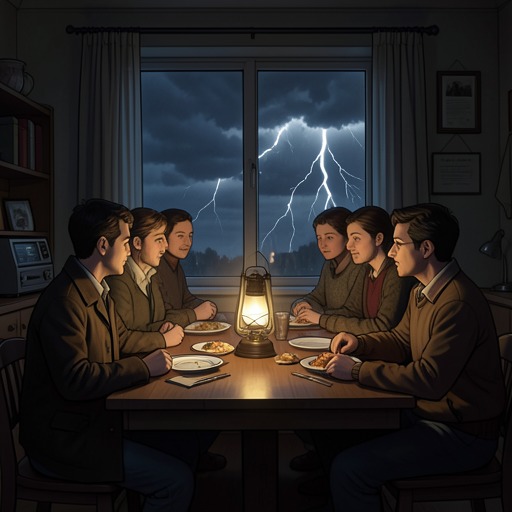
The meal is planned for four, with herring, pork, potatoes, two kinds of vegetables, and marinated pears for dessert. Sophia worries that Eriksson will refuse the vegetables, which he calls grass, and will not eat dessert. Grandmother knows this, but keeps the food on the table because it looks nice. The gesture captures a small tension in the welcome: the household prepares for a guest whose habits and attention remain largely his own, rather than tailoring the celebration to secure his approval.
Weather, Custom, and Memory
Midsummer Eve opens under a strong north wind. Rain starts toward noon, and Sophia’s father spreads a tarpaulin over the bonfire laid out on the point. It blows into the water, as it always does; he puts a can of petrol behind a tree, since a Midsummer bonfire that fails to burn would be a disgrace. The launching platform for Eriksson’s fireworks stands on the veranda, its cradles angled upward, but the weather keeps the promised spectacle uncertain. The wind continues through the day, with occasional showers, while terns call from the point.
Grandmother’s recollection of Midsummer in Sweden supplies a contrasting image. When she was young, she remembers still air, a garden in bloom, and a maypole garlanded up to its small banner. Sweden had no bonfires. Lying beneath the birch greenery, she wonders why there had never been a fire, then falls asleep. The memory does not resolve into a general account of the holiday; it sets two particular versions beside each other—one associated with stillness and a maypole, the other with a bonfire that the island’s wind repeatedly threatens.
The evening also follows a rule of its own: no lamps can be lit on Midsummer. When a shout and a slamming door wake Grandmother, the room is dark, and she understands that Eriksson must have arrived. Sophia calls for haste: he does not want to eat, and they must start at once and dress warmly. The expected domestic guest has brought no time for the carefully planned supper. The holiday’s schedule gives way to his urgency.
The Night at Sea
Grandmother gathers her sweater, warm trousers, walking stick, and Lupatro, while the others hurry about and Eriksson’s motor runs at the shore. Outside, the wind has shifted west; fine rain falls, and the surroundings are lighter than the unlit room. Grandmother goes down alone and climbs aboard. Eriksson does not greet her: he watches the sea, and they set off without speaking. From the floor of the boat she catches glimpses of the rising and falling water beyond the rail and sees the first Midsummer bonfires along the northern coast, faint through rain and fog.
Eriksson heads south for Outer Skerry, where other boats converge. Wooden crates of rounded bottles bob in the choppy grey water, their upper edges showing dark above the surface. Boats race in, slow long enough to haul crates aboard, and hurry off again. The Coast Guard moves through the area in powerful boats, salvaging what it can while turning a blind eye to the others. The scene makes the night’s activity neither an orderly public operation nor a simple loss at sea: salvage proceeds in a shifting company of boats, with the recovered cargo going into different hands.
Sophia’s father leans over the rail to lift the crates aboard while Eriksson holds the rudder. They work faster, reducing each movement to save time, until their motions fit the movement of the boat so closely that the work becomes a pleasure to watch. Grandmother observes and remembers their coordination. Around them, more of the Midsummer bounty tosses on the Gulf of Finland. Far toward the mainland, a few weak rockets rise against the grey sky; Sophia, meanwhile, has fallen asleep. The festival’s lights remain distant while the family’s attention is on the sea and its cargo.
Dawn and the Failed Fireworks
By morning, the makeshift fleet divides. The boats drift apart and set off separately for home; by dawn the sea is empty, the wind has died, and the rain has stopped. A clear, lovely morning spreads colour across the sky, though it is very cold. When Eriksson lands at the island, the terns begin screaming. He leaves his motor running and departs again as soon as the others have climbed out, continuing south to check that nothing has been missed.
For a moment, Sophia’s father thinks Eriksson might share the salvage, but the thought passes. He makes sandwiches for everyone and brings the box of fireworks onto the veranda. The first rocket will not light, nor the second; the water has ruined all but the last. That final rocket rises toward the sunrise in a shower of blue stars, and the terns begin screaming again. The single successful launch gives the holiday its closing image: the promised fireworks have mostly failed, but one brief display survives the wet night.
A Festival Made and Remade
Midsummer joins household ritual to conditions the household cannot command. The clean windows, birch bower, meal, bonfire, and fireworks are prepared in advance, yet rain and wind interfere with the fire and soak the rockets. Eriksson’s arrival redirects the evening from supper to salvage; the family’s participation becomes part of a larger movement of boats across the Gulf of Finland. The celebration is therefore not simply cancelled or preserved. Its expected forms are interrupted, then reassembled around the work at sea and the one rocket that still burns.
The ending holds together two kinds of Midsummer light: the weak rockets seen from the boat in the grey evening and the final blue stars above the island at sunrise. Between them lie darkness without lamps, rain, a cold dawn, and the quiet dispersal of the fleet. The holiday’s meaning in this episode rests less on an uninterrupted ceremony than on what the people do when ceremony meets weather, work, and the habits of a solitary visitor.