Midsummer sea salvage operation
The Summer BookThe Midsummer sea salvage operation is a night-long recovery of floating crates in the Gulf of Finland, undertaken by Eriksson, Sophia’s father, and Grandmother among many other boats. Its significance lies in the contrast between the disorderly, rain-dark sea and the practiced coordination of the people working on it: the cargo is recovered, the fleet goes home, and a single surviving firework carries the night into morning.
The summons and departure
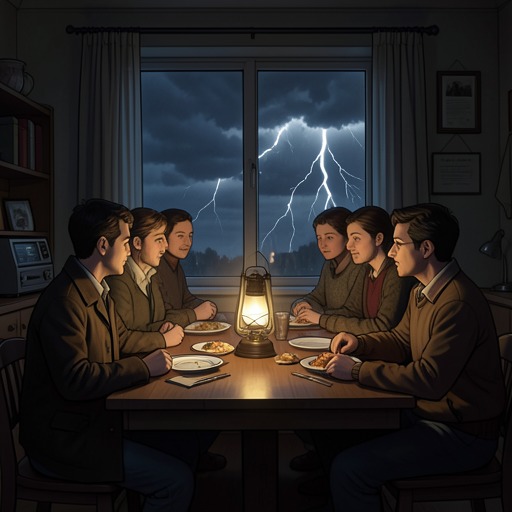
The operation begins after a day of piercing wind and occasional showers. Grandmother has been thinking about Midsummers in Sweden, when the garden bloomed around a garlanded maypole and there was no wind; she falls asleep on the bed beneath birch greenery. Then a shout and a slammed door break the quiet. Since lamps cannot be lit on Midsummer, the room is dark when Grandmother sits up and understands that Eriksson has arrived. Sophia calls for everyone to hurry: there is no time to eat, and they must dress warmly.
Grandmother gets to her feet, finds her sweater, warm trousers, and walking stick, and at the last moment puts the Lupatro in her pocket. The others are moving quickly, while Eriksson’s motor runs at the shore. Outside, the light has begun to return. The wind has shifted west, and a fine drizzle hangs over the water. Grandmother walks down alone and climbs aboard. Eriksson offers no greeting; he watches the sea, and nobody speaks as they set off. From the boat’s floor, Grandmother catches brief views of the rising and falling water over the rail. Along the northern coast, the first Midsummer bonfires appear faintly through rain and fog.
The salvage at sea
Eriksson steers straight south for Outer Skerry. Other boats are heading the same way, emerging from the darkness like shadows. Wooden crates, loaded with rounded bottles, bob in the grey, choppy water, their upper edges showing black above the surface. Boats race in, slow only long enough to haul crates aboard, and then accelerate away again. The narration compares the recovery to a neatly balanced dance: the crews move swiftly amid the waves, while the Coast Guard patrols in powerful boats, salvages what it can, and turns a blind eye to the other boats.
The activity does not become a conversation or a contest between crews. All the boats are out on the same water, ignoring one another as they work. The sea is both the source of the bounty and the condition that makes the work urgent: crates rise and fall in the chop, and every delay risks losing time or cargo. As the night continues, more of the Midsummer salvage appears around them in the Gulf of Finland. Towards the mainland, a few weak rockets rise against the grey sky, their brief trails resembling arrows of light.
Work in concert
Aboard Eriksson’s boat, the roles are clear. Eriksson holds the rudder, while Sophia’s father leans over the rail and lifts the crates on board. They increase their pace, cutting unnecessary movements so that they will not lose a second. Their separate tasks settle into such exact harmony with the motion of the boat that Grandmother watches with appreciation and remembers what she sees. The scene makes skill visible not as a boast but as timing: steering, reaching, and hauling fit together while the vessel moves beneath them.
Sophia, who had been part of the hurried preparations, falls asleep during the salvage. Grandmother remains awake to watch the work and the spreading field of crates. Her attention gives the operation a second register beyond the practical recovery: she witnesses the coordinated labor and stores it in memory, even as the night’s activity continues around the boat. The cargo is ultimately salvaged, though the account leaves an ambiguity about who has the right to what, observing that some of it reaches the right hands and some the wrong ones. Nothing is simply lost.
Dawn and aftermath
Towards morning, the makeshift fleet breaks apart. Boats drift farther from one another and head home individually. By dawn the sea is empty; the wind has died and the rain has stopped. The clear Midsummer morning brings color to the sky, but it is very cold. When Eriksson lands at the island, the terns begin screaming. He leaves the motor running and sets off again as soon as the others have climbed out, later sailing south once more to make sure nothing has been missed.
For a moment, Sophia’s father wonders whether Eriksson might have shared the booty, but the thought passes quickly. He makes sandwiches for everyone and brings Eriksson’s box of fireworks onto the veranda, setting the rockets in their launching cradles. The first will not light, nor will the second; the water has ruined all of them except the last. That rocket rises towards the sunrise in a shower of blue stars, and the terns scream again. The salvage has produced a successful night’s work, but the planned fireworks cannot properly follow it: one brief launch, against the new morning, is all that remains of the display.