Moppy
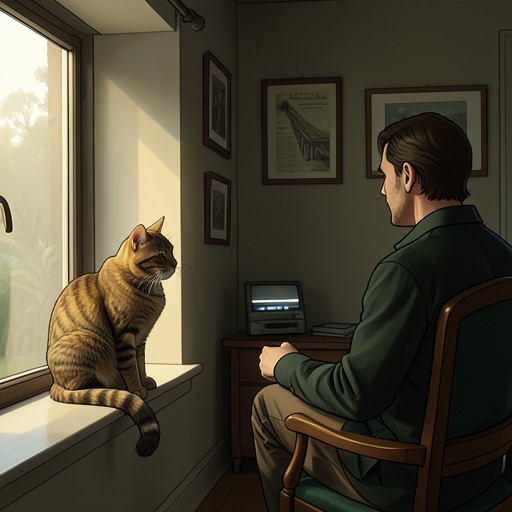
The Summer BookMoppy is a fisherman’s cat whose independence repeatedly frustrates Sophia’s desire for affection. Their relationship moves from intimate care to pursuit, estrangement, and a fierce acknowledgment of love: the more Sophia tries to draw him close, the more readily he withdraws. His habits and hunting remain distinctly his own, while the family’s responses expose the limits of affection as a means of changing an animal.
Early Life and Habits
Moppy arrives as a tiny kitten, too young to drink without a nipple. The family finds Sophia’s baby bottle in the attic and initially keeps him warm in a tea-cosy. Once he can walk, he sleeps in the cottage in Sophia’s bed, with a pillow beside hers. This beginning places him within a scene of careful, almost intimate nurture, but it does not establish the closeness Sophia hopes will last.
As he grows quickly, Moppy leaves the cottage for the house. He settles under the bed in the box used for dirty dishes, a choice that gives him a sheltered sleeping place but creates a practical problem for the household: when the box fills, he howls until someone washes the dishes. Sophia carries him back to the cottage and tries to win his favor, only for him to return to the box. His name is Ma Petite, though the family calls him Moppy; even from the start, the story presents him as a creature with preferences that do not yield to Sophia’s efforts.
Sophia’s Pursuit and Moppy’s Withdrawal
Sophia describes their mismatch as a painful rule of love: the more she loves Moppy, the less affection he seems to return. Grandmother recognizes the pattern, while Sophia’s response is to keep loving him with greater intensity. Yet her attachment is not simple happiness. She admits that she sometimes thinks she hates him, feels unable to continue loving him, and still thinks about him constantly.
For weeks Sophia pursues Moppy, speaking softly and offering him comfort and understanding. At times she loses patience, yelling or pulling his tail. Moppy hisses and runs under the house; afterward, he eats better and sleeps for long stretches, curled up beyond reach. The sequence makes their relationship a recurring approach and retreat, not a steady domestication: Sophia’s attention does not secure the closeness she wants, and his withdrawal does not end her preoccupation.
The strain begins to displace Sophia’s play and gives way to nightmares. Moppy, meanwhile, grows into a lean, wild animal. One June night he does not return to his dish box. In the morning he comes into the house, stretches, sharpens his claws on the rocking chair, and goes to sleep on the bed. His unhurried conduct appears to Grandmother as a sign that he has begun hunting; the next morning confirms it when he brings a small bird to the doorstep.
Hunting and Estrangement
Moppy’s hunting changes the terms of the conflict. Sophia is distressed by the dead bird and cannot accept the distinction between animals Moppy treats as prey and animals she considers appealing. She stops speaking to him for three days. Thereafter, Moppy goes into the woods at night and brings prey into the house in the morning. The family throws the remains into the sea, while Sophia repeatedly calls from outside to ask whether the evidence has been cleared away. Her anger makes the mornings and even the household’s coffee feel different.
Moppy eventually stops displaying his catches. Grandmother discovers evidence of continued hunting beneath a floorboard after dropping her cigarette holder through a crack in the veranda. She knows he has not stopped; concealment has only changed what the family must see. When Moppy later rubs against her leg, Grandmother draws away. His food dish remains untouched by the steps and attracts flies. Sophia, meanwhile, voices a wish that either Moppy had never been born or she had not been born. Grandmother’s question about whether they are still refusing to speak underscores how a conflict that began with affection has become a household estrangement.
Attachment and Ending
During a storm, Moppy lies on his back instead of responding to Sophia’s alarm. In a burst of anger, she puts him outside and urges him to behave like a hunter; then she begins to cry and runs to Grandmother. Her demand to have Moppy back is not a claim that their difficulties have passed. Sophia expects their relationship to remain difficult, but still chooses him as the object of her love.
Moppy’s importance lies partly in what he resists: Sophia’s care cannot make him consistently affectionate, and her distress does not make him stop hunting. The story gives his habits and preferences consequences independent of her wishes, even as his distance becomes the focus of her emotional struggle. Their ending, as presented here, is therefore an acknowledgment rather than a resolution. Sophia wants him back knowing the relationship may again be painful; the evidence does not establish what happens after that plea.