Moppy and Fluff’s exchange and return
The Summer BookThe exchange and return of Moppy and Fluff turns Sophia’s longing for an affectionate pet into a choice between easy companionship and attachment to one particular, independent cat. Moppy’s growing wildness leads Sophia to accept a replacement, but Fluff’s docility cannot satisfy her. When a storm exposes that difference, she asks Grandmother to exchange the cats back, knowing the familiar difficulties will return with Moppy.
Moppy’s independence and Sophia’s pursuit
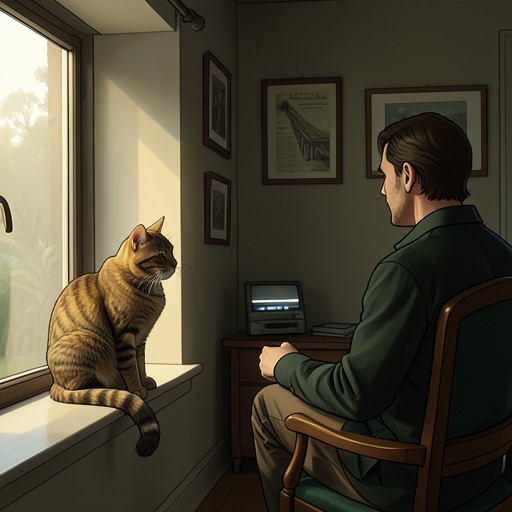
At first, Moppy gives Sophia little of the response she hopes for. She carries him to pleasant places, hugs him, and confides secrets, while he shows little interest beyond food and sleep. He tolerates her embraces, then returns to the dish box. His reserve is not a brief phase that Sophia can overcome by trying harder: week after week, she pursues him with gentle words and comfort, but he remains difficult to reach. In moments of frustration she sometimes shouts or pulls his tail; he hisses, runs under the house, and later resumes his usual habits of eating and sleeping.
The relationship takes a toll on Sophia. She says she sometimes thinks she hates Moppy because she has no strength left to keep loving him, even as she cannot stop thinking about him. She stops playing and begins having nightmares over his refusal to be affectionate. These changes make the mismatch between the child’s need for an answer and the cat’s indifference more than a passing disappointment. Moppy does not appear to understand himself as withholding something Sophia is owed; the narration presents him as absorbed in a life of his own.
In June, Moppy spends a night away from his dish box. He comes back the next morning, stretches, sharpens his claws on a rocking chair, and goes to sleep on the bed. Grandmother infers that he has begun hunting. The following morning, he brings a small bird to the doorstep. Sophia turns pale and leaves rather than approach him. Grandmother later observes that wild animals such as cats do not distinguish between prey that people regard differently. Sophia answers by resolving not to speak to Moppy for three days, and then stops talking to him. The episode sharpens the distance between her human judgments and Moppy’s independent animal behavior; it does not make him more responsive or bring the two closer.
Fluff arrives and the first exchange
Moppy becomes wilder and rarely enters the house. His appearance and movements belong to the island landscape: his light yellow-grey, striped coloring recalls granite and sunlight on a sandy bottom, while his passage through the grass is compared to a stroke of wind. He watches from the thicket, slips beneath the creeping pines, and grooms himself when the sun returns. The account describes him as happy, but not as sharing that happiness with anyone. His life remains largely beyond Sophia’s knowledge.
One Saturday, the Övergårds arrive for coffee. Their boat is loaded with bags, jerry cans, and baskets, one of which holds a meowing cat. Sophia lifts the lid, and the cat licks her hand. Unlike Moppy, this large white cat continues purring when she picks it up and carries it ashore. Anna Övergård explains that the cat is not a mouser, so they had planned to give it to friends. Sophia sits on the bed with it on her lap, experiencing its warmth, softness, and steady purring. The exchange is quickly arranged, with a bottle of rum closing the bargain. Moppy is captured and taken away on the Övergårds’ boat before he understands what is happening.
The replacement, named Fluff, provides the companionship Sophia has been trying to get from Moppy. Fluff eats fish, welcomes petting, moves into Sophia’s cottage, and sleeps in her arms each night. In the morning it joins her for coffee and sleeps beside the stove; in sunshine it rolls on warm granite. Its ready affection changes the daily rhythm of the cottage, but does not erase Sophia’s attachment to Moppy. When Fluff settles in Moppy’s usual place, Sophia carries it elsewhere and directs it to the new spot. Fluff obediently rolls there and licks her nose. The correction preserves Moppy’s place in the household even while another cat occupies it.
The storm reveals what the replacement cannot do
The summer turns into a long succession of calm, blue days. Sophia remarks that fine weather can become boring. Grandmother connects the preference to Sophia’s grandfather, who also liked storms, but Sophia leaves before she can hear more. The wind rises during the night, and by morning a southwester is throwing foam over the rocks. Sophia wakes Fluff to tell it that there is a storm. The cat stretches and purrs but remains sleepy beneath the sheet.
Sophia’s frustration escalates when Fluff does not respond to her excitement or act as she expects a cat should. She shouts, opens the door, and puts Fluff outside in the wind, urging it to hunt and behave like a cat. Then she begins to cry, runs to the guest room, and bangs on the door. The storm has not changed Fluff’s temperament; rather, it makes the contrast between this calm, affectionate pet and Moppy’s wildness newly urgent. Fluff can offer closeness, but it cannot become the particular cat Sophia wants beside her in this moment.
Sophia tells Grandmother that she wants Moppy back. Grandmother reminds her that she knows what life with him will be like. Sophia acknowledges that it will be awful, but says that Moppy is the one she loves. The exchange is therefore not a discovery that Moppy has become affectionate, nor a promise that Sophia can reform him. She chooses the relationship as it is, with its frustration and lack of reciprocity, rather than continuing to accept the comfort Fluff readily provides. Grandmother and Sophia exchange the cats again.
Consequence and significance
The return completes a compact reversal: Sophia gives up an unresponsive cat for a welcoming one, experiences the ease of Fluff’s affection, and nevertheless asks for Moppy back. The storm is the immediate occasion, not a cure or transformation. Before it, Moppy’s hunting and withdrawal have already shown how little his life conforms to Sophia’s hopes; afterward, the decision to restore him leaves that independence intact. The narrative gives no suggestion that Moppy understands either exchange or that his behavior changes because of it.
The two cats make the emotional choice concrete. Fluff is warm, submissive, and content to be petted and held; Moppy is elusive, absorbed in food, sleep, and hunting, and offers Sophia no assurance that her care will be returned. The first exchange appears to solve the problem of unreciprocated affection by replacing its object. Its reversal shows that Sophia’s attachment is not simply a preference for receiving affection: she wants Moppy, even when being with him is difficult. The conclusion preserves the tension rather than resolving it. Moppy returns to Sophia’s life, but the gap between her love and his apparent indifference remains.