Push machine event
The Summer BookThe Road is a bulldozer road-building episode in which a practical effort to reach the sea becomes a visible remaking of the woods. Sophia sees the machine uproot trees and displace boulders, follows the new route to the shore, and finds the bulldozer stalled in a hollow. The contrast between the crew’s forceful plan and the machine’s sudden immobility gives the episode its turn: the landscape is damaged, but it does not yield completely to human intention.
Background and purpose
The village men have rented an exceptionally large bulldozer, at a cost of more than a hundred marks an hour including its journey to and from town. They guide it through the woods toward the water, where it is meant to make a road. The machine does not follow the existing path; it advances directly toward the shore. Its purpose is straightforward, but the scale of the work makes the road more than a new means of access: the crew has to clear the route by remaking the ground it crosses.
Sophia encounters the operation while carrying a milk can. She watches from behind a rock, frightened and captivated by the machine’s power. The men move around it as they try to keep it on course. From her perspective, the bulldozer seems to act without regard for the small lives and settled features of the woods. Her thought that it would be unpleasant to be an ant at that moment gives the scene a change of scale: the machine’s work, ordinary to its operators, appears immense from the point of view of the creatures and plants in its path.
The road through the woods
The bulldozer lifts boulders and breaks through trees as it proceeds. A bird-cherry tree falls, and the ground exposed beneath it is dark. Sophia’s attention follows these changes in succession, so the route is registered not just as a line cut through the woods but as a sequence of losses to the landscape. The machine carries on toward the sea while the men call to one another and try to direct it.
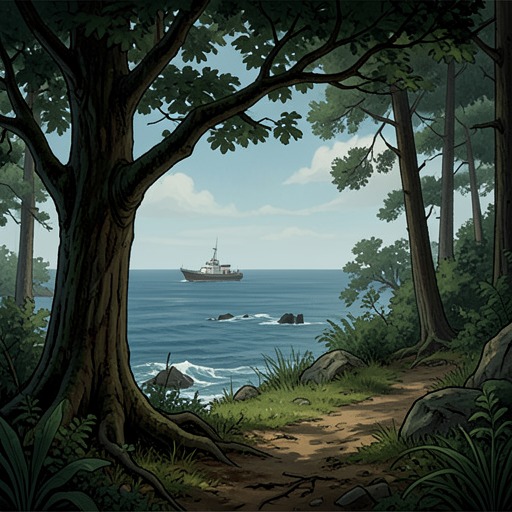
After collecting the milk and the mail, Sophia returns along the newly made road rather than the old path. The altered route offers an unfamiliar passage through the woods. On either side, the forest has been pushed back and bent; broken trunks, exposed roots, and drying soil mark the disturbance. The road appears longer than the former path, and the woods are quiet. The description makes the human-made route legible through what has been displaced to create it: the new way through is inseparable from the damage along its edges.
The machine stops
At the bay, the bulldozer has reached the meadow by the beach but has slid sideways into a hollow and raised sand around itself. The grassy bank has given way, leaving the machine at an awkward angle. The crew is no longer there. Sophia finds Emil Ehrström sitting beside the bulldozer and learns that the others have gone back for equipment. His response to her question about the equipment is dismissive, but she continues across the meadow rather than staying to ask about the stranded machine.
The stalled bulldozer reverses the direction of the scene. Until then, it has seemed able to push aside whatever obstructs its route; at the shore, the ground defeats its progress. The road-building has not simply ended in a completed connection to the water: the machine is left in the hollow, and its operators have had to leave to fetch what they need. Sophia regards the situation as something she will be able to tell Grandmother about. Grandmother is waiting by the boat at the point, and Sophia imagines that the machine might be enjoyable to ride instead of walking. Her response holds the episode’s fear and fascination together, without making her the person responsible for the work.
Island change and significance
The episode belongs to a book in which human alteration of the island takes different forms. Elsewhere, Sophia’s father imports black soil and plants bulbs, shrubs, and trees; he digs into the ground, builds protective stone walls, and modifies the marsh pond with a concrete dike. Those carefully planned works are distinct from the bulldozer’s road, but together they show how people attempt to reshape the island for access or cultivation. The consequences are not presented as equivalent: the road scene concentrates on the abrupt clearing of woods, while the planting project depends on sustained care and protection.
That later gardening also exposes the limits of such efforts. When spring stays dry, the island’s own turf browns, spruces die, and the water basin used for irrigation empties. These events do not follow from the bulldozer’s work, but they place its display of mechanical force within a wider account of an environment that cannot be mastered simply by human plans. The machine can cut a route toward the sea; it cannot guarantee that the terrain will bear it. Its stranded position leaves the road episode suspended between transformation and resistance, while Sophia’s attentive passage over the new track makes the altered woods the lasting record of the attempt.