Solitude and Companionship
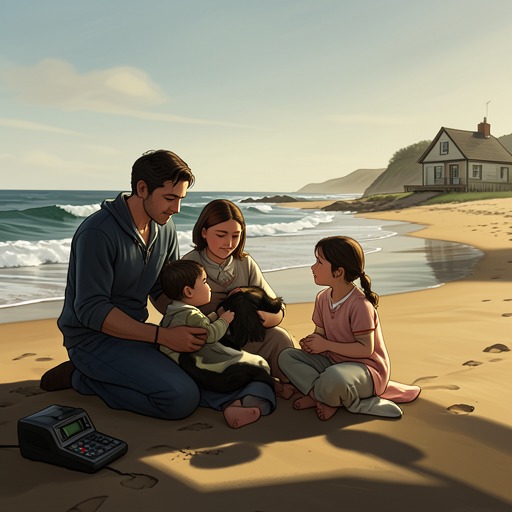
The Summer BookSolitude and Companionship is a recurring tension in The Summer Book: the island offers distance and quiet, but its inhabitants remain bound together by visits, obligations, shared labor, and a horizon that can change. Solitude is not simply a refuge from society. It is a luxury that people seek, a condition that others may impose, and sometimes a way of being together without demanding intimacy.
Eriksson’s watchful independence
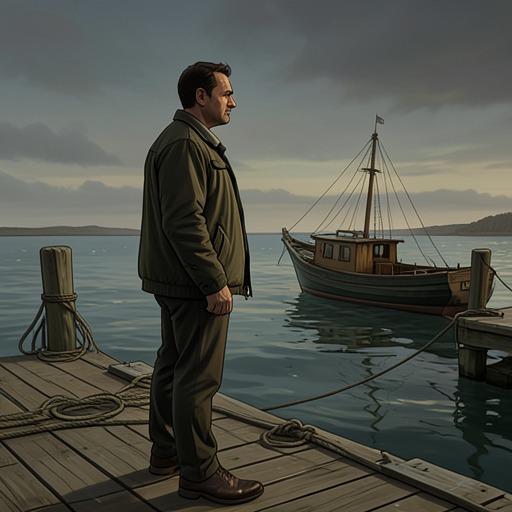
Eriksson embodies a form of solitude that is active rather than withdrawn. The family recognizes that he does not particularly care for fishing, hunting, or motorboats, even though these are the visible parts of his life. What draws him is the sea’s capacity for sudden change: drifted objects, groundings, and things shifted overnight by the wind. Following such possibilities calls for experience, imagination, vigilance, and what the narrative calls “a good nose.” His attention moves freely across the water, and he seems to live in a quiet, perpetual excitement of his own.
That independence does not make Eriksson useless to others. He fulfills people’s often whimsical requests, from finding a half-ton round rock to supplying things they hope to keep. The search itself appears to matter to him, though no one knows what he finds for himself along the way. His work joins personal freedom to service: while looking for something for someone else, he can remain free to discover what was not expected. The family’s dreams, in turn, cost petrol, and gifts he leaves—fish, a rooted wild rose, a nameplate, a metal box, glass floats—offer a rare chance to put a price on those dreams.
Eriksson’s visits preserve his distance. He may arrive at any hour, accept coffee, a meal, or a drink, and then fall quiet, listen, and leave. He says little about himself or other people, yet while he is present the family’s attention gathers around him; afterward, they think gravely about what he did not say. His reserve is not the same as indifference to the world. He watches the sea closely, but does not make himself socially available in the ordinary way. Sophia adores him, and he treats her with the same solemn greeting and brief nod he gives the others, without asking her age or what she does. Their connection rests on recognition without interrogation.
The Midsummer salvage makes visible how this solitary watchfulness can become coordinated companionship. Eriksson arrives in a rush, and Grandmother dresses warmly, takes her walking stick and Lupatro, and boards his running boat alone. He keeps watch without greeting her, and the voyage begins in silence. On the way south to Outer Skerry, other boats emerge from the darkness to retrieve crates of bottles bobbing in the rough Gulf of Finland. The Coast Guard salvages what it can while turning a blind eye to the other boats. Eriksson holds the rudder as Sophia’s father hauls crates aboard; their motions become so closely timed that the work is a pleasure for Grandmother to watch and remember. Sophia falls asleep. By dawn the boats have dispersed, the sea is empty, and Eriksson leaves again almost as soon as the family is ashore, returning south to check that nothing has been missed. The episode makes companionship an accomplished rhythm of shared labor, not a demand for conversation or permanent closeness.
Malander and the contested horizon
Malander gives solitude a more explicit name. He says that fishing does not interest him; what he likes is primitive, undisturbed nature, wilderness, and solitude. Grandmother answers that solitude is a luxury, then adds that a person can also find it with others, though this is more difficult. Their exchange exposes a difference between solitude as an ideal of being left alone and solitude as an inward condition that need not depend on isolation. Malander’s alert but vague response leaves the difference unresolved.
His house on Blustergull Rock makes the problem spatial. The family initially avoids discussing the new building because they have learned not to talk about painful things, but they remain keenly aware of it. From their familiar view of skerries and channel markers, the big square house cuts into the horizon. It gives an anonymous outer skerry a name, closes its lagoons, and ends the family’s position as the people living farthest out. The neighbor is less than a mile away, yet the family imagines the company he might bring—children disturbing the moss, a radio, and constant talk—as an encroachment on the quiet they value.
When Grandmother and Sophia row to Blustergull Rock, the sign reading “PRIVATE PROPERTY – NO TRESPASSING” turns distance into a question of access. Grandmother is angry enough to treat the sign as an insult and declares that going ashore is a demonstration of disapproval. The act is not a simple rejection of solitude: it challenges the neighbor’s attempt to define the island as exclusively his, while acknowledging that the family’s sense of its own far-flung privacy has already been altered. Sophia accepts Grandmother’s explanation as a lesson in how social rules can be answered with deliberate trespass.
After visiting Malander, Grandmother judges that he wants to be left alone but has not yet understood that about himself; she also predicts that he will build his dock anyway. She sees him as a person still working out an idea, vulnerable to losing it or recognizing it too late to begin again. His house consequently becomes more than an intrusion. Every time a storm comes, the family thinks of Malander and considers ways to save his boat, although he never returns their visit. The landmark that first breaks the clarity of the horizon becomes something to reflect on and a focus for concern across the distance between them.
Solitude among others
Grandmother’s remark to Malander is grounded in her own practice of companionship. She does not equate closeness with constant speech or agreement: she can row away from a visit feeling sad, see the neighbor’s possible mistake clearly, and still continue thinking about his safety. Her idea of finding solitude with others recognizes that people may share space without dissolving into one another. The ease of that arrangement is uncertain, but the possibility matters in a place where neighbors, weather, and water repeatedly bring separate lives into contact.
Verner’s account gives this contact a more burdensome side. At seventy-five, he says it is not easy simply to do what he likes, because one must be considerate of those who feel responsible for him; when it comes down to it, he feels mostly in the way. His words complicate solitude as a freedom freely chosen. A person may be physically apart yet constrained by other people’s care, and consideration can become an awareness of being a responsibility. Grandmother responds by stopping to replace a piece of moss with her walking stick, a small act of care for the island’s living surface as Verner speaks about the difficulty of his own place among people.
The family’s efforts during the drought offer a contrasting kind of togetherness: practical, urgent, and dependent on what the landscape permits. Sophia’s father brings an enormous orange plastic sausage to Bog Skerry, where he pumps thousands of litres of bog water into it. The hot boat, running tar, stench of plastic, and slow swelling of the vessel make the undertaking feel precarious even before it is moved. When it will not budge, he throws himself against it; it slides off the sea grass, and the family then has to shift forward as it sinks and drags at the motor, leaving less than four inches between the gunwales and the water. Their shared danger is not the same as chosen intimacy, but it makes clear that island independence depends on mutual effort as well as individual resolve.
The great storm sharpens the contrast between private experience and common exposure. Sophia believes her prayer has brought the storm, runs into the wind, and celebrates it as her own. At the same time, Sophia’s father wakes to remember his nets and pushes his boat out against the waves; Grandmother wakes to the breakers’ rumble through the rock. The storm is intensely personal to Sophia, yet its force reaches beyond her and interrupts the island’s separate routines. Across these scenes, companionship does not erase solitude: it arises when people attend to the same changing conditions, whether through silence, work, responsibility, or danger.