Sophia
The Summer BookSophia is the child at the heart of the book’s loosely connected summer episodes, where ordinary island life can become an adventure, a threat, or a private ritual. Her imagination is not separate from practical life: it gives form to grief, boredom, affection, and fear, while her encounters with her grandmother and the natural world repeatedly test what she believes and what she can control.
Identity and Introduction
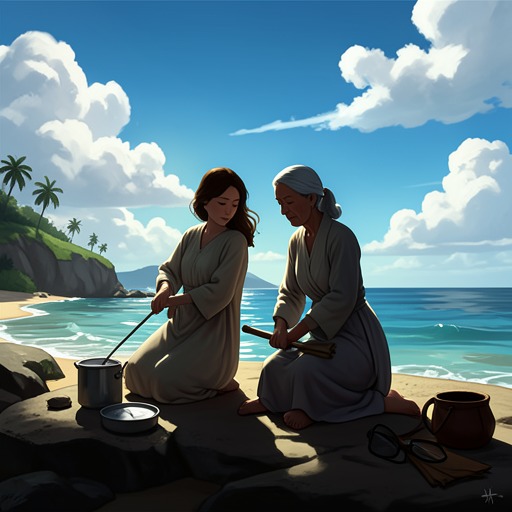
Sophia is introduced through small, direct questions and a willingness to enter the scene. When she finds her grandmother searching below the veranda on a warm July morning, she asks what she is doing and where she lost her false teeth. The moment makes the child an observer of bodily frailty as well as a companion who comes down to help investigate it. The soaked granite, dense vegetation, and grandmother’s precarious search make the setting vivid, but Sophia’s practical curiosity keeps the encounter grounded in their everyday intimacy.
She is also capable of careful attention to other people’s vulnerabilities. When her first guest of her own, Pipsan, comes to visit, Sophia explains that the new friend is frightened of many things and needs to be treated gently, especially at first. Sophia notices Pipsan’s quietness, her unsuitable shoes, and her beautiful naturally curly hair. The scene presents her as a child who can anticipate another person’s embarrassment and adapt her behavior accordingly, even as her own social world is still new.
Loss, Play, and Attachment
Sophia’s mother is dead, a fact the book gives stark force in an April moonlit scene. She wakes, remembers that she and her grandmother have returned, and understands that she has a bed to herself because her mother is gone. The cold floor, the still-burning stove, and the boots drying above it belong to the room’s ordinary material life; in the windows, however, reflections multiply the fires, the room, and the figures outside. A rowan tree seems to grow through two children on the rock. As Sophia returns to bed, the island appears to approach the house, then a channel opens in the floor and the luggage floats away in a river of moonlight. The dreamlike movement gives grief a form without explaining it away: familiar things remain visible, but they become unstable and cannot all be recovered.
Her attachment to Moppy offers a more comic, domestic version of longing. The kitten first needs milk from a nipple and warmth in a tea-cosy; when it finds its legs, it sleeps beside Sophia in her bed, on its own pillow. It grows quickly and moves into the house, choosing a box for dirty dishes under the bed rather than the cottage. Sophia carries it back and tries to win it over, but her affection only sends it fleeing sooner to the dish box. When that box fills, the cat howls until someone washes the dishes. Sophia’s observation, “The more you love someone, the less he likes you back,” turns this small frustration into a sharp, child-sized account of love that cannot command a return.
Boredom and the Storm
The book also shows Sophia’s moods changing with the weather. On a hot, quiet, lonely day, she walks the entire shoreline and finds only rock, juniper, smooth stones, sand, and dry grass. Haze veils sky and sea; the heavy swell pushes waves toward the shore. Her prayer asks for something to happen because she is bored to death. The landscape’s stillness is not merely background: it establishes the pressure that makes the coming storm feel like an answer.
The signs change in stages. The swallows fall silent, the sky empties, and the horizon turns black. Wind reaches the island in a whisper, passes, and leaves a brief quiet before the storm advances over the water. Sophia runs toward it and welcomes the wind, shouting, “It’s the wind! It’s the wind!” She experiences the storm as something granted specifically to her. Water roars over the rocky shore and into the junipers; she runs back and forth across the ground, praising God, and the world becomes sharp and active again. The episode makes her imaginative response bodily: after a day in which nothing happened, movement and weather restore intensity to her surroundings.
Omens and Her Father
Sophia’s imaginative readiness takes a more anxious turn when she and her grandmother discuss old superstitions. On a hot day, midges dance above the tallest spruce, and her grandmother recalls warnings about dancing midges and a full moon. The list includes spilled salt, broken mirrors, swallows leaving a house, and other supposed portents. Sophia first questions these inherited beliefs, then suggests warning her father. Her grandmother replies that he is not superstitious and that Sophia should believe him, and Sophia accepts the answer for the moment.
Later, ordinary coincidences seem to gather into evidence. The milk goes sour; a stickleback is caught in a net; a black butterfly settles on a mirror; and Sophia finds a knife and pen crossed on her father’s desk. She moves them apart, but fears the damage has already been done. When she tells her grandmother, the older woman explains that her own grandmother invented frightening stories out of boredom and to tyrannize her family. Sophia refuses reassurance and walks away. The forest’s footprints, crossed branches, and single red blueberry bush become part of the signs she reads as a secret language, while the full moon intensifies her fear that fate may threaten her father.
Sophia searches for herbs to make him an elixir, but finds only ordinary plants and cannot tell which ones count as herbs. She admits, “I’ve turned superstitious,” and insists that her grandmother do something. The urgency becomes physical when Sophia sees the moon over the sea and fears it might set unexpectedly. Her grandmother tells her to remain silent until they have gathered what they need. Together they collect a beach-pea head, pebbles, dry grass, tree moss, fern, a dead moth, and finally rotting wood from the steps. Sophia’s nerves ease as the ingredients accumulate in her grandmother’s pocket. At the house, she urges her grandmother to let the collection work undisturbed; the moon sets, and there is no immediate cause for alarm.
Change and Narrative Role
The ritual has a small but telling afterlife. From then on, the grandmother keeps her cigarettes and matches in the pocket that held the gathered objects, and the family lives together happily until autumn. When she later sends her coat to the cleaners, Sophia’s father sprains his ankle almost immediately. The sequence does not establish that the ritual works, but it preserves the child’s fear and the family’s willingness to live alongside it. Sophia’s belief has briefly recruited her grandmother into a shared action, even though neither coincidence nor protection can be conclusively proved.
Across these episodes, Sophia moves between sensible observation and imaginative interpretation without settling permanently into either. She can attend to Pipsan’s fears, ask practical questions about false teeth, mourn her mother in a disorienting moonlit vision, and invest a crossed pen and knife with danger for her father. Her loneliness can make a storm feel like a personal gift; her love for a kitten can produce a rueful theory about affection. The book’s seasonal framing also places her experiences within a larger rhythm: as August darkness gathers, the household gradually draws its equipment and objects closer to the house, and traces of habitation begin to disappear. Sophia’s distinctive role is to make those shifts felt as immediate changes in what can be feared, loved, or hoped for.