Sophia’s first deep-water swimming attempt
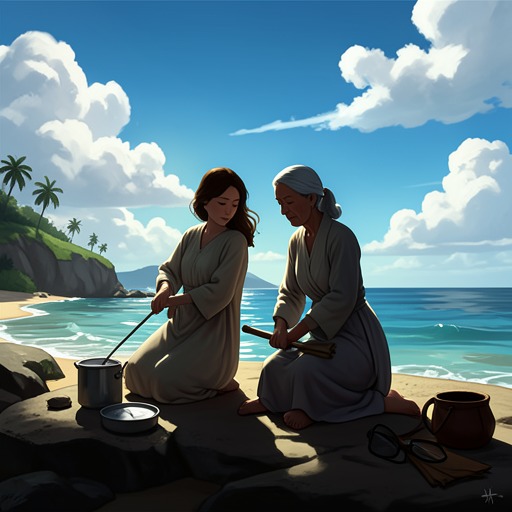
The Summer BookSophia’s first deep-water swimming attempt is a small excursion that brings a real limit into view: although Grandmother trusts that Sophia can dive, Sophia is not ready to swim where she feels unsupported. Their walk to a forbidden promontory becomes a test of independence, confidence, and the difference between believing a child can do something and knowing what that child is afraid to do.
The forbidden route
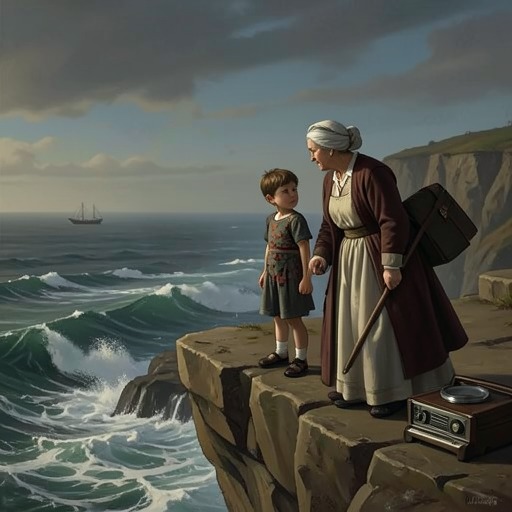
Grandmother leads the way out across the rock and towards the ravine, despite Sophia’s protest that they are not allowed there. She acknowledges that Sophia’s father forbids them both to go, then says they are going anyway because he is asleep and will not know. The disobedience places the excursion outside the family’s usual limits before Sophia reaches the water: Grandmother is willing to cross a boundary, but the child has not yet agreed to what that crossing will ask of her.
They walk farther than either has been before, all the way onto a little promontory. There, the rock descends in terraces towards water that fades into total darkness. A fringe of light-green seaweed edges each step and sways with the sea’s movement. The setting makes the depth visible as a change in the landscape: the rock offers successive footholds, but the underwater slope disappears from sight. Sophia’s wish to swim begins in this exposed place, where the familiar footing gives way to water she cannot see through to the bottom.
Entering the water
Sophia says that she wants to go swimming and waits for Grandmother to object. When no objection comes, she takes off her clothes slowly and nervously. Her glance towards Grandmother conveys uncertainty about the absence of resistance: permission does not reassure her that she is ready. She puts her legs into the water, finds it cold, and then slides in up to her waist, waiting anxiously.
Grandmother tells her to swim, assuring her that she can. But Sophia’s own assessment is more immediate than that reassurance: the water is deep, and she remembers that she has never swum in deep water unless somebody was with her. She climbs out and sits on the rock. The attempt thus stops short of a dive or a swim across the water. Sophia has entered far enough to confront the depth directly, but not far enough to overcome her fear of being alone in it.
After climbing out, she declares that it will be a nice day. The sun has risen higher, and the island and sea glisten in the light, while the air seems unusually light. Her comment shifts the conversation away from the failed attempt without erasing it. The bright surroundings offer a contrast to the dark water below the terraces, but do not make Sophia’s hesitation disappear.
Grandmother’s confidence
Sophia turns the subject to diving, asking Grandmother whether she knows what it feels like. Grandmother describes diving as letting go, preparing, and plunging in: seaweed brushing the legs, clear water lighter near the surface, bubbles, a glide, a turn, and finally a rise to breathe and float. The description is precise and embodied, presenting diving not simply as a feat but as a sequence of sensations and movements. Sophia adds that the diver keeps her eyes open; Grandmother agrees that people do not dive with their eyes shut.
Sophia then asks whether Grandmother believes she can dive without having seen her do it. Grandmother answers that she does. This trust is not the same as having witnessed Sophia succeed: the child has just left the water because it was too deep to manage alone. Grandmother’s confidence may encourage Sophia, but it does not supply the companion she feels she needs in the water. The exchange holds those facts together without resolving their difference. Sophia seeks assurance that Grandmother believes in her; Grandmother gives it, even though the attempt itself has shown how much support Sophia still needs.
Return and what remains
Grandmother tells Sophia to get dressed so they can return before Sophia’s father wakes. The excursion therefore ends with a practical deadline as well as an unfinished swim: they have gone somewhere forbidden, and their return depends on getting back unseen. Grandmother is already tired and thinks that, once home, she will take a nap. She also means to tell Sophia’s father that the child is still afraid of deep water.
That intention clarifies what Grandmother has taken from the morning. Her encouragement did not make Sophia’s fear vanish, and she has noticed the important qualification in the child’s experience: deep water is frightening when nobody is with her. The excursion does not culminate in a successful dive. Instead, its consequence is a more exact understanding of Sophia’s hesitation, alongside Grandmother’s continued faith in her ability. The island’s forbidden edge, the cold water, and the child’s retreat leave independence open as a possibility, not an achievement already secured.