Sophia’s night alone in a tent
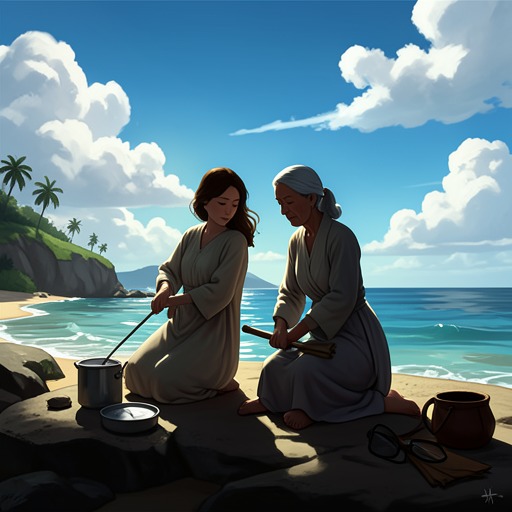
The Summer BookSophia’s night alone in a tent is both a childhood trial of solitude and an occasion when experience passes between generations. The bright yellow shelter first seems friendly and sealed off from the world; after dark, its thin protection cannot keep the island’s sounds and uncertainties at bay. When Sophia seeks Grandmother, the night becomes something they can describe together—and Sophia’s account helps revive memories Grandmother feared she had lost.
Background and the Tent
The tent belongs to a practical arrangement made by Sophia’s father: he bought it and pitched it in a ravine so he could hide there if too many people came. It is so small that its occupants must crawl inside on all fours, though two people can fit if they lie close together. Candles and lamps are not allowed. Its intended usefulness and cramped dimensions make it a different kind of shelter from the cottage: a place to withdraw, but not one equipped with the familiar comforts of a house.
Sophia asks whether it is a Scout tent. Grandmother initially rejects the comparison. She remembers the tents from her own youth as huge, sturdy, and greyish-brown, and considers the bright yellow one a modern toy rather than a proper tent. But she relents, and the two crawl inside and lie side by side. The exchange brings a family object into contact with Grandmother’s past: what Sophia sees as a possible Scout tent is, to Grandmother, a poor substitute for the tents she remembers.
That difference matters because Grandmother’s connection to the Scouting movement is more than a fond recollection. She had been a Scout leader when young and had helped make it possible for girls to be Scouts in Sweden, where girls had not previously been allowed to sleep in tents. Sophia’s question invites a story about that achievement, but Grandmother finds that remembering an event and recovering its felt texture are not the same thing. Her short account of a log, a fire, cold weather, and soup sounds spare beside the importance she says those years once held.
Setting Out Alone
Grandmother suggests that Sophia ought to try sleeping in a tent all night. Sophia takes the suggestion literally: she carries her bedclothes out, closes the door of her cottage, says goodbye as the sun goes down, and walks by herself to the ravine. The walk makes the familiar place seem distant and abandoned. Once she zips the tent shut and lies under her quilt, however, its smallness changes character. In the sunset it glows yellow, then red, and seems friendly; inside, Sophia feels enclosed in a cocoon of light and silence, unable to look out and unseen by anyone outside.
The sense of safety belongs to the evening, not to the whole night. When Sophia wakes, the tent offers no view beyond darkness. A bird cries near the ravine and then farther away; although there is no wind, Sophia hears the sea. Gravel crunches as if someone has stepped on it, though nobody is there. Other birds call, and movements and sounds accumulate without becoming identifiable. The shelter has not stopped the night from reaching her. It has made her attentive to a world that, outside the tent, would be easier to overlook.
Sophia tries to manage her fear by praying not to become scared, then immediately imagines what being scared would be like and worries that others might mock her. The sequence turns apprehension back on itself: she is afraid of fear as well as of what she cannot see or explain. Yet she does not remain only inside that imagined danger. Outside the tent, she listens closely and, for the first time, notices the ground beneath her bare feet: gravel, wet grass, flat stones, and plants brushing her legs. The darkness does not make the ground uniform; walking reveals it as varied and difficult to read.
Seeking Grandmother
The island seems tiny to Sophia, like a drifting leaf on the water. A light in the guest-room window gives her a destination, and she knocks gently because every sound has become too large. Grandmother asks how the night is going. Sophia answers that it is good, sits on the foot of the bed, and looks at the lamp, nets, and raincoats on the wall until her teeth stop chattering. She can report something definite amid the night’s uncertainty: there is no wind. Grandmother confirms that it is calm.
Grandmother makes up a bed for her on the rug with a blanket and a cushion. It is not the same as returning to the cottage, and it is not really sleeping outside. Sophia recognizes the distinction without cancelling what has already happened: she is no longer alone in the tent, but she has been alone there, and she has slept outdoors. The episode’s test is therefore not a triumphant insistence that she stay in the ravine until morning. Its meaning lies in what she has dared to experience before seeking company.
The conversation also opens a different kind of night for Grandmother. Distressed that memory and interest seem to be slipping away just when she needs them, she insists that what she cannot recall is what it was like to sleep in a tent. She explains that she made it possible for girls in Sweden to do so and that she and the other girls had a wonderful time, but she can no longer convey the experience. The loss is specific: not the bare fact of leadership, but the remembered quality of the nights she helped make possible.
Experience Shared and Memory Recovered
Sophia answers by describing what the night has taught her: everything can be heard more clearly in a tent, and the tent is very small. It makes her feel safe, she adds, and it is good to hear everything. Her account does not reproduce Grandmother’s past or claim to know what Grandmother felt as a girl. Instead, it offers present-tense particulars—smallness, safety, and intensified listening—that Grandmother can meet with her own remembered awareness of hearing the outdoors.
The exchange takes place over hard bread, sugar, and cheese from the food box beneath the bed. When Sophia says she is sleepy and thinks she will go back, Grandmother lets her go and turns out the lamp. After the initial darkness, the room becomes lighter again to Grandmother’s eyes, and she can see everything distinctly. Once Sophia has left, Grandmother wraps herself in a blanket and tries again to remember. Images return, increasingly numerous. In the cold first light she falls asleep in her own warmth.
The night thus links two acts of attention without making them identical. Sophia learns the sounds and textures of the ravine by encountering them alone; Grandmother, prompted by Sophia’s descriptions, recovers images from an experience she had believed closed off. The tent is both a physical shelter and the subject of a difficult memory: its smallness first frightens Sophia, then gives her something precise to say, and those precise observations help Grandmother approach her own past. Sophia does not restore the memory by retelling Grandmother’s history for her. She gives Grandmother a present experience to compare with it, and the remembered scenes begin to return.