Superstition and omens
The Summer BookSuperstition and omens in The Summer Book are neither a settled system of belief nor merely a joke: they are stories about danger that can suddenly become instructions for action. Through Grandmother’s inherited warnings and Sophia’s fear for her father, signs transform weather, animals, and household objects into a language of possible catastrophe. The resulting ritual offers comfort, but its final reversal leaves that comfort uncertain.
Inherited Explanations and Family Stories
The book first presents supernatural questions in a more playful, practical register. Walking through a flowering pasture on a very hot day, Sophia asks what Heaven looks like and whether it contains ants. Grandmother imagines Heaven as like the pasture, answers that there are no ants, and tries to sleep while the insects fill the summer air with sound. Sophia then presses her about how God could attend to everyone’s prayers at once, and what would happen if someone prayed while falling from a tree. Grandmother’s answer—that the person would catch on a limb—treats divine intervention as a problem of timing and rescue. These exchanges do not establish a doctrine; they show the two turning belief into an intimate conversation in which an immense mystery can be tested against everyday peril.
The account of superstition itself also arrives as family inheritance. When Midges dance above the tallest spruce on The island, Grandmother recalls her own grandmother’s warning to be careful when the Midges were dancing and the moon was full. She describes it as a dangerous mating day: salt must not be spilled, mirrors must not be broken, and a house from which swallows depart should be left before sunset. Sophia challenges the warnings as foolish and asks what “superstitious” means. Grandmother’s explanation—that it means not trying to explain what cannot be explained—makes room for a practice that resists rational account rather than supplying one.
Grandmother illustrates that practice with the story of her grandmother, who was married to a priest who rejected superstition. Whenever he was sick or depressed, his wife secretly prepared an elixir. If it helped him, she had to credit Innosemtseff’s Tonic instead. The story makes belief a domestic activity passed down through women and practiced under the cover of another explanation. Its humor lies in the strain of concealment; its ambiguity lies in the fact that the elixir’s apparent success is preserved only as family testimony, not demonstrated as magic.
A Landscape Read as Omen
After their conversation, Sophia and Grandmother sit by the shore. The day is calm, with a long, windless swell, but Grandmother’s catalogue of dog-day beliefs makes calmness feel unstable: boats may sail away by themselves, objects may come in from the sea, some things sink while others rise, milk sours, and Dragonflies dance desperately. Lizards, by contrast, are not afraid. At night, red spiders mate on uninhabited skerries until the rock seems carpeted with them. These details place omens amid the island’s actual seasonal life. The natural world is not just a backdrop for the beliefs; its changing creatures and conditions supply the images through which danger is imagined.
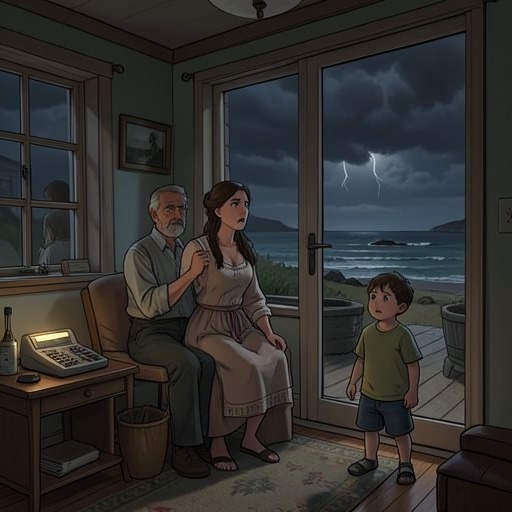
Sophia wonders whether they should warn her father. Grandmother replies that he is not superstitious, then adds that superstition is old-fashioned and Sophia should always believe her father. That advice establishes a boundary between the elders’ folklore and paternal authority, but it does not keep Sophia from looking for signs. Soon the milk does sour; they catch a stickleback in their net; a black butterfly enters the house and settles on a mirror. Toward evening, Sophia finds a knife and pen crossed on her father’s desk. She separates them quickly, but believes the harm is already done. The household object has become more alarming than the earlier stories because it appears inside her father’s own space and seems to point directly toward his safety.
From Doubt to Fear
Grandmother tries to undo the warning by saying that her grandmother made things up out of boredom and to tyrannize her family. Sophia refuses reassurance, tells her not to say anything, and walks away. As evening cools, the Midges disappear, frogs begin singing, and the Dragonflies seem dead. The full moon rises, while the surrounding forest appears to Sophia to contain a secret language: impossible footprints, crossed branches, and one red blueberry bush among green ones. The narration gathers these observations into a mounting inventory of signs, but the question driving them remains personal: what can any sign do for her father?
Sophia searches for herbs to make him an elixir. The plants she finds look ordinary, and she cannot tell which ones count as herbs; the imagined ingredients should be small, pale-stemmed, perhaps mouldy, and from swampy places, yet none of those features gives her certainty. When she asks what herbs Grandmother’s grandmother used, Grandmother admits she has forgotten. Sophia’s anger makes clear that inherited lore has become an obligation: if Grandmother cannot supply the recipe, Sophia does not know how she is supposed to save her father before the moon sets. She declares that she has become superstitious, even more so than the older woman, and demands help.
The Pocket Ritual and Its Aftermath
Grandmother responds by getting dressed. Sophia urges her to hurry, and when Sophia sees the moon over the sea she begins to cry, fearing it may set according to its own schedule. Grandmother then imposes rules for the remedy: Sophia must not speak, sneeze, cry, or belch until they have gathered what they need; afterward, they will place it in the safest available place and let it work from a distance. The ritual takes the form of a quiet walk across The island. In moonlight, Grandmother gathers a beach-pea head, two small pebbles, and dry beach grass, then adds tree moss, fern, and a dead moth from the woods. Sophia follows silently, growing calmer as the pocket fills.
The scene gives the improvised rite a grave visual authority. Grandmother moves with stiff legs and a walking stick, and Sophia sees her as carrying the moon on her head while she watches over fate and The island. Back at the house, Sophia tells her not to talk and to leave the ingredients in her pocket. Grandmother adds a piece of rotting wood from the steps and goes to bed. The moon sinks into the sea, and there is no immediate cause for alarm. The collected objects have not been explained or tested; their force in the scene lies in the shared procedure and in the calm Sophia gains by following it.
The ending both sustains and punctures that reassurance. From then on, Grandmother keeps her cigarettes and matches in her left-hand pocket, as though the ritual has altered an ordinary habit. The family lives together happily until autumn, when Grandmother sends her coat to the cleaners. Almost immediately, Sophia’s father sprains his ankle. The coincidence revives the logic of the warnings: the protective objects are no longer in the pocket, and misfortune follows. Yet the book does not establish that the pocket caused safety or that its emptying caused the injury. Instead, the ending leaves superstition suspended between inherited play, fear-driven care, and the human wish to make danger legible.