Taboos when gnats dance in swarms under a full moon
The Summer BookTaboos when gnats dance in swarms under a full moon are a set of inherited warnings that begin as family folklore and become, for Sophia, an urgent way to interpret danger. Grandmother presents the beliefs with amused skepticism, but when Sophia fears that omens threaten Sophia’s father, the two enact a ritual of protection. Its apparent success lasts only until the ritual’s keepsake is discarded and Sophia’s father injures himself, leaving the rules suspended between comic invention and emotional necessity.
The warning and its inheritance
On a very hot day around noon, Midges rise in precise, singing columns above the island’s tallest spruce. Grandmother calls their movement “The wedding dance,” and recalls that her own grandmother warned people to be careful when the Midges danced and the moon was full. The rule comes with a catalogue of precautions: avoid tempting fate, do not spill salt or break a mirror, and move before sunset if swallows leave the house. Grandmother calls the whole business a nuisance, while Sophia challenges the credibility of the ideas and their source. The exchange makes the belief’s transmission visible: it comes down through Grandmother’s family as an inherited saying, not as a set of rules whose authority has been established.
That uncertainty matters because Grandmother later gives the tradition a deliberately deflationary explanation. She says her grandmother invented the warnings out of boredom and to tyrannize her family. The explanation makes superstition sound like a domestic instrument of control, passed from one generation to another through stories. Yet Grandmother’s comic dismissal does not prevent the old rules from shaping the evening. The tale can be called made up and still exert force once Sophia connects it to someone she loves.
From custom to feared signs
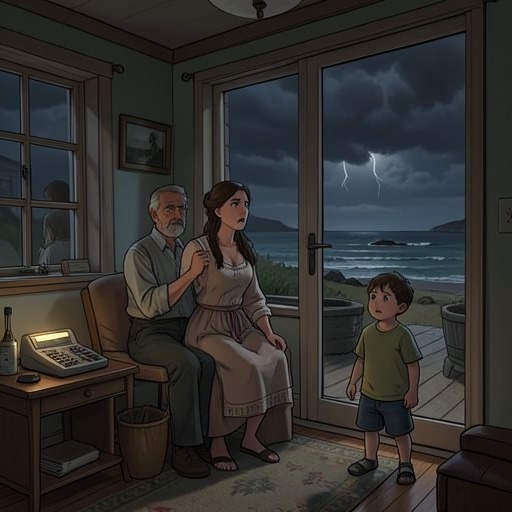
As the evening advances, coincidences gather around the warning. The milk goes sour; a stickleback is caught in the net; a black butterfly flies into the house and lands on a mirror. Later, Sophia finds the knife and pen crossed on Sophia’s father’s desk. She separates them, but believes the damage has already been done. She runs to Grandmother and insists that nothing can make it better. A crossed pair of objects becomes frightening not because the story establishes a definite rule about knives and pens, but because Sophia reads it within the broader atmosphere of omens and threatened fate.
Grandmother tries to distinguish her grandmother’s invented warnings from genuine danger. Sophia rejects that reassurance and tells Grandmother not to say anything more. The contrast is sharp: Grandmother can regard the signs as folklore, whereas Sophia experiences them as evidence accumulating against her father’s safety. The evening landscape intensifies that reading. The Midges disappear as the air cools; frogs begin singing, dragonflies seem dead, and the full moon rises. The narration presents the forest as filled with signs—strange footprints, crossed branches, a single red blueberry bush among green ones—while Sophia wonders what any of them can do for her father. Her search for herbs to make him an elixir turns interpretation into an attempted remedy, although she cannot identify which ordinary plants would count as the needed ingredients.
The protective ritual
Sophia finally admits that she has become more superstitious than Grandmother’s grandmother and demands help. Her fear is tied to a deadline: the moon might set according to its own schedule, and she believes the remedy must be prepared in time. Grandmother responds by turning the inherited lore into a careful procedure. Until they have collected everything, neither of them must speak, sneeze, cry, or belch. Then, Grandmother says, they will put the ingredients in the safest place they can find and let them work from a distance.
Under the moonlight, Grandmother gathers a beach pea head, two small pebbles, and dry beach grass. In the woods she adds tree moss, fern, and a dead moth, stopping as they cross the island to collect more ingredients. Sophia follows in silence, and her nerves ease a little with each item that enters Grandmother’s pocket. The scene shifts the burden of action from Sophia’s frantic search for the correct herbs to Grandmother’s steady gathering. Her stiff legs and walking stick carry her through the moonlit landscape, while Sophia comes to see her as a figure capable of watching over the island and finding what is needed to avert misfortune.
Back at the house, Sophia insists that Grandmother must not talk and must leave the collected objects in her pocket. Grandmother adds a piece of rotting wood from the steps and goes to bed. The moon sinks into the sea, and there is no immediate cause for alarm. The pocket functions as the ritual’s container: rather than applying an identifiable medicine to Sophia’s father, Grandmother holds an assemblage of natural objects and lets it supposedly work at a distance. The procedure offers Sophia something concrete to do when neither the signs nor the danger can be verified.
The pocket, the accident, and the rule’s ambiguity
After the ritual, Grandmother keeps her cigarettes and matches in her left-hand pocket, preserving the gathered materials there. The family lives together happily until autumn, when Grandmother sends her coat to the cleaners. Almost immediately, Sophia’s father sprains his ankle. The sequence gives the superstition a pointed afterlife: the pocket’s contents have remained with Grandmother, but the coat is sent away, and an injury follows. The account does not establish that the ritual prevented harm or that losing the objects caused the sprain. Instead, the coincidence reopens the question that the episode has held in suspension.
The taboos therefore operate less as a dependable code for predicting events than as a framework through which the characters manage uncertainty. Grandmother’s explanation exposes the rules’ human origin, but her participation in the ritual shows that dismissal and practice can coexist. Sophia’s fear transforms a ridiculous catalogue of warnings into an urgent effort to protect her father; Grandmother answers not with proof, but with a pocketful of small things gathered from the island. The later sprain prevents the ritual from settling into a simple success story. What remains is the emotional force of the inherited belief—and the uneasy possibility that, for a family living among signs, even a debunked rule can return when danger feels close.