The family’s island
The Summer BookThe family’s island is the setting that gives Sophia and Grandmother’s summer life its intimate scale and its exposure to the wider archipelago. A small home ground for play, work, and companionship, it is also a shoreline shaped by weather, ecological limits, and other people’s claims. Its boundaries never quite close: boats connect it to neighboring skerries, floating cargo arrives from the sea, and a new house alters the horizon they had long regarded as their own.
Setting and the house
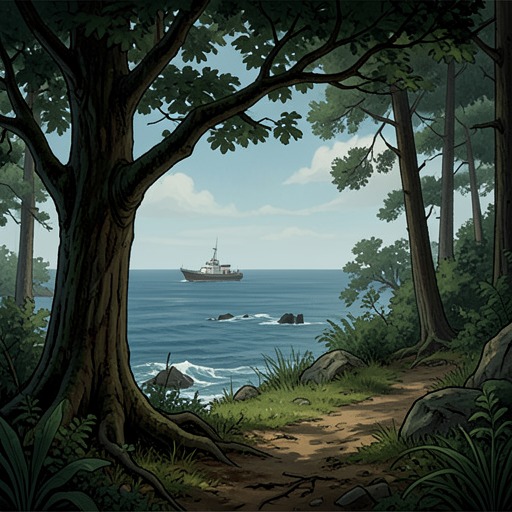
The family’s island lies in the outer archipelago, reached by boat from the Pellinge peninsula. The journey is short enough to make the island accessible, but the rough crossing in a contrary wind reminds visitors that access depends on the sea. On shore, the family house stands among pines. Tove Jansson and her brother Lars built it after discovering the island in 1947. Its familiar features include a woodpile, steep stone steps leading to Grandmother’s room, faded blue paint, and a window unusually large for its wall. The attic holds Papa’s bathrobe, and the house’s screen door, stove, and window opening toward the sea are part of the practical arrangement of island life.
To a first-time visitor, the island can seem almost claustrophobically small. A walk around its edges, through rocks, scrub, a patch of flowers, dry grass, and pinewood, takes only four and a half minutes. Yet this first measurement does not settle its scale. After time spent attending to the terrain, the visitor sees cliffs where there had seemed to be rocks and a ravine where there had seemed to be a creek. The island’s smallness is real, but so is the sense that a summer would be needed to discover all it contains.
Daily life and care for the shore
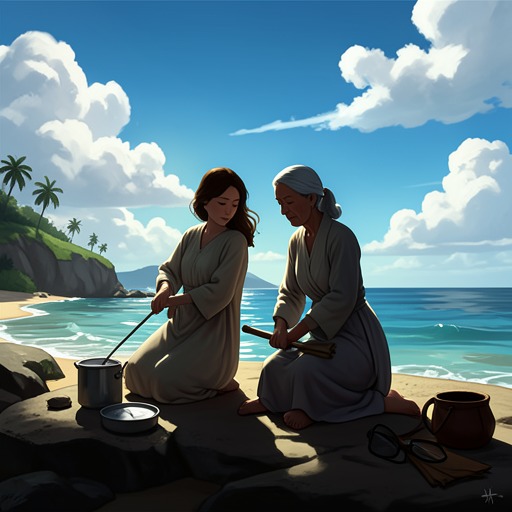
Sophia and Grandmother fill the island’s long months between spring and autumn with an accumulation of modest activities. They make animal sculptures, carve boats from bark, collect berries, driftwood, and bones, draw “awful things,” tell stories, build Venice in the marsh pool, row to other islands, swim, sleep, and talk. These practices turn limited ground into a varied world: the marsh can become a city, scraps from the shore become materials, and familiar routes support both routine and invention.
That intimacy with place also involves restraint. Grandmother warns that moss does not recover if repeatedly walked on and that eider ducks may abandon their nests after being frightened away too many times. The island is not simply an open playground; its surfaces and nesting places are vulnerable to repeated disturbance. The rule makes care concrete by connecting a casual step or intrusion to lasting damage. On the same terrain, children’s camps and dens appear among the rocks, while a swing hangs from a branch, marking the island as a place used and remade without being limitless.
The shore also invites small acts of courage and trust. When Grandmother drops her cane into the water, Sophia climbs down from a channel marker to retrieve it, although her father has forbidden her to go there. Grandmother recognizes that the climb frightened Sophia, and the incident becomes something they negotiate between themselves rather than immediately reporting to her father. The channel marker is at once a practical feature of the surrounding waters and a boundary Sophia crosses; the island’s life is shaped by both the freedom to explore and the rules that define its limits.
The horizon and the new neighbor
For years, the family’s sense of the surrounding islands depends on a familiar horizon: skerries and channel markers remain where they have always been, offering reassurance that the view is clear and the world is in its place. That steadiness is disrupted when a businessman builds a large, square house on Blustergull Rock, less than a mile away. The construction changes more than the view. The family is no longer the one living farthest out, and the formerly anonymous skerries at the island’s threshold acquire a new name and a new sense of enclosure.
The house first appears as a possibility the family fears as much as a building they can see. They imagine a neighbor who will bring company, a large family, radio noise, and trampling feet on the moss. When workers nail on the tin roof beneath screaming gulls and Terns, the building takes on the force of a conspicuous new landmark. Yet its owner does not arrive at once, leaving the family to wait with their unease unresolved.
Grandmother and Sophia eventually row toward Blustergull Rock. In its gravel landing area they find a sign declaring the property private and forbidding trespass. Grandmother treats the sign itself as an affront: because it has been put up, she argues, going ashore becomes a demonstration of disapproval. Their decision exposes a tension between the established habits of island neighbors and the new owner’s assertion of private boundaries. Later, after meeting Malander, Grandmother recognizes that he wants to be left alone without yet understanding it himself, and expects him to build his dock anyway. The house remains a subject of thought rather than a settled friendship. During storms, the family considers ways to save Malander’s boat; he never returns their visit, and his house becomes a landmark through which they reflect on change and on people’s capacity to see their own mistakes too late.
Sea routes, salvage, and scarcity
The sea is not merely the island’s edge: it is its road, its hazard, and a source of goods. On Midsummer, Grandmother joins Eriksson and Sophia’s father for a nighttime salvage journey toward Outer Skerry. In rain and fog, boats gather around wooden crates of rounded bottles bobbing in the choppy water. The boats move at speed, slowing just long enough to haul crates aboard, while the Coast Guard salvages what it can and ignores the other crews. Sophia’s father lifts the crates as Eriksson steers; their movements become so closely coordinated with the boat that Grandmother watches and remembers them as a shared piece of work.
By morning the improvised fleet has dispersed and the sea is empty. Eriksson leaves again to search for anything missed. The return does not produce an uncomplicated celebration: water has ruined nearly all the fireworks in his box. Only the last rocket lights, rising toward the sunrise in blue stars as the Terns scream. The island’s Midsummer gathering therefore depends on both the abundance carried by the Gulf of Finland and the damage the same wet, unsettled conditions can do.
In a later heatwave, the island’s dependence on water becomes urgent in another way. As the ground looks increasingly exhausted, Sophia’s father brings an Enormous Plastic Sausage to carry water from a bog on Bog Skerry. At the bog, a pump fills the orange container with thousands of litres. The operation initially seems to follow its plan, but towing the weight tests the limits of the boat and its passengers: the sausage sinks into deeper water, pulls at its lines, and brings the gunwales to less than four inches above the surface. The scene makes the island’s remoteness material. Water and equipment must be brought across exposed water, and even an ingenious solution can become a danger once it meets the sea.
Weather and the island’s changing scale
Storms repeatedly revise what the island permits. During the great storm, Sophia’s father wakes and remembers his nets; his boat is bumping broadside against the shore, its oars clattering and its motor caught in twisted sea grass. He pushes out and rows against mountainous waves that angle around the lee shore. The storm is not confined to the family’s experience: the same confusion and surprise extend along the coast. The island offers some shelter, but it cannot keep the force of the weather outside its domestic world.
Across these episodes, the island shifts between a bounded home and an open point in a network of waters. Its tiny circuit supports a dense variety of games and routines, while boats carry its inhabitants to other skerries and bring salvaged cargo, visitors, and new neighbors into view. Moss, nests, drought, waves, and the changing horizon all place limits on what can be done there. The island’s particular richness comes from that double condition: it is small enough to know by heart, yet never separate from the sea and the changes moving across it.