The storm Sophia believed she had summoned
The Summer BookThe storm Sophia believed she had summoned begins as a child’s wish for something to happen and becomes an ordeal whose consequences reach well beyond the island. Sophia greets the approaching gale as an answer to her prayer; when she imagines the destruction it may cause elsewhere, she instead takes its violence as her fault. The storm chapter holds these two interpretations together: the weather is a large natural event, but for Sophia it also becomes a test of prayer, responsibility, and the limits of her power.
Background and Sudden Arrival
The storm belongs to the summer remembered by its defining weather rather than by a year. The account establishes its scale before returning to the island: huge waves swept through the Gulf of Finland from the east, and the winds reached fifty knots, while the waves suggested sixty or, some insisted, seventy. The radio had forecast gentle, variable winds, and boats had been rigged for good weather. The storm rose in half an hour and quickly reached full force. Afterwards, government helicopters searched the coast, lifting people from rocks and the bottoms of swamped boats and recording the islands and survivors. The account says that everyone was saved, though the danger had been real.
That retrospective knowledge does not make the storm feel safe as it arrives. On the island, Sophia is restless in the heat and quiet. She circles a landscape of rock, juniper, stones, and dry grass, with the yellow haze veiling the sea and sky. She asks God for something to happen because she is bored. The first sign of change is not a dramatic gust but the swallows falling silent; then the sky empties of birds and the horizon darkens. The water seems to shiver as the blackness spreads toward shore. A whisper of wind reaches the island, passes, and leaves a pause before the storm itself sweeps in.
Sophia’s Welcome and the Work at Sea
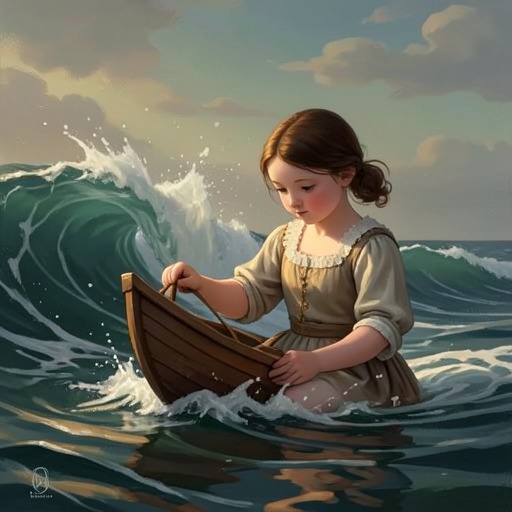
Sophia runs toward the wind and welcomes it as her own storm. The breakers drive water over the rocky shore, grass, and moss, then roar among the junipers. She runs back and forth across the island, praising God as the world becomes vivid and active again. This exuberant response is sharply different from the event’s wider danger: what feels to Sophia like deliverance from stillness is the same weather that has caught boats unprepared along the coast.
The storm also interrupts ordinary work. Sophia’s Papa wakes and remembers the nets. His boat is bumping broadside against the shore, its oars clattering and its motor caught in twisted sea grass. He pushes off, rows into the waves, and tries to retrieve the gear. The first net comes up with only one rip; the second is caught on the bottom. After the line at its edge breaks, he hauls rather than trying to ease it free, bringing up a tangled mass of seaweed and fish. The storm makes the task hazardous, but abandoning the nets is not his first response: he continues until he has recovered what he can.
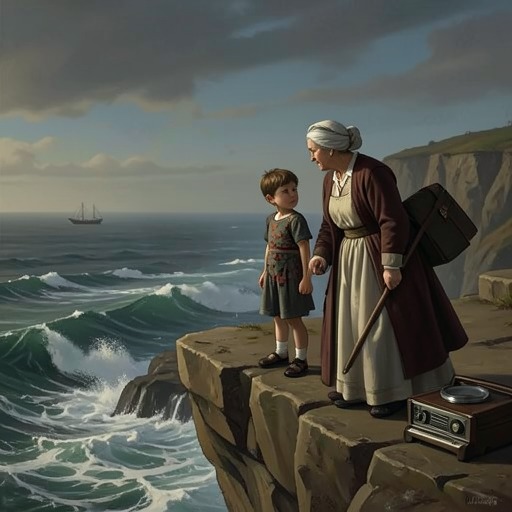
When he turns back, the sea presents another difficulty. Mountainous waves angle around the lee shore, while the sky above remains yellow, bright, and empty. Sophia and Grandmother watch the boat approach through overwhelming seas. Sophia’s Papa leaps out and grabs its side; a broad wave sweeps around the point, strikes the stern, and pushes the boat firmly ashore as the water recedes. He secures it, gathers the nets, and walks toward the house leaning into the wind. Grandmother and Sophia follow together, her walking stick planted firmly with each step. Their burning eyes and salty lips register the storm not as a spectacle alone but as something they must pass through bodily.
The Island Washed Clean
The storm’s force reaches beyond the boat and nets. Wind lifts rubbish from beside the well and carries it toward the shore; refuse that had been left to rot rises and flies out to sea. The account gathers together the old rubbish, the smell from the well, and the accumulated sadness of many summers, then shows breakers and white foam washing across the island. The weather alters the place physically, clearing away what had settled there, even as it threatens boats and lives elsewhere.
This local cleansing is not evidence that Sophia has commanded the storm. The larger account has already described a gale that struck the coast with sudden force and required a region-wide rescue effort. The contrast matters: the island’s dramatic washing is part of a much broader event, not a private weather system created for one child. Sophia’s experience gives the storm a personal meaning, while its reach and consequences exceed her understanding of it.
Guilt and Reassurance
The emotional turn comes when Grandmother speaks of people at sea and boats that may be wrecked. Sophia tells her not to say more, then cries that the storm is her fault because she prayed for it and it came. Her fear expands into visions of wreckage: broken boats, gladioli, windows, people, pots and pans rolling on the sea bottom, and flags shredded by the wind. These images express the catastrophe she imagines, not a confirmed inventory of losses. The account’s earlier knowledge that everyone was saved stands against the scale of the destruction she pictures.
Grandmother first recalls that they may at least have pulled up the dory, then directly reassures Sophia that the storm would have happened in any case. Sophia resists the consolation, insisting that it would not have been so large and that she and God made it happen. As evening darkens the room, the fire remains alight and the wind continues. The storm therefore does not end with the argument, and neither does Sophia’s distress resolve into certainty. The episode leaves her claim intact as a child’s fearful interpretation, while Grandmother offers a boundary between wishing for an event and causing it. Its significance lies in that gap: the storm answers Sophia’s prayer in her imagination, but its independent scale exposes how little control a person has over the sea and weather.