Venice
The Summer BookVenice is both a real city recalled by Grandmother and an imagined landscape that Sophia and Grandmother build in the marsh pool. Its image of palaces, canals, and slow submersion gives their game its materials and mood; when the marsh floods and their handmade city disappears, Grandmother responds by making a new Venice that Sophia can hold and examine.
The postcard and Grandmother’s memories
One Saturday, a postcard addressed to Sophia arrives from Venice. Her full name appears on the address side with Miss before it; the picture side shows pink and gilded palaces rising beside dark water, their reflections mingling with lanterns on slender gondolas. A full moon hangs in a dark blue sky, and a solitary woman stands on a small bridge with one hand over her eyes. Gold catches the light in selected places. The family puts the picture on the wall beneath the barometer, giving the distant city a place in the cottage before Sophia begins to imagine it for herself.
Sophia asks why Venice’s buildings stand in water. Grandmother has visited the city and answers from memory, exhilarated by the recollection of Italy. Though she tries at times to describe other places she has seen, Sophia wants to hear about Venice, especially its canals. In Grandmother’s account, the dark waterways smell of must and rot and draw the city farther down into mud and soft black slime. The picture’s gold and elegance acquire a counterweight: a city sinking toward its doom, with golden dinner plates buried below.
Grandmother’s story makes this decline part of Venice’s allure rather than a reason to turn away. She imagines a Venetian household treating the loss of a kitchen to rising water as a small inconvenience because the drawing room remains. The family rides down in a lift and steps into a gondola; vehicles have already sunk into the ooze, leaving the bridges and the water to define movement through the city. Footsteps continue through the night, sometimes joined by music or the creak of a palace settling deeper. The imagined Venice is beautiful, but its beauty is inseparable from decay and the smell of mud.
A city made in the marsh
Sophia carries the tale from conversation into play. At the marsh pool, smooth and brownish-black beneath the alder trees, she digs a canal through moss and bilberry bushes. She treats a lost gold ring with a red ruby as a Venetian loss, extending the game from the postcard’s luxurious city to the landscape around her. Grandmother first reminds her that she is her grandmother, not her mother; Sophia explains that this is only a game and proposes that Grandmother play her mother while she becomes a dear child from Venice.
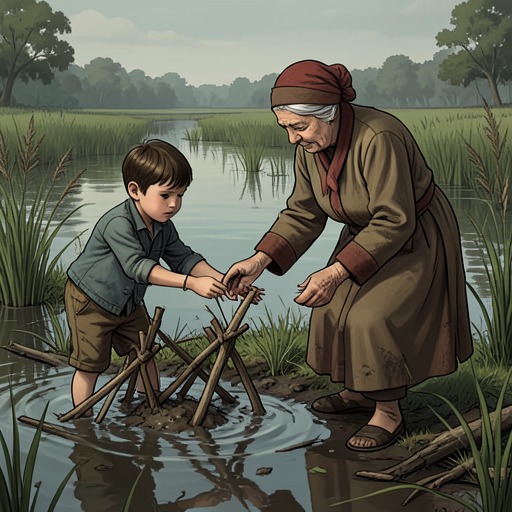
Grandmother changes the game’s direction. Rather than remain a family in a sinking city, they become old Venetians building a new one. In the marsh pool they make pilings for Piazza San Marco from little wooden plugs and cover them with flat stones. They dig more canals and lay bridges across them. Black ants hurry over those bridges while, in the imagined waterways below, gondolas glide in the moonlight. Sophia searches along the shore for pieces of white marble and announces that she has found a new palace. The improvised city is at once a copy of the postcard and a place made from the materials and creatures of the island.
The flood and the rebuilt Venice
The game’s miniature city does not survive the changing water. After Grandmother has taken Sophia back to the cottage and assured her that she will find the palace, she returns to the shore. The marsh has become a bay: waves wash into the heather and retreat to the sea, while the alders stand far out in the water. The canals and constructions of the game have vanished beneath the flood. Grandmother watches for a while, then goes home. The change turns their play’s central image—Venice disappearing under water—into an immediate loss in the landscape where they built it.
Grandmother answers that loss by making a substitute. She lights the lamp, gets out her tools and a suitable piece of balsa wood, and puts on her glasses. By seven o’clock, the Doge’s Palace is ready. When Sophia comes to the door, Grandmother first assures her that they were lucky and then alters the model so it will not look untouched by disaster: she pours water over it, empties ash from the ashtray into her hand, and rubs the cupolas and walls with it. The model’s weathered appearance is deliberately made, as if a new object could carry traces of the vanished city.
Sophia examines Grandmother’s Doge’s Palace model very carefully, puts it on the nightstand, and says nothing. Grandmother anxiously asks whether it is all right. The ending leaves the success of the repair unspoken: the model has restored a visible Venice, but Sophia’s silence does not confirm that it has replaced the palace she lost. Across the episode, Venice shifts from postcard image to remembered story, from story to a collaborative construction, and finally to a handmade object. Its repeated sinking and rebuilding give the city a special place in the relationship between Sophia and Grandmother: imaginative play can transform loss, even when it cannot make the lost thing return.