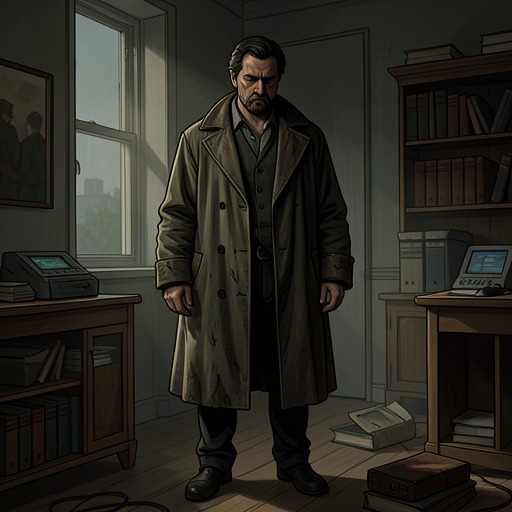
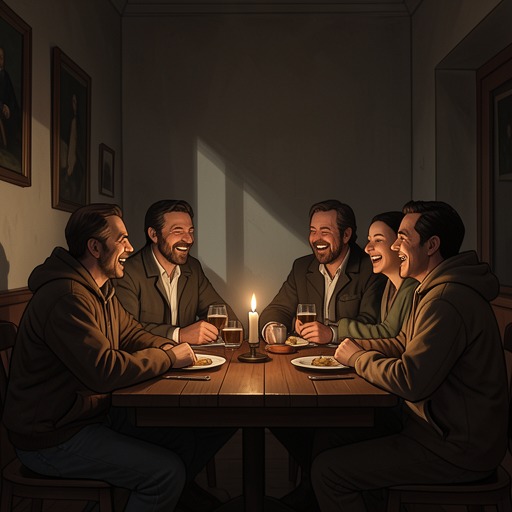
Jake Barnes
The Sun Also RisesJake Barnes appears here chiefly as Robert Cohn's tennis friend, but his importance lies in more than companionship. Through Jake's eyes, Cohn's European life becomes legible: the proposed excursion, Frances's silent control, Cohn's immediate retreat, and Jake's effort to preserve an ordinary friendship beneath an increasingly constricted relationship. Jake's narration is observant and understated, making social pressure visible through gestures, interruptions, and altered plans rather than through abstract explanation.
Identity and Narrative Position
Jake is one of Robert Cohn's two friends during Cohn's three years in Europe. Braddocks is Cohn's literary friend, while Jake is identified specifically as his tennis friend. That distinction places Jake close to Cohn's daily life without making him the authority on Cohn's writing or literary ambitions. His position is practical and social: he plays tennis with Cohn, eats with him, discusses travel, and notices the changing atmosphere around him.
Jake also functions as the narrator of the episode. He reports what he sees at dinner and in the cafe, including Frances's physical reaction and Cohn's private explanation after they leave together. The account therefore combines direct observation with limited access to Cohn's thoughts. Jake does not claim omniscience; instead, Cohn's situation is revealed through what Jake notices and what Cohn chooses to tell him.
The Proposed Journey
After dining with Cohn and Frances and going for coffee at the Cafe de Versailles, Jake prepares to leave. Cohn has been discussing a weekend trip with him, wanting to get out of town and take a long walk. Jake responds with a concrete proposal: they could fly to Strasbourg and walk up to Saint-Odile, or travel somewhere in Alsace. The plan is presented as an uncomplicated extension of their friendship, built around exercise, travel, and escape from Paris.
Jake then adds that he knows a girl in Strasbourg who could show them the town. The suggestion changes the social meaning of the proposed trip. Frances kicks Jake under the table, and he sees her chin lift and her face harden. Jake registers the gesture without initially treating it as a serious prohibition. When he changes the destination to Bruges or the Ardennes, Frances no longer kicks him, and the immediate tension subsides.
The episode shows Jake testing the boundaries of Cohn's freedom without fully understanding that those boundaries exist. His suggestion is casual, but Frances's response reveals that even the presence of any other woman threatens the arrangement governing Cohn's life. Jake's ordinary travel talk thus becomes the trigger for a small but decisive exposure of control.
Relationship with Robert Cohn
Cohn trusts Jake enough to walk with him after dinner and to discuss the incident away from Frances. Once they reach the street, Cohn asks why Jake mentioned the girl in Strasbourg and whether Jake had not seen Frances. Jake answers that he sees no reason for Frances to object merely because he knows an American girl living in Strasbourg. His response reflects a straightforward understanding of friendship and personal independence, one that Cohn can no longer apply to himself.
Cohn explains that it makes no difference which girl is involved: he could not go with Jake if another woman were part of the plan. This confession clarifies the extent of Frances's influence. Jake is not merely arranging a trip with a companion who happens to be attached; he is dealing with a man whose movements and social contacts have become subject to another person's approval. Jake's role is therefore both participant and witness: he proposes the outing, sees it curtailed, and learns from Cohn that the restriction is comprehensive.
Even after the disagreement, Jake tries to keep the friendship intact. He suggests Senlis as an alternative destination, naming the Grand Cerf and a walk in the woods, with the prospect of returning afterward. Cohn accepts the substitute plan, and Jake says they will meet the next day at the courts. The exchange turns conflict back toward routine, but the routine now carries knowledge of the constraint under which Cohn lives.
Restraint, Repair, and Significance
Jake's conduct is marked by quick adjustment rather than confrontation. He moves from Strasbourg to Bruges or the Ardennes, then to Senlis, responding to Cohn's discomfort without forcing an argument with Frances. This flexibility protects the immediate relationship, yet it also leaves the underlying power arrangement untouched. Jake can change the destination, but he cannot make Cohn free to choose it.
The closing gestures reinforce Jake's tactful concern. After saying good-night, Cohn starts back toward the cafe; Jake notices that Cohn has forgotten to buy the paper and points it out. Cohn then walks with Jake to the kiosk at the corner and asks whether Jake is sore. The question suggests that Cohn fears the restriction has damaged the friendship. Jake's presence in this scene is consequently not only critical or amused. He is also the person whose goodwill Cohn wants to retain while returning to the relationship that has limited him.
Jake's narrative significance comes from this combination of proximity and reserve. He does not dominate the scene, solve Cohn's predicament, or turn the incident into open melodrama. Instead, he records the kick under the table, Frances's hardened face, the cancelled destination, Cohn's explanation, and the final recovery of ordinary courtesy. Those details make an intimate hierarchy visible: Jake can perceive it clearly, while Cohn recognizes it mainly as a condition he must obey. The scene establishes Jake as an economical observer whose friendship gives him access to private tensions and whose restraint allows those tensions to speak for themselves.