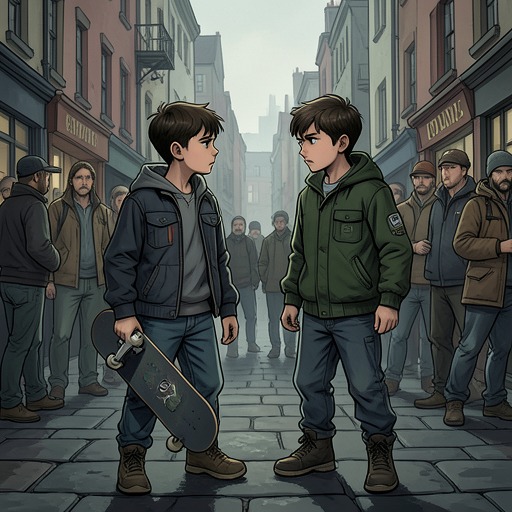
Charles Jae Won Bae
The Sun is Also a StarCharles Jae Won Bae, known as Charlie Bae, is the elder son in a family that gave him a name joining American and Korean identities, and the older brother whose sudden failure at Harvard University unsettles his family’s expectations. Daniel Jae Ho Bae’s account makes Charles both an almost impossibly accomplished figure and a personal antagonist: a brother admired by others for his looks and success, but remembered by Daniel as a bully who has disliked him for years.
Identity and Family Background
Charles is identified as the older brother and firstborn son of a firstborn son. His full name reflects his mother Min Soo Bae’s deliberate compromise over how to name her children. She considered whether to choose an American name that teachers and classmates could pronounce or a traditional Korean name, then combined the two: Charles Jae Won Bae for her first son and Daniel Jae Ho Bae for her second. In her view, names locate a person in time and geography; giving her sons both American and Korean names was a way for them to know where they came from.
Harvard and the Family’s Expectations
Charles’s required withdrawal from Harvard University becomes the story’s opening family shock. Daniel presents the news as an abrupt reversal in the household’s fortunes: the acceptance letter had led Min Soo Bae to regard Harvard as the best school, but now she frowns, struggling to believe or understand that her eldest son has been required to leave. Her questions about his grades and why the university would not make him stay and study more show her effort to make sense of the decision; Dae Hyun Bae corrects her terminology, insisting that being required to withdraw is not the same as being kicked out. The distinction does not soften the disappointment, but it reveals how Charles’s departure is discussed and contested within the family.
The withdrawal is especially jarring because Daniel describes it as Charles’s first conspicuous failure after a record of being good at nearly everything: mathematics, English, biology, chemistry, history, and sports. Daniel calls the fall at Harvard spectacular, but his account makes clear that the shock is not simply that Charles has failed. It is that someone so consistently successful has finally met a limit, disrupting the image of the effortlessly capable eldest son.
Reputation and Daniel’s Perspective
Daniel’s portrait is openly hostile. In a list of reasons he considers Charles an asshole, he moves from Charles’s all-around achievement to his masculinity, appearance, and treatment of others. Charles is described as tall, with sharply sculpted cheekbones and lips that girls find attractive. Daniel frames those qualities as an excess of advantages that might have been forgivable if Charles were kind. Instead, he calls him smug and a bully, and says Charles has not liked him for years. These judgments establish the emotional distance between the brothers, but they are also distinctly Daniel’s: the account gives the reader a younger sibling’s grievance rather than an impartial assessment of Charles.
Encounters with Daniel and Natasha
When Daniel stands and hands back the hair dye, he greets Charles familiarly. Charles replies with a deliberately punctuated taunt about the sky being up and addresses Daniel as little brother. The exchange suggests a familiar pattern of needling between them; Daniel recognizes the phrase as something Charles has used that way throughout their lives. Charles then directs his attention past Daniel to Natasha Kingsley, looking at her with a sneer rather than a smile and asking who she is. In this brief introduction, his attention and manner reinforce the portrait already offered by Daniel: Charles enters the scene not as a softened or newly sympathetic brother, but as someone whose habitual condescension shapes the first impression he makes on Daniel’s companion.