Coincidence and the construction of meaning
The Sun is Also a StarCoincidence and the construction of meaning is the novel’s account of how people turn accidental events into stories about purpose, fate, and love. Its central tension is not simply whether events are random or destined: it is that the same chain of occurrences can seem meaningless, miraculous, or ordered depending on who remembers it and how far away the events are viewed. Through Natasha Kingsley and Daniel Jae Ho Bae, the book allows chance to be real while also showing how interpretation gives chance its emotional force.
Chance, Fate, and Causal Explanation
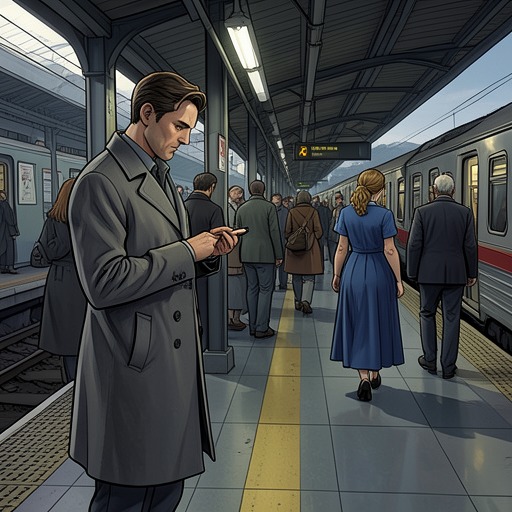
The novel first makes meaning-making visible through ordinary disappointments that invite an explanation. When a cafeteria seems to have run out of someone’s favorite pastry, or a missed train delays a journey, it is tempting to imagine that the universe has intervened for a protective reason. The examples turn quickly comic: perhaps the missed train would have exploded in a tunnel, or carried the first case of a dreadful bird flu. Such explanations offer consolation by transforming inconvenience into rescue. But the ordinary sequence is less dramatic: the cafeteria had another box in the back, a friend supplied a slice of cake, another train arrived, and nobody on the missed train died or even sneezed.
The gap between those imagined explanations and the mundane outcomes is the point. People rarely return to test the story they told themselves at the moment of disappointment. They remember the apparent warning or protection, not the uneventful arrival of a later train. The novel therefore presents coincidence as an event and meaning as a human addition: people make stories about what happened, but the story does not establish that the event was arranged for their sake. Its sardonic examples puncture the comforting habit without denying that the comfort can feel real.
That account differs from both divine fate and strict causal determinism. Patricia Kingsley’s belief that things happen for a reason offers the reassurance of a plan, even when its purpose cannot yet be known. Natasha instead understands events through cause and effect: one action leads to another, and those actions shape what follows. Daniel occupies a less settled position. He can wonder whether meeting Natasha was chance, while still feeling that their love became inevitable once they had met. The novel preserves this contradiction rather than resolving it into a single doctrine: the encounter may not have been ordained, yet what grew from it can feel compellingly necessary.
Scale, the Universe, and Love
Natasha’s reflections at the American Museum of Natural History give this tension a physical scale. In the Hall of Meteorites, she approaches Ahnighito, a thirty-four-ton section of the Cape New York meteor and the largest meteorite displayed in any museum. Its iron surface, pitted by tiny impacts, connects a tangible object beneath her hands to the origins of the solar system. The museum functions for Natasha as a place of near-religious awe, but the awe comes from material history: the innumerable actions and reactions involved in forming a solar system, a galaxy, and a universe.
Against that immense history, falling in love can seem small: a sequence of coincidences to which people grant cosmic significance because they want their lives to matter on a galactic scale. Natasha’s comparison does not make love unreal; it challenges the scale of the claim made for it. The formation of the universe required an astonishing number of events to go right, and she judges the contingencies of romance unable to compete. Her imagined visit with Daniel sharpens the contrast: she would have asked him to write poetry about space rocks and impact craters, directing his attention toward the vast causal history that she finds more astonishing than their love.
Yet the book also allows the human scale to retain its own meaning. Daniel’s sense that love became inevitable after the two met does not prove that the universe arranged their meeting. It describes a different kind of necessity, one produced by what followed the encounter. In this way, the novel separates cosmic purpose from personal consequence: a chance meeting need not have been planned in order to become decisive in the lives of the people who experienced it.
Memory Reorders the Coincidences
Years later, neither character can hold the day in New York with the certainty it once seemed to possess. Natasha comes to suspect that she imagined its magic and romanticized it as a first love. The relationship does leave a lasting consequence: she searches for a passion and finds one in physics. Before sleep, she sometimes recalls her conversation with Daniel on a roof, where he connected love and dark matter as forces that keep the universe from flying apart. The memory still quickens her heart, even as she places it among the sentimental and impossible things she no longer expects to recover.
Daniel, too, remembers the day as a chain of contingencies rather than secure evidence of destiny. His recollection gathers the religious subway conductor, Natasha absorbed in her music, the Deus ex machina jacket, her shoplifting ex-boyfriend, the errant BMW driver, and the security guard smoking on the roof. Each detail helped shape the route by which the two met and spent the day together. In retrospect, the sequence can look like a pattern because its details are collected around a known outcome. But Natasha’s counterargument remains: they did not end up together then, and the same kinds of events that seemed to go right also went wrong. The coincidences that made connection possible could not guarantee its permanence.
The changing memories expose how selection creates a story. Natasha retains doubt about whether she romanticized the day; Daniel retains its small convergences and resists her conclusion that their love was insignificant. Neither perspective cancels the other. The day can be an important memory without being proof of a cosmic plan, and it can shape a life even when its original meaning fades. Natasha’s turn toward physics is itself an outcome of the encounter, though not the fulfillment of a guaranteed romantic destiny.
Order Seen from a Distance
Daniel’s later way of thinking offers a final counterweight to the book’s skepticism. Up close, he believes, everything looks like chaos; pull back far enough and wait long enough, and order may emerge. He does not treat this as proof that every coincidence has a purpose. Rather, distance and time change what can be perceived: a pattern that is invisible within an immediate confusion may become legible later. His hope that their universe is still taking longer to form keeps possibility alive without converting it into certainty.
The novel’s movement between immediate events and later recollection makes that uncertainty part of its form. A set of details first experienced as accidents can acquire the shape of a story in memory, then lose that shape, or acquire another one. The ten-year interval does not settle whether the day was fate, randomness, or something between the two. Instead, the altered memories demonstrate that meaning is not fixed at the instant an event occurs. It is built, revised, and sometimes doubted by the people who carry the event forward.