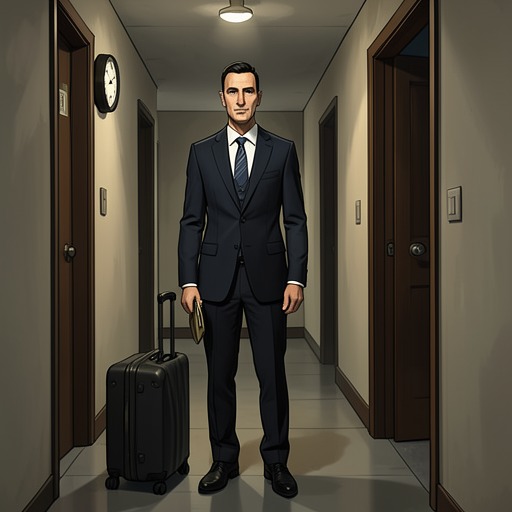
Dae Hyun Bae
The Sun is Also a StarDae Hyun Bae is a Korean immigrant and father whose rise from a poor fishing family to a more prosperous life in the United States does not erase the hardship he escaped. His central contradiction is one of care: he wants his sons to have choices and security, but, believing that knowledge of poverty might harm them, he withholds the history that explains his own values. The novel’s account of his life connects family duty, migration, work, and the difficult inheritance of memory.
Identity and Migration
Dae Hyun grew up poor in South Korea. His move to the United States began in his relationship with Min Soo Bae: when she fell in love with him, she did not expect that love to take them across the world. Dae Hyun, however, had been poor throughout his life, and a cousin who was doing well in New York City promised to help them. Their move was therefore both a consequence of their relationship and a chance to leave scarcity behind.
The move is presented as a leap rather than a guaranteed ascent. Immigrants leave familiar language, people, country, and history without knowing whether accounts of safety and opportunity will prove true, or whether they will be able to adapt or be welcomed. Dae Hyun and Min Soo adapt as much as they can, avoiding people and places that do not want them. The cousin keeps his promise, and they prosper. Their success makes the gamble pay off, but it does not make Dae Hyun’s earlier life disappear.
Family, Names, and Inheritance
When Min Soo learns she is pregnant, she thinks first about what to name their child. She sees a difference between the role of names in Korea and in the United States: in Korea, the family name comes first and carries ancestral history; in the United States, it is called the last name. Dae Hyun interprets that ordering as a sign that Americans place the individual ahead of the family. Their discussion makes naming a choice about how their children will be located between inherited culture and the society in which they will grow up.
Min Soo considers an American name that teachers and classmates can pronounce against the Korean tradition of choosing two Chinese characters for a two-syllable personal name. Her compromise gives each son an American personal name, a Korean personal name, and the family name: Charles Jae Won Bae and Daniel Jae Ho Bae. Dae Hyun’s reflection on the contrast between individual and family identity also anticipates the expectations he later places on his sons. For him, family history is not merely a matter of names; it carries obligations and lessons about what a secure life requires.
Work and Cultural Encounter
In Harlem, Daniel takes Natasha Kingsley toward his parents’ store along Martin Luther King Boulevard. The neighborhood’s closely packed shops and predominantly Black street life mark a change from the part of the city they have left behind. Daniel slows as they pass an empty storefront and a pawnshop, then stops outside Black Hair Care, the family’s hair-care and beauty-supply store.
The store stands within a broader tension Natasha already recognizes: Black hair-care businesses owned by Korean merchants are widely understood as a source of injustice. That context becomes personal when Dae Hyun finds a product for her. He takes a large tub of relaxer from a shelf, hands it to Natasha, and explains that it will make her hair less big. The encounter shows the distance between his practical intervention and Natasha’s sense of what it means. It also places the family business at the meeting point of immigrant enterprise and the racial and cultural tensions surrounding the Black hair-care trade; the scene does not establish that Dae Hyun intends to insult her.
A Father’s Practical Ideal
Dae Hyun’s care for Daniel is expressed through a clear hierarchy of priorities. After calling his son out to speak privately, he asks why Daniel’s wants should matter more than what is good for him. In his view, parents are responsible for directing a child toward lasting security, even when that direction conflicts with what the child wants in the moment. He urges Daniel to study, become a doctor, succeed, and avoid having to work in a store like the family’s. Money and respect, he believes, will make other desired things possible: a partner, children, and the American Dream.
This advice is not detached from Dae Hyun’s history. He thinks of poverty as something that can spread, and keeps his past from his sons because he believes a father who loves them should protect them from it. The protection is also a silence: Daniel and Charles do not know what poverty can do to a person’s body and mind, or why their father regards financial security as urgent. Dae Hyun’s prescription reflects both affection and the limits of a model of care built around preventing hardship rather than explaining it.
The Memory He Cannot Leave Behind
At thirteen, Dae Hyun was being prepared by his father to take over the family’s crab-fishing business in South Korea. The business earned very little, and each fishing season was a struggle to survive. As the eldest of three sons, Dae Hyun understood succession as his place in the family: family seemed to determine his future before he had chosen one.
His first trip on the fishing boat unsettled that expectation. The crabs were trapped in mesh-metal baskets, climbing over one another in an effort to escape. Dae Hyun hated what he saw, and the day sparked a small rebellion in his mind. The memory returns unexpectedly even after he has come to the United States; he had imagined that migration might wipe it away, but it does not. The crabs’ desperate persistence remains lodged in his memory, a reminder of the conditions he wanted to escape and the force of survival that marked his childhood.
The contrast between that memory and his present life gives his ambition for Daniel its emotional weight. Dae Hyun has achieved a degree of prosperity, but he cannot simply leave poverty behind as a story belonging to another person. He tries to keep its influence from reaching his sons while organizing their futures around the dangers he remembers. His silence protects them from one kind of knowledge and leaves them less able to understand the father whose insistence on education, money, and respect grows out of a life they have not been told about.