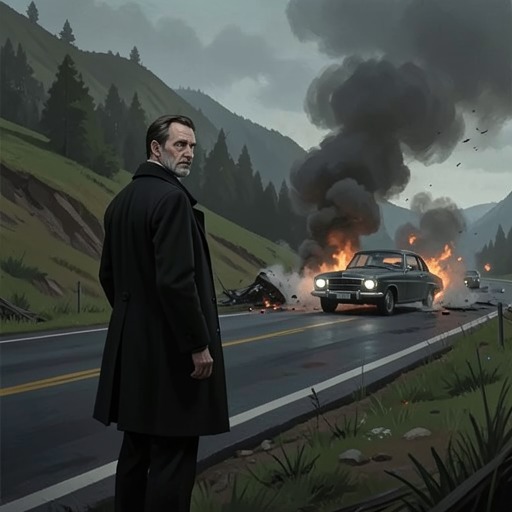
Donald Christiansen
The Sun is Also a StarDonald Christiansen is a former insurance actuary whose professional habit of calculating the cost of catastrophe collides with a loss he cannot quantify: his daughter was killed by a texting driver. Two years later, grief has dismantled much of his life and contributed to his drinking; on the day he nearly hits Natasha and strikes Jeremy Fitzgerald, the consequences of that grief reach other people as well.
Identity and Background
Donald once worked in insurance, where his job was to put prices on unwanted and unexpected losses. He carries that training into the way he thinks: he knows the actuarial costs associated with lives lost in airplane crashes, car accidents, and mining disasters. When he learned that his own daughter had been killed by a texting driver, his first thought was what the driver’s insurance company would pay. The reflex does not mean that the loss is small to him; rather, it reveals how thoroughly a professional language of valuation has shaped his response to catastrophe.
Grief and Its Consequences
Two years after his daughter’s death, Donald’s grief has not receded. It has cost him his marriage, his smile, and his ability to eat, sleep, and feel enough. It has also cost him his sobriety. The story connects that ongoing bereavement to his impaired driving, without suggesting that grief excuses the risk he poses to others.
After nearly running over Natasha, Donald pulls to the side of the road, switches on his hazard lights, and rests his head on the steering wheel. He touches the flask in his coat pocket and wonders whether people recover from losses like his; he doubts that they do. He cannot make sense of why the universe took his only daughter. What he has learned is that no price can capture the loss of everything, and that a person’s imagined future can be destroyed in a single moment.
Collisions and Narrative Role
Donald’s driving brings him into two consequential encounters. He almost runs over Natasha, who is having a terrible day, and offers to buy her new headphones. She does not accept the offer in the scene; she recognizes that replacements could not restore what she has lost. His attempt to make amends is therefore limited: money can replace an object, but it cannot undo the danger or recover the particular thing that mattered to her.
In a separate collision, Donald, described as drunk and distraught, hits Jeremy while Jeremy is crossing the street. He is driving a white BMW at twenty miles per hour. The impact does not kill Jeremy, but it forces him to consider his mortality and his present life, including his long-standing love for his paralegal, Hannah Winter. Donald is thus a point of contact between separate lives: his own bereavement leads to dangerous actions, while those actions prompt Jeremy to recognize what he stands to lose. His actuarial knowledge once made tragedy legible as a price; the collisions expose the gap between calculating loss and living with its consequences.