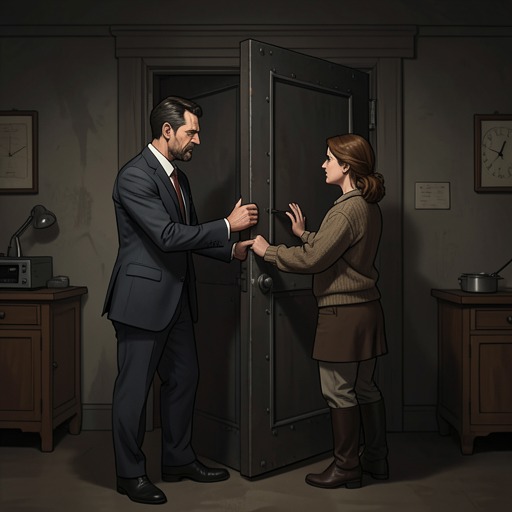
Fitzgerald fails to stop Natasha’s deportation
The Sun is Also a StarJeremy Fitzgerald’s failure to stop Natasha Kingsley’s deportation closes the legal avenue she hoped might let her remain in the United States: the judge will not overturn her Voluntary Removal order, and she is still due to leave that night. The later disclosure that Fitzgerald missed the decisive court appointment to spend the afternoon with Hannah Winter changes the failure from an unexplained defeat into a consequential breach of trust.## The family’s legal predicament The crisis grows out of a chain of events that begins with Natasha’s father’s DUI. His arrest brings the Kingsley family’s undocumented status to the attention of immigration authorities; a few weeks later, they receive a Notice to Appear from the Department of Homeland Security. Natasha reduces the sequence to its personal consequence: her father’s one night of fame led to a DUI, then to the family being discovered, and finally to her losing the only place she calls home. When an attorney points to her father’s DUI, she protests that his mistake is his responsibility, not hers. The distinction between individual fault and family consequence is central to her anger: she faces removal for a circumstance she did not create.
At the family’s Master Calendar Hearing, the judge offers two paths: accept Voluntary Removal or pursue Cancellation of Removal. Natasha’s father initially rejects voluntary departure. That night, he and Natasha’s mother research cancellation, which requires at least ten years of residence in the United States, good moral character, and proof that removal would cause extreme hardship to a qualifying U.S.-citizen spouse, parent, or child. The family believes that Natasha’s younger brother Peter, a U.S. citizen born about nine months after their arrival, might provide the basis for relief. They hire the cheapest lawyer they can find and bring that strategy to the Merits Hearing.
The strategy fails because the family cannot establish the required extreme hardship. Returning to Jamaica would not put Peter’s life in danger, and the psychological harm of uprooting him from the home he knows does not persuade the court. The judge denies the case, and Natasha’s father accepts Voluntary Removal. The family’s lawyer advises against an appeal, says they have no case and no remaining options, and recommends leaving voluntarily rather than acquiring a deportation on their records. Voluntary departure preserves at least the hope that the family might return one day, but it does not spare Natasha the immediate loss of home.
Natasha searches for another way
On the day the family is due to leave, Natasha goes to the United States Citizenship and Immigration Services building in downtown Manhattan, hoping someone—or even fate—can help her stay. She does not believe in fate, but desperation sends her to an agency that is not responsible for her case. When she later explains this to Fitzgerald, she can only say that she did not know what else to do. Her visit is not a legal strategy so much as a final attempt to find a door that has not yet closed.
At Fitzgerald’s office, Natasha completes paperwork that asks about her criminal history, political affiliations, willingness to defend the United States, the stages of her deportation process, and her time in the country. She struggles to know what the attorney needs from her. The paralegal tells her to explain what America means to her, why she wants to stay, and how she would contribute to the country; anything Fitzgerald could use to humanize her might help. The request makes the legal task explicit: her lived attachment to the country must be translated into a form that could matter to a decision-maker.
That attachment is concrete. Natasha has lived in the United States since she was eight, knows no one in Jamaica in the familiar sense of family, and says she does not have a Jamaican accent. Her senior year, prom, graduation, and friends are all here. She has begun an application to Brooklyn College, while her mother has spent two years saving for a trip to Florida to obtain a stolen Social Security number that could be used for financial-aid and college applications. Natasha hopes that financial aid and a scholarship might make an in-state college such as SUNY Binghamton affordable. These plans are not abstract dreams: they show the ordinary future she has started preparing for just as removal threatens to take it away.
The failed intervention
When Fitzgerald tells Daniel Bae that he could not stop Natasha’s deportation, Daniel first struggles to understand what he is hearing. Fitzgerald explains that the judge would not overturn the Voluntary Removal order. He slides Natasha’s file across the desk; the official form identifies her by her full name, Natasha Katherine Kingsley. Daniel’s hope that this might concern a different Natasha gives way to recognition. The document makes the threatened separation bureaucratically definite: the order belongs to the woman he loves, and the departure is set for that night.
Daniel accuses Fitzgerald of not trying hard enough. He suspects that Fitzgerald’s affair with Hannah Winter has distracted him from his promises to his wife, children, and Natasha, though at this point Daniel does not know the full explanation. His anger is sharpened by the disproportion between the lawyer’s calm manner and the scale of the consequence. This is not a missed appointment that can simply be rescheduled; it is Natasha’s life and Daniel’s relationship with her. He insists that Natasha should not bear the cost of her father’s failure.
The narrative subsequently supplies the fact Fitzgerald withholds from Daniel: Fitzgerald missed the court appointment with the judge who could have reversed the Voluntary Removal order. Instead of appearing before the judge, he spent the afternoon at a hotel with Hannah. The failure was therefore not simply that the judge rejected an argument Fitzgerald had made. The decisive opportunity to ask for reversal was lost because Fitzgerald did not attend. His earlier claim that he had tried everything conceals the particular omission that made the outcome unavoidable by the time he reports it.
Consequences and significance
The missed appointment leaves Natasha’s removal in force and gives Daniel the news on the very night she is to depart. The consequences reach beyond the immediate legal result: Natasha loses the chance to continue the life she has built since childhood, while Daniel is confronted with a separation that neither his love nor his protest can undo. Fitzgerald’s personal choice enters a process already structured by the family’s undocumented status, the failed hardship claim, and the limits of the available procedure. The scene does not erase those legal constraints, but it identifies a specific point at which professional responsibility could have mattered and was abandoned.
The account also distinguishes what Daniel initially knows from what the reader learns afterward. Daniel sees the file, hears that the judge refused to reverse the order, and interprets Fitzgerald’s failure through suspicion and grief. The later disclosure names the missed appointment and Fitzgerald’s reason for missing it, confirming that Daniel’s accusation that Fitzgerald had not tried hard enough was more than an angry guess. By withholding that explanation until after the confrontation, the narrative makes the legal setback a betrayal as well as a loss: Natasha’s fate has been decided in part by a private choice Fitzgerald never admits to Daniel.