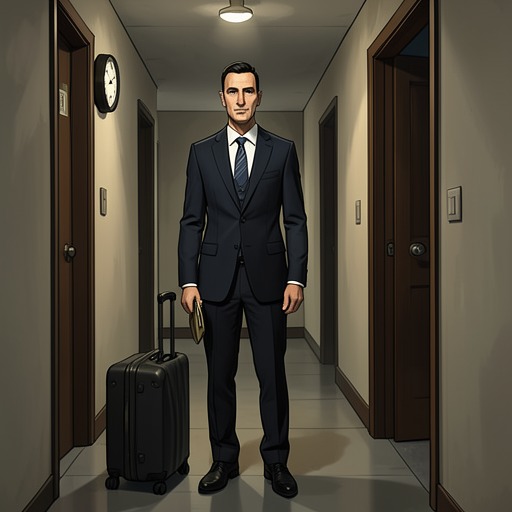
Jeremy Fitzgerald
The Sun is Also a StarJeremy Fitzgerald’s story turns on a consequential divide between professional responsibility and private desire. An immigration lawyer who tells Natasha Kingsley that she is never out of options, he ultimately fails to stop her deportation because he misses the appointment with the judge who could have reversed her voluntary departure order. His absence is first associated with a car accident; the later account reveals that he was with his paralegal, Hannah Winter, having finally acknowledged his love for her. The contrast between the promise of legal help and the truth of his failure defines both his personal turning point and his part in the novel’s chain of consequences.
Identity and Work
Fitzgerald is an attorney building an office and handling immigration cases. Natasha reaches him after Lester Barnes, who has been unable to help her, gives her his name as a long shot. When she comes to the office, Fitzgerald is unavailable: he has been hit by a car while crossing the street and is expected back later that afternoon. Natasha fills out forms about her immigration history and her time in the United States, including questions about what the country means to her and how she might contribute. The office’s staff explains that personal details may help Fitzgerald humanize her case.
When Fitzgerald later speaks with Natasha, he asks how her family’s case proceeded. She recounts that her father, Samuel Kingsley, was arrested after a drunk-driving crash and disclosed the family’s undocumented status to police. The family received a Notice to Appear, then pursued cancellation of removal after learning that Samuel might qualify through his length of residence, good moral character, and the hardship deportation would cause a United States citizen relative. Their younger son, Peter, was a citizen, but the judge found the required extreme hardship difficult to establish. After the judge denied the case, Samuel accepted voluntary removal. The family’s lawyer advised against an appeal and recommended leaving voluntarily in hopes of preserving the possibility of returning.
Fitzgerald listens as Natasha lays out this history, including her objection that she should not have to pay for her father’s mistake. He examines the case and reassures her that she is not out of options, presenting himself as a highly capable immigration lawyer. His confidence matters because Natasha has come to him at the end of her available time, after finding no other way to try to remain in the country. But the assurance sets a high expectation against which the eventual failure will be measured.
The Accident and a Private Realization
While crossing the street, Fitzgerald is struck by Donald Christiansen, a drunk and distressed insurance actuary driving a white BMW at twenty miles per hour. The impact leaves Fitzgerald with bruises rather than a fatal injury, but it makes him consider his mortality and the shape of his life. In that moment, he admits to himself that he has been in love with Hannah for some time. The accident therefore becomes more than an interruption to his workday: it prompts a recognition he had not acted on.
The narration looks ahead to his return to the office, where he will take Hannah into his arms without explanation and briefly wonder what loving her will cost him. That anticipated gesture links a sudden, involuntary encounter with danger to a choice he can make. Fitzgerald’s feelings are not presented as newly created by the accident; the collision gives him the occasion to acknowledge a love that has already been present.
Hannah Winter and the Choice He Makes
Hannah is Fitzgerald’s paralegal, and her belief that he would never love her changes on the day he realizes that he does. Fitzgerald is married and has two children, a family made visible in the photograph he has unpacked in his partly established office. When he shows the picture to Natasha, its happy appearance sits alongside the personal decision he has yet to make. He wonders briefly about the future cost of loving Hannah, but does not let that uncertainty end the relationship.
Later that day, Fitzgerald returns to the office and wordlessly embraces Hannah. He spends the afternoon with her at a hotel instead of attending the court appointment concerning Natasha. Within the next month, he tells his wife that he no longer loves her and that leaving would be best for her and the children. He then calls Hannah, makes promises, and keeps them. The narrative gives both sides of this change: Fitzgerald acts on a long-suppressed attachment, but his chosen time away from work has an immediate consequence for someone whose case he has undertaken to help.
The Missed Appointment and Its Consequences
Daniel Jae Ho Bae learns that Fitzgerald could not stop Natasha’s deportation and that the judge would not overturn the voluntary departure order. The account initially leaves the failure unexplained. Fitzgerald does not tell Daniel the truth: he missed the appointment with the judge because he was with Hannah. That disclosure changes the meaning of his earlier absence. What had appeared to be an unfortunate consequence of being struck by a car becomes a professional failure linked to a personal choice.
The missed appointment closes off the legal possibility Fitzgerald had encouraged Natasha to hope for. Natasha is still due to be deported that night, and Daniel receives the news while trying to understand why the lawyer could not prevent it. Fitzgerald later thinks repeatedly about Daniel, remembering the young man’s distress when he heard the outcome. He does not undo the consequences, and his private regret does not restore the lost opportunity in court.
Narrative Role and Significance
Fitzgerald’s characterization depends on a delayed revelation. His car accident first explains why he cannot attend to Natasha at the expected time; later, the narrative supplies the decisive information that he missed the judge’s appointment for a different reason. This shift makes the reader reassess an apparent misfortune as an avoidable absence. The movement between Natasha’s and Daniel’s limited understanding and the account of Fitzgerald’s private choice creates a sharp gap between what the characters know and what the reader eventually learns.
His arc also places intimate change beside legal procedure without making their consequences equivalent. Fitzgerald chooses to leave his marriage and build a life with Hannah, and the narrative confirms that he keeps the promises he makes to her. At the same time, his choice to spend the afternoon with her costs Natasha the chance for a judge to reconsider her order. His role is thus neither simply that of a capable advocate nor merely a romantic partner: the same day brings an honest recognition of love and a failure to meet a responsibility on which another person’s future depends.