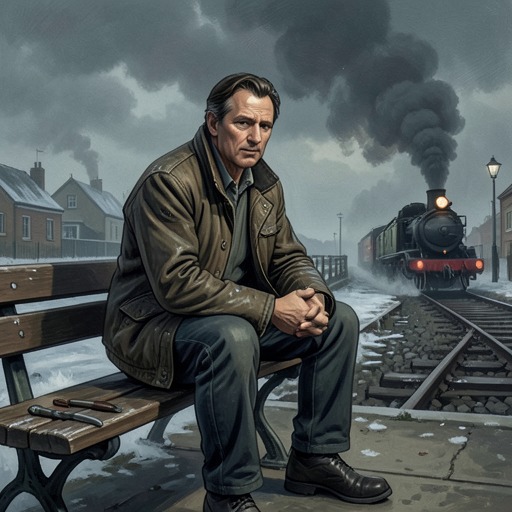
Joe
The Sun is Also a StarJoe is a grieving widower whose encounter with a young couple briefly reopens a future he had closed off after his wife Beth died. Their intimacy recalls the partnership he once cherished, while his smoking and return to work register how grief has narrowed his life to the present. By the end of the rooftop scene, he has not changed his habits, but he can imagine changing them: perhaps he will stop smoking and make new plans.
Life After Beth
Joe and Beth had been retired for only six months when she was diagnosed with cancer. The diagnosis arrived the day after their retirement, just as the plans they had saved and waited to pursue were within reach. Beth wanted an Alaskan cruise to see the aurora borealis; Joe wanted to go to Venice, drink grappa, and see the canals. Their separate destinations suggest the different pleasures each anticipated, but their shared life had made room for both. They used to say they had won the lottery with each other, and Joe remembers their closeness as lasting throughout the marriage, not merely belonging to its beginning.
Beth died the previous year. For Joe, the loss is bound up with the plans that never happened: the saving, the waiting, and the assumption that there would be a right time to go. His grief focuses on that interrupted future as much as on the absence of his wife. The plans are not just discarded holiday ideas; they stand for the life the couple expected to have together and the time they believed they still had.
Smoking and the Rooftop Encounter
After Beth’s death, Joe came out of retirement and began smoking again. He treats the distinction between working himself to death and smoking himself to death as almost immaterial, because he believes there is nothing left to live or plan for. That fatalism gives his smoking a particular weight: it belongs to a period in which he has stopped imagining that his own future might contain anything worth protecting.
On the rooftop, the girl challenges the habit. Joe asks how she can know he will not simply go get more cigarettes, and she admits that she cannot know. He looks at her for a long moment, then tells her, “Life doesn’t always go the way you plan.” She does not believe him, and he recognizes her disbelief without insisting that she accept his view. Instead, he lets the exchange stand, tells them to stay away from the edge, and wishes them a good time. The scene gives his words a double edge: he speaks from the experience of plans being destroyed, while the couple’s presence offers a glimpse of a life still being lived in the moment.
Beth and the Young Couple
The girl reminds Joe of Beth: she is direct but sweet. That resemblance is what leads him to let the girl and the boy remain on the roof. He knows they will be looking at each other rather than at the view, and he sees no harm in it. Their attention to one another recalls how he and Beth were together, including after the early days of their marriage. His response is not simply permission; he recognizes in the young couple an intimacy that remains vivid in his memory.
As Joe closes the door, he sees them looking at each other as if there is nowhere else they would rather be. The sight connects his present to the marriage he has lost, but the connection does not make him reject the couple or retreat into bitterness. Instead, their closeness gives him a way to remember Beth without turning the memory into a reason to deny them their moment. The encounter puts his grief beside their apparent happiness, with his recognition of the resemblance bridging the two.
A Tentative Return to the Future
Joe’s change is deliberately modest. After taking one last look at the couple, he wonders whether he might give up smoking after all and make some new plans. He does not claim to have quit, choose a destination, or promise that grief has lifted. The shift is from certainty that there is nothing left to plan for to the possibility that he may plan again.
That hesitation preserves the force of his loss while allowing the encounter to matter. The couple cannot restore the future Joe and Beth were denied, and Joe does not mistake their presence for a cure. But what he sees recalls a form of companionship that once made his own life feel lucky, and the memory loosens his resignation by a small but consequential degree. His ending is not a completed recovery; it is an opening, expressed in the tentative thought that new plans may still be possible.