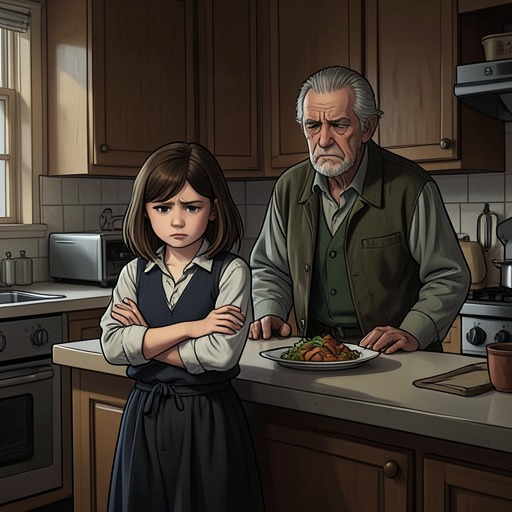
Natasha confronts Samuel about regretting his family
The Sun is Also a StarNatasha Kingsley’s confrontation with Samuel Kingsley takes place as she prepares to leave the United States for Jamaica, and forces a family wound into the open just before separation. After hearing Samuel call his family his greatest regret, she challenges the performance and evasions that have let him treat their shared life as if it were temporary. Her answer does not erase his disappointment or absolve him; it insists that his feelings cannot make his family unreal or undo his responsibilities to them.
Circumstances and Stakes
The argument comes at a moment when the family is preparing to leave the United States. Natasha has lived there since she was eight and says she does not know Jamaica, its people, or even her relatives there as she believes family should be known. She is in her senior year, thinking about prom and graduation, and has only just begun assembling an application for Brooklyn College. Her mother has spent two years saving for a trip to Florida to obtain a “good” Social Security card, one with stolen numbers rather than bogus ones, because Natasha believes it could let her apply for financial aid and possibly afford SUNY Binghamton or another in-state school. Deportation threatens not only her present home but the near future she has begun trying to plan.
The family’s impending move also carries its own practical strain. Natasha recalls her mother saying they would need to live with her mother in Jamaica until they had enough money to rent their own place, and that she had never thought life would come to this. The immediate prospect is therefore not a clean return to a familiar home: Natasha has already described Jamaica as a place where she knows no one, while her family faces the material work of starting again. Against that backdrop, Samuel’s regret lands not as an abstract complaint but as a judgment on the family whose future is already being forced into upheaval.
Natasha has been navigating the immigration process in terms both bureaucratic and personal. At the Fitzgerald law office, she fills out forms about the deportation proceedings and her time in the United States, including questions about criminality, communism, terrorism, and defending the country. When asked why she wants to stay and how she might contribute to America, she is told that anything that can humanize her may help. The language of proving her worth to an institution sharpens the contrast with the intimate question she brings to Samuel: whether he can acknowledge the worth and reality of the family he has called a regret.
The Confrontation
Natasha begins by naming what she overheard Samuel say to her mother after his play: “I heard what you said to Mom after the play. You said we were your greatest regret.” The reference to the performance matters because Samuel’s artistic aspirations and disappointments are part of the history Natasha is addressing. She is angry not only at the words but at the way he has returned to a thick, forced Jamaican accent, as if acting as though he had never left Jamaica and the past nine years had not happened. To Natasha, that manner of speaking is another performance—one that makes the family’s actual American life seem like make-believe.
Samuel’s scowl gives way to an emotion Natasha cannot name but believes is genuine. He tries to answer, but she speaks first. Instead of asking him to apologize, she tells him she is sorry life did not give him everything he wanted. As she says it, she realizes she means it: she now understands something about how disappointment can last a lifetime. Her empathy does not cancel her anger. It lets her recognize Samuel’s thwarted hopes without allowing those hopes to excuse what he said about his family.
She then turns to the play itself and tells him he was amazing in it—“Just incredible. Transcendent.” The praise makes the exchange more complicated than a simple accusation. Natasha can recognize his talent and the force of the performance even while confronting the damage of his words. Samuel has tears in his eyes, though she cannot tell whether they come from the compliment, regret, or something else. When she suggests that perhaps he was right that he had been cheated of the life he wanted, he shakes his head and insists he did not mean what he said. Natasha refuses to treat intention as the whole measure of its consequences.
Regret, Memory, and Responsibility
Natasha’s reply draws a line between what Samuel meant and what the family has lived: “It doesn’t matter if you meant it or not. This is the life you’re living. It’s not temporary and it’s not pretend and there’s no do-over.” She hears Daniel Jae Ho Bae in the firmness of the thought, but the claim is hers in this confrontation: Samuel cannot use regret to imagine himself outside the consequences of his choices. Their life is neither rehearsal nor a story he can revise by deciding that he did not mean what he said.
The overheard conversation has also altered Natasha’s memories. She wonders whether Samuel regretted her existence when they watched cricket together, when he held her tightly at the airport as the family was finally reunited, or on the day she was born. These questions show the remark reaching backward, recasting ordinary and tender memories without proving that they were false. Natasha holds together what is difficult to reconcile: Samuel may have loved her in those moments and still have said something devastating about the family. In her account, the painful truth is not reduced to one side or the other.
As Samuel cries, Natasha says the sentence that gives the confrontation its decisive force: “You don’t get to regret us.” It is not a demand that he deny his disappointments, nor a claim that family life has gone as he hoped. It is a refusal to let his disappointment become a verdict that erases his wife and children. His response is a sound she understands as carrying a lifetime of pain. The scene leaves that pain present, but changes what can be left unsaid: Samuel has been made to face the difference between regretting the life he wanted and disavowing the family he actually has.
Reconciliation and Departure
After the confrontation, Natasha gives Samuel a concrete charge for their life in Jamaica. He must at least try to audition, treat her mother better, and stop living in his head; her mother has done everything for the family, Natasha says, and is tired. This appeal connects his artistic disappointment to present obligations. Natasha does not ask him to give up acting; she asks him to pursue it while also caring for the people who have borne the consequences of his choices.
The family’s response is physical rather than a neatly resolved explanation. Natasha’s mother is crying, and Peter goes into her arms. Samuel joins them, and her mother accepts him. Together they turn toward Natasha and gesture for her to join them. She turns first to Daniel Jae Ho Bae, who hugs her so tightly that the embrace feels like a goodbye already. Soon a driver loads Natasha’s suitcase into the trunk; Peter and her parents have gone ahead to the airport in a separate cab. Inside the car, Natasha rests her head on Daniel’s shoulder as they travel toward the departure that the confrontation has not stopped.
The scene therefore gives reconciliation a limited, concrete form. Samuel is accepted into the family’s embrace, but the words that prompted the argument are not declared harmless, and the family’s departure remains imminent. Natasha’s confrontation makes room for compassion toward her father’s disappointment while demanding that he live responsibly within the family he has. At the threshold of leaving, she insists on both truths: his pain is real, and so are the people he does not get to regret.